


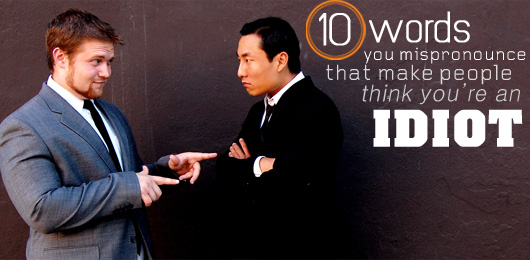
It’s been said, though we’re not sure by whom, that it is better to remain silent and be thought a fool than to open your mouth and remove all doubt. But sometimes we’ve got to open our mouths so use this handy guide to make sure, at the very least, you’re saying the words right.
Don’t worry, I won’t waste your time with the elementary school lessons about how to accurately pronounce “library,” “February,” or “arctic”… although I will take this opportunity to note that if you’re discussing a library and still dropping the first ‘R’, there’s a very good chance that your friends and/or colleagues are laughing at you behind your back.
I won’t trouble you with a lecture covering how some of the words you use actually aren’t words at all. If you’re using words like “snuck,” “brang,” or “irregardless,” (no, none of those are real words) a magazine article – much less one written by me – is not going to solve your problems.
What I will do is offer up a rudimentary form of help, in terms of how to properly pronounce relatively common words that are bound to show up in your daily life. These tips will not seal the deal in a job interview or on a date (I can especially vouch for the “date” scenario) but if pronunciation continues to be a potential chink in your armor, your problems will soon be solved.
Thus, behold, People of the Internet… the ten most important words you should learn to pronounce, if you would like to appear reasonably knowledgeable about your own language.
ATHLETE
-
Incorrect pronunciation: ath – a – leet
-
Correct pronunciation: ath – leet
This may have been more helpful before the media blitz that was the Summer Olympics but it is a very valuable lesson to have for the future. It applies to “athlete” and any derivative (biathlon, triathlon, decathlon, etc.) and, honestly, I’m sad that I even have to point this out: there is no vowel between the ‘H’ and the ‘L’ in any of these words. There never has been. Let the dream die.
ESCAPE / ESPRESSO / ET CETERA
-
Incorrect pronunciation: ex – cape / ex – presso / ex – set – err – uh
-
Correct pronunciation: ess – cape / ess – presso / ett – set – err – uh
Yes, a three-for-one deal, but only because this one is dually very common and very simple to fix. For some reason, we of the English tongue have an obsession with changing any ‘S’ to an ‘X’, if it follows an ‘E’ sound; call it the Exxon Indoctrination. These words are spelled phonetically… let’s try to respect that.
Also: the yuppie kids will really respect you, if you master “espresso” and “et cetera” – what more motivation do you need?
NUCLEAR
-
Incorrect pronunciation: nuke – you – lerr
-
Correct pronunciation: new – clee – err
I’m going to try to get through this one without a President Bush joke. All right, so, despite the fact that it’s 2008, this is a word with which we’re somehow still struggling. Like most of the words on this list, “nuclear” is spelled EXACTLY AS IT IS SUPPOSED TO BE PRONOUNCED and yet, people continue to screw it up worse than the War in Iraq… oh, dammit.
PRESCRIPTION / PREROGATIVE
-
Incorrect pronunciation: purr – scrip – shun / purr – ogg – uh – tiv
-
Correct pronunciation: pre – scrip – shun / pre – rogg – uh – tiv
Overlooking the fact that many people also seem to have precisely no idea as to the latter word’s true definition (I’ve had several conversations where people bizarrely substitute “prerogative” for words like “agenda”), this is another problem that can be attributed to ignorance in the arena of “Sound It Out, You Lummox.” The ‘R’ comes before the ‘E’ in both of these words. Please ercognize this erality. Sorry.
UTMOST
-
Incorrect pronunciation: up – most
-
Correct pronunciation: utt – most
In a bizarre twist, people actually became so certain of this word’s meaning that they alter its pronunciation to reflect that definition. Yes, “utmost” is an adjective synonymous with “greatest” (a term that immediately calls to mind some tangible Mount Olympus-type of vertical hierarchy and the word “upper”) but that second letter? It’s still a ‘T’.
CANDIDATE
-
Incorrect pronunciation: can – uh – dett
-
Correct pronunciation: can – da – dett
Mastering this word will help you at least sound educated in your excruciating political debates as we approach November 3. I cannot explain it any more simply than my second grade teacher once did: “You always want to have a good candidate for your CANDY DATE.” Candy date. It’s sweet and simple.
SHERBET
-
Incorrect pronunciation: sherr – berrt
-
Correct pronunciation: sherr – bet
This is one of those words that ultimately had to abandon its crusade for righteousness and now has been corrupted to the point where dictionaries may list the incorrect pronunciation as acceptable because of just how rampant the ignorance grew to be. But there’s only one ‘R’ in “sherbet,” America… no matter how awesome the rainbow flavor is, there’s still only one ‘R’.
AWRY
-
Incorrect pronunciation: aww – ree
-
Correct pronunciation: uh – rye
Up until very recently, I could not even conceive a situation where someone would mispronounce this word; it always seemed very simple, to me. However, I have heard three different people – in the world of talk radio, no less – pronounce it inaccurately in the last few months. It’s like… it’s like the mechanism that allows people to speak in an educated fashion went awry (see what I did there?).
FOR ALL INTENTS AND PURPOSES
-
Incorrect pronunciation: “for all intensive purposes”
-
Correct pronunciation: “for all intents and purposes”
All right, yes, I cheated a little bit here (for posterity’s sake, I should note that a phrase and a word are not the same thing) but this is still a very popular pronunciation mistake and one that I really feel must be addressed in a public forum. While “intensive” is absolutely a word, the clichéd saying that most people are trying to channel is all about intent. As for the rumor that I, as a younger man, frequently employed the incorrect pronunciation… no comment.
OFTEN
-
Incorrect pronunciation: off – ten
-
Correct pronunciation: off – en
If there is a bigger red flag for “I am misinformed about how to pronounce something” in our language, I have yet to encounter it. This word and its evolutionary course in American vernacular could be a cultural study unto itself.
For a while, nobody was aware that the ‘T’ was silent; this sneaky caveat had to be beaten into our brains for years and years in school. But then – in what can best be described as the greatest grammatical epiphany since someone decided that we needed a contraction to turn “I am” into a single word – people seemed to universally scream out “We get it! A silent ‘T’!”. It was a glorious day.
However, this euphoria was ultimately fleeting. At some point, the rational people of Earth decided to flip over the Buffet Table of Reason at the Banquet for Intellectual Hope and thought it best to, once again, simply start pronouncing the ‘T’ in “often.” I do not know whether this was brought on by an innate human desire to flout the rules of our world or just a collective hatred for all things associated with the establishment but it is now arguably the most frequent linguistic speed bump in the history of hyperbole. And I would like to lead the charge to restore balance.


874 People had something insightful to add, but we're missing your voice! Continue the conversation with a comment.
Virilitas
Justin, thank you for a very useful article. I hope that you’re pacific examples of grammatical errors help men to write more better than they did before. ;D
Sep 1st, 2008
Doc Brown
That picture is 1.21 gigawatts of Awesome.
Sep 2nd, 2008
Oswald Criollo
I must interject for just a moment and point out how audacious it is to claim that “snuck” and “irregardless” are not words. What may seem a bastardization is just the natural evolution of language. Language grows, expands, and changes with time. Both of those examples are now accepted as part of the American lexicon and should be respected as such. If anything is to be addressed, it should be the misuse of irregardless in place of regardless.
Beyond that, I enjoyed this article. I found myself questioning my own pronunciations while reading this and, with the exception of sherbet, I seem to be in the clear.
Sep 3rd, 2008
Rich CL
Pro-nown-see-ay-shun is very in-poor-unt!
“Important” is my big pet peeve at the moment.
Sep 9th, 2008
tjgoldstein
Ok, I have one for you.
Nougat. The constant murder of this word drives me insane, so much so, that when there was a particularly annoying Yahoo radio advert in which the word is mangled roughly 5-6 times in 30 seconds, every time I heard the ad start, I would turn the sound off on my computer. I was sick of screaming at the radio, ‘Noo-garrr… it’s friggin’ Noo-garrr!’
Americans pronounce it with a hard T at the end of it.. Noo – gaT, when in fact, it’s pronounced… Noo – garrr.
While I know its unfair to pick on an accent, something people have little control over, I found the combination of the ‘average’ over enthusiastic American voice over combined with the pronounciation was quite possibly the most revolting sound I’ve ever encountered.
So much so, that I was forced to send an email to the company pleading with them to take it off the air.
Feb 16th, 2009
Kel
Lingerie / buffet are also common mistakes.
Feb 16th, 2009
Gene
I must differ with you on one of these, although your narrative is interesting reading. Often is also “legally” pronounced “off-ten”. Look it up, just about anywhere. Either pronunciation is acceptable.
I’d also like to add one that drives my wife crazy: “jewelry” pronounced “joo-ler-y”. It should be pronounced exactly as it sounds.
And another: “Irregardless” used when the word should be “regardless”. Irregardless is not a word.
Feb 26th, 2009
Rick
Often should be pronounced “off-en” regardless of what lexicographers put in their dictionaries. I often use fabric softener (not sof-ten-er) when I do laundry.
Feb 28th, 2009
justin
Great article on mispronouncing words, Jason. Keep up the good work.
Mar 10th, 2009
Katie
ok dude snuck is a word! I looked it up on dictionary.com. It is the past tense of sneak. I even spell checked it on Microsoft Word. If you want to stop people from sounding like idiots you have to do so first. What now?! That’s right you just got schooled.
P.S. have you looked nougat up in the dictionary? the pronunciation guide says a hard T is acceptable, and there’s no R.
Mar 11th, 2009
James
@Katie, the dictionary lists “snuck” as informal, meaning it’s slang, meaning it’s not correct.
Spell check can’t be used as a source to whether a word is proper or not. It allows snuck because Microsoft knows some people will want to type it when speaking colloquially. So Word is correct when it tells you “snuck” is SPELLED right, but that doesn’t mean it’s correct.
Mar 13th, 2009
tjgoldstein
Oh dear Katie.
Never said that there was an ‘r’ in nougat, quite simply pointed out that it is infact pronounced as ‘noo-garr’ and not as ‘noo-gaT’
you are right to say that a hard T at the end is acceptable, unfortunately, just further evidence that America is destroying the English language.
Poor, poor little yankee’s.
Mar 15th, 2009
Nate
I’m guessing the “noo-garr” pronunciation you recommend only includes pronunciation of the R sound when it is followed by a word beginning with a vowel. This is known as an intrusive R–something common in many British accents–but particularly the “Estuary accent,” which was long considered to be working-class and incorrect.
You have no reason to be bragging about it.
Mar 23rd, 2009
Angie
On one hand, I’ve found the banter to be just as entertaining as the article itself….on the same hand – actually, that phrase bothers me so much that I can’t even finish my sentence!
My personal can’t stands are using the words “forwards” or “backwards” – when it’s simply “forward” and “backward”…no plural people!
And just an FYI: yes, I’ll begin properly pronouncing sherBET – despite the fact that I’m going to catch a LOT of crap. How did the mispronunciation of sherBERT become so widespread anyhow?
Mar 23rd, 2009
Joe
With the ongoing wars raging across the Mid East and Asia, I keep hearing about a weapons “cache”, pronounced ka shay. Drives me nuts, it’s pronounced kash
Mar 23rd, 2009
Frank
Actually this guy has got 2 words wrong.
nuclear is pronounced as “nuke-uh-lar” so often that it’s completely acceptable and deemed as a correct pronunciation.
often – “off-en” and “off-ten” are both proper pronunciations as well
The Oxford English Dictionary is the definitive source of “proper” words and pronunciations for the english language. Keep in mind, that language is very dynamic and always adapting.
Mar 28th, 2009
Steve
I’m seeing a movement to create a mispronunciation as a way to to sound “important.” When discussing spreadsheets, a woman at work says “col-yumes” for columns.
Apr 5th, 2009
Paul
People won’t “soften” about “often.” They just won’t “listen” about a silent “t” in the middle of an American word.
I blame teachers who tolerate children and immigrants speaking words as they are spelled. Thank goodness nobody uses the word “cupboard” anymore.
American has never been as easy as saying what you read. Ask any Englishman.
Apr 13th, 2009
Eric
My biggest pet peeve…..PREVENTATIVE is not a word. The word is PREVENTIVE. This is butchered all of the time in speech and written word.
Apr 13th, 2009
bob
Don’t forget forte. “For-tay” means loud. “Fort” mean strong.
Apr 15th, 2009
Katie
You people are so amusing. I’d like to thank everyone who responded to my post because you gave me something to laugh about. It is so diverting that people actually make posts on a regular basis to challenge each other about pronunciation. Does anyone have a life? I simply made a post because I’m in Lit. class, bored to death. So I laugh. Ha. Now go back to your humdrum lives and really consider the activities you are taking part in on a daily basis. Why not go for a walk? Visit an old person… Sneak into a movie… devote your life to philanthropy…you obviously have enough time on your hands.
Apr 22nd, 2009
Doc Brown
Katie, according to my calculations your last reply made you sound like a defensive bitch.
Apr 22nd, 2009
Jack
I won’t take sides. But I will opine that the “get a life” defense in a comment thread is about as fresh and effective as “I’m rubber, you’re glue.” I’m saying this broadly because it really gets my goat when I see a pretty amazing feat on YouTube (guy playing two guitars at one time!?!?!?) and all people can say is “get a life,” as if patronizing YouTube is any more life affirming than being featured on it for honing a craft to inhuman excellence.
On another note:
http://www.zyra.org.uk/getgoat.htm
Apr 23rd, 2009
Katie
ok doc brown, its just one person’s opinion, no need to be profane! do you kiss yo mutha wit dat mouth? and jack you make a good point because the only reason i comment on here is because im freakin bored at school and i wanted to see people’s reaction to my lecture hehe jaja
Apr 24th, 2009
Jaimie
Wait, I thought English was still a living language?
Apr 29th, 2009
Clive
I’d like to add “jive” and “jibe” here.
So irritating.
May 27th, 2009
Doug
All this discussion about pronunciation is just a mute point…
May 28th, 2009
Lance
The one I hear the most, especially on the radio is height. Most mispronounce it as heighth as in length x width x heighth not realizing there is no h sound on the end.
Jun 2nd, 2009
SeanO
I agree completely with the post about the image chosen for this article – well done! As a visual artist, I value how a picture is worth a thousand words (grammatically correct or otherwise!).
I agree that English is indeed a living language – we should not lose sight of this fact. But language is also about communication. If our means of communication become vague and sloppy, doesn’t our communication follow? But being articulate should be a means to more clearly express your thoughts, not to impress or condescend.
Jun 8th, 2009
Jesse
A few more…
“mute point” (moot point – thank you Doug)
“all of the sudden” (all of a sudden)
“bolth” (both)
Jun 11th, 2009
Bill
Living language or not, ignorance and sheer stupidity should not be reasons for a language to “evolve.” Just another example of mediocrity becoming the MO for the average American.
Perhaps if our schools actually TAUGHT English, rather than High School 101: Beating the No Child Left Behind Test…
No wonder the Brits hate us for what we did to their language.
Jun 12th, 2009
Mikey Knuckles
My two pets are “would’ve” spelled, and even pronounced “would of” and “Axe” for “ask”.
Language must evolve in the sense that new words like “BLADING” [clip of verb rollerblading ] or “BLOG” [contraction of web-log] are used to articulate standard means of communication.
The Brits butcher their own language, they need not our help.
Jun 12th, 2009
kva
Amphitheatre – the ‘ph’ is an F – all ph’s are F’s
I go crazy at the DJ’s on the Toronto radio stations that refer to the concert venue as the Ampi-theatre – there will be amps but really…
nice article – I think we can expand it to the top 100 easily
then can you write an article on top 10 grammar mistakes
top pet peeves in that area are:
gone/went i.e. I should have went…
good/well i.e. He did really good
Jun 17th, 2009
michael
All I can think of here is the ongoing Family Guy joke about “whip”. (Enunciating the “h”.)
Jun 27th, 2009
Drew
Is anyone else equally irritated by:
“Supposably” (Supposedly)
Can’t stand it!
.-= Drew´s last blog ..drewpeneton: READING: 10 Words You Mispronounce That Make People Think You’re an Idiot http://bit.ly/Vtlr What other words belong on this list? =-.
Aug 13th, 2009
Nax
I think that the protection of proper English is important and this was a great article. My favorite would have to be asterisk (not asteriks). Just got called out on that one a few years back and felt like an idiot.
I do, however, say “wash” with an “r” in it. Oh well…
Aug 29th, 2009
Chaps
Coming from Down Under where we bag both Poms and Yank language alike, the one word that is starting to get my goat is “disorientated” instead of “disoriented”… Even the newsreaders are starting to say this…
Sep 7th, 2009
Andrew
Chaps, I’ve noticed that too! I thought I was crazy. I just looked it up in the dictionary and it says “another form of disorient.” Whether it’s ‘correct’ or not the jury is still out.
.-= Andrew´s last blog ..Linkszomania for September 9, 2009 =-.
Sep 9th, 2009
Moody
I can’t decide who to ask to marry me – Bob or Nate – for their brilliant comments.
Chomping at (or on) the bit, instead of champing at the bit almost sends me into a seizure.
Confession: I mispronounced automaton for DECADES
.
And though not spoken, “air quotes” could be the cause of my demise when, after seeing one too many, I jump out of the window.
Sep 24th, 2009
Ariana
I have thoroughly enjoyed this article as well as the ensuing discussion. This sort of interplay almost overloads my pleasure center.
I cannot help but notice one minor error in the article itself referencing the grammatical function of a ‘conjunction.’
“But then – in what can best be described as the greatest grammatical epiphany since someone decided that we needed a [conjunction] to turn ‘I am’ into a single word.”
To my understanding, a conjunction is any word or expression that serves as a connector for multiple words, phrases, clauses, or sentences.
I submit that the more appropriate term in this instance is ‘contraction.’ Grammatically speaking, a contraction is a shortened form of a word or group of words, i.e. “I am” conveniently becomes “I’m.” I’m a fan of contractions; I love nothing more than to express myself with precision, and I do so appreciate legitimate shortcuts.
I am open to the possibility that I am mistaken. I just [couldn't] (love it) help but giggle after finding what I believe to be an error in an article written in such a haughty, patronizing tone. I laugh because I relate.
Sep 27th, 2009
Atom
alright, i was kind of upset at how uppity this “justin brown” character sounded, what with his flowery vocabulary and zeal for ego-bashing…but then i noticed the name of his blog was “esteban was eaten!”, which can only be a reference to life aquatic, my favorite film of all time.
so, justin, i admit that you have a pretty good grasp on the english language. i’m keeping my ‘often’, though.
Sep 27th, 2009
Justin Brown
All right Ariana, I think you’re right. It took twelve months but someone finally spotted the error I tried to pretend wasn’t there. You win. September 27 is your day; do with it what you like.
Atom, don’t be fooled by my bombastic language or haughty tone (see, I used flowery vocabulary in referring to my flowery vocabulary, that’s meta or something) — I am completely an idiot, most of the time (if you visit Esteban Was Eaten!, this would become exceptionally clear in a very short time).
I’m glad that people seem to be this passionate about their language (over a year after the article was published, no less). A few more generations of people talking about these things and we’ll all be better off.
Grammar fever! Catch it!
.-= Justin Brown´s last blog ..Nobody seems to know where this came from. And I. don’t…. =-.
Sep 27th, 2009
Ariana
I am impressed by your graciousness, Justin. No one wins or loses here — the article was exceptionally entertaining as well as informative (oh, the shame — I was, before reading, a great purveyor of “ofTen.”) The joy of it all lies in the analysis! I always appreciate getting caught making a mistake, as long as the redirection occurs not in the heat of an argument
Because I, too, am occasionally guilty of bombastic pomp, I have cached these little treasures away for a rainy day: magniloquence and fustian. The irony therein is nothing less than sublime!
Sep 27th, 2009
Adamant
Often can be pronounced with or without the ‘t’ sound. Both are correct, and to pretend that one is superior to the other is simply arrogant.
.-= Adamant´s last blog ..deke =-.
Sep 28th, 2009
DigablePlanet
@ tjgoldstein:
I am PRIH-TEE SHURE that your NOO-gurr is waaaaay too close to “N*gger” than most politically-inclined Americans are comfortable with pronouncing. Sorry.
Nov 24th, 2009
DigablePlanet
How about this one:
“It just wasn’t all it was CRAPPED UP TO BE”…Wow. I’ve heard that one more than a few times. I guess that’s not so much a pronunciation problem, as it is a FOOLISHNESS problem. Did I spell “pronunciation” right just now? Ah crap.
Nov 24th, 2009
PLG
Language is a living creation, which means that it mutates and evolves all the time. What people mispronounce today could very well be considered high English in the coming decades.
Moral: get off your high horse, the lot of ya
Dec 3rd, 2009
Wordly
This is a good start and I could certainly add more malapropisms however, there are two problems.
1. “Irregardless” is now in the dictionary (not saying that it is right, just saying…)
2. Et cetera is ACTUALLY pronounced as “et ketera” because in Latin, a “c” is the equivalent to our “k”.
Dec 3rd, 2009
Wordly
P.S. Dear “PLG”, it is people like you who are responsible for the bastardization of our lovely language. For the love of language, get back on your high horse and act like you got an education!
Dec 3rd, 2009
mark clayson
Glad to see that Frank has made me feel good about “off – ten”.
.-= mark clayson´s last blog ..Get Your Child’s Twitter Background on MY Twitter Page =-.
Jan 7th, 2010
bob dylan
One thing that drives me crazy- and this is very common on the internet.
People who write “Wallah” instead of “Voila”, because they’re idiots.
You’ll see recipies on various cooking sites (good ones, too), with instructions like “Fold the egg mixture into the flour mixture, add to a silicone cake pan and bake for one hour or until sets. Wallah! Your very own devils food cake!”
And it makes me want to slit my wrists.
Other than that, I agree that english is a living language. And the OED is not the be all and end all of what constitutes proper english- there is no “Academie Anglaise” officially approving words and phraseology. Sure, go to the OED for guidance, or look to Mirriam Webster for a more American perspective. In all honesty, if I want to know how a word is used I’ll most likely check urbandictionary.com first. (With a large grain of salt, of course. But it’s surprisingly useful.)
Feb 2nd, 2010
Observer6
Well, I guess I do not have to AKS any more questions about this topic…so it is up to you to AKS somoene…Fo sho!
Feb 2nd, 2010
Cerce
I have noticed that several of my co-workers when trying to explain their consternation with certain parts of the job process use the term frustration, but forget it contains the letter r. I am subsequently aurally assaulted with fustrated, and fustration. Irony at work.
Feb 3rd, 2010
Jamal
You forgot “ATHLETE” – some folks say “AFF-LETE”
these same people probably (prolly) use AXE (murderer) instead of ASK.
Oh yeah and my gf says “put your 2 sentences in” instead of “2 cents” ah hahahaha LMAO
ignorance is bliss.
Feb 4th, 2010
Lem
Hmmm nope I dont make any of those mistakes.
Mind you I do live on the other side of the pond to you so…
Feb 6th, 2010
Chepe
Language prescriptivists are shitty in bed.
Mar 9th, 2010
Sandy
I am a teacher, so it irks me when people mispronounce words, but also when they use words incorrectly. “Dad borrowed me a few bucks last week.” What??? I am also annoyed when people in television broadcasting mispronounce words. Why do they assume their grammar is correct before putting it out there for all to hear? A phrase that has popped up in the last few years is “they went missing.” It sounds like the person went to a specific place themselves. How many of you “warsh” your hands, or listen to the “warshington” news correspondent?
Mar 19th, 2010
El Degüello
Hi there. I didn’t quite get the pronunciation key since I speak both Spanish and Tagalog; I read letters as they’re pronounced in my languages. Would you be so kind to put an IPA (Int’l Phonetic Alphabet) transcription?
Hope it not be too much for you. Thanks
Mar 30th, 2010
Norman Kelley
Justin, the following is a great line:
“Flippped over the Buffet Table of Reason at the Banquet for Intellectual Hope”
and I’ve committed it to memory and will forward it to all my friends!
Absolutely great line!
Apr 14th, 2010
Justin
Utmost being pronounced as “upmost” is a common phenomenon in linguistics called assimilation. Basically, it’s more difficult to rapidly pronounce a series of sounds changing between voiced and unvoiced than a series that is entirely voiced or unvoiced.
In this case, what starts out as unvoiced voiced becomes voiced voiced, with the [t] shifting to the voiced equivalent [p].
Also, I think it’s funny that you rail on the majority of them as being pronounced how they are spelled, then give out often, which isn’t. All I can think of is Robin Williams in Live on Broadway shouting, “AH! A clue!”
Apr 22nd, 2010
J Kane
Good article, I often notice when people make these mistakes but rarely point it out to them!
Apr 28th, 2010
greg
absolutely is often said with a P. As in aPsolutely. Drives me crazy!!!!
May 6th, 2010
Bee
I noticed that someone already mentioned fustrated. It has 2 R’s for a reason. Both are meant to be pronounced.
The other big pet peeve I have is unthaw. As in “I’m going to take the meat out to unthaw it for dinner”. Unless you plan to eat frozen meat, I’d recommend thawing it or defrosting it or even unfreezing it (which is slightly better that unthaw).
May 29th, 2010
ravi
@eric preventative is most certainly a word.
Jun 18th, 2010
Mke
I know this is a couple months old, but @Justin, /p/ and /t/ are both unvoiced plosives. The voiced counterpart of /t/ is /d/. The assimilation here with utmost and upmost would be of the dental plosive /t/ to the labial nasal /m/, resulting in the labial plosive /p/ before /m/. But I think the author’s theory is more correct, people have it in their heads that it should be ‘up” because they think of the “the top” in the idea they are trying to get across.
Jun 30th, 2010
Kevin
Sorry to be harsh, but your linguistic prescriptivism here is hilariously narrow-minded. A little research into etymology would show you that a huge number of words you use in everyday speech are borne of “idiotic mispronunciations”, yet you simply don’t realize it because a few grammarians arbitrarily decided that it was okay.
Words and pronunciations change all the time. It’s part of what makes language so fascinating. Go ahead and keep complaining though… just think twice before you pronounce “at your” as “atchour” or “did you” as “didju” (these are both instances of assimilation, so if you’re going to complain about “utmost”, you have to complain about these as well) Also, you may consider changing your pronunciation of “ask” to “aks”, as there’s ample evidence that this is how it was pronounced in the past.
Jul 2nd, 2010
Andrew
Kevin, I certainly agree language evolves, but to suggest we shouldn’t correct our pronunciations because some words have evolved from being mispronounced doesn’t make a lot of sense. The point here is the same as spelling words incorrectly: we should strive to do it correctly, regardless of whether those spellings will change due to error at the macro level.
Jul 2nd, 2010
Ron
I realize that this post is more than a year old, but it still seems to be drawing comments.
Mispronouncing “across” as “acrost” is an annoying abuse of the language which I have encountered more than once.
Jul 19th, 2010
Snooples
This is a very funny post. I will have to confess, I am guilty of about 50% of the incorrect pronunciation. Now I know why people are looking a me funny.
thanks for the great post, very entertaining.
Jul 31st, 2010
Mike
This just seems silly to me. None conceded to regional dialect? Hell in Europe there are countries with such a stark difference in regional dialects they almost are completely different languages. That is more culture and more culture means greater art/science/biology/creativity. Only a great FOOL would put these means down or sweep them under a mat as I have seen so often on the net!
For crying out loud turn off your computers once in a while and take a trek down the interstate! visit a “non local” museum or beach or…
Aug 5th, 2010
Griffen
This list strikes me as rather pretentious and ignorant about dialects. Yes, most Americans don’t speak an official version of English, but instead a slang filled one. However neither do most British who have their own slang, and for that matter so do the French, Germans, Dutch Etc. . No native speakers learns their language by a textbook, but instead listening to real people talk. The idea that a language must be spoken in one way in all of its domains is ridiculous. I live in southern Georgia in the US. I personally don’t have a strong accent and use mostly proper grammar. However, I still pronounce words differently than the “Queen’s English”, and no one thinks me an idiot for it.
Aug 5th, 2010
Andrew
Griffen, I don’t disagree with anything you’ve said, but that doesn’t mean there AREN’T words that people actually pronounce incorrectly. Expresso isn’t a word, that’s not dialect, it’s incorrect. Or “For all intensive purposes” is a misunderstanding of what the expression is supposed to be, not native language adding spin.
Aug 6th, 2010
Michael
Sherbert – turns out it’s really a word, complete with two letters ‘r’.
http://dictionary.reference.com/browse/sherbert?qsrc=2446
.-= Michael´s last blog ..Walking Test 1 =-.
Sep 3rd, 2010
Mark
What’s your take on “vegetable”? Is the bi-syllabic form “vedge-table” acceptable, or does it need to be tri-syllabic “vedge-eh-table”? My wife and I will disagree on this until the day we die. Oooh… and “Worcestershire” – is it “Worse-ter-shur” or “Wor-ches-ter-shire”? Another word of contention on our household.
Sep 3rd, 2010
Justin Brown
Mark,
Well, at the least, vegetable has three syllables. You broke “vedge-table” into two parts but it still has three syllables (I know we all gloss over the break between “ta” and “ble” but it’s a two-parter). As for how you’re supposed to pronounce it, most dictionaries agree that there’s more than once acceptable way. “Vedge-tuh-bull” is fine as “vege” could be read as monosyllabic but if you want to emphasize the second E as in “vegetation” or “vegetarian”, that’s also fine.
Sep 3rd, 2010
Justin Brown
Oh, also: Worcestershire is one of those words that nobody likes to talk about. But as the name comes from a place (Worscestershire in England), we can pretty easily track it down: it’s “woos – ter – sheer”.
You could pronounce the “shire” with an American accent but if you’re trying to be as accurate as possible, going with the original English pronunciation is best.
Sep 3rd, 2010
Kenneth Farmer
My favorite often mispronounced word is the first on the list, athlete. What’s so bad here is that men who are professional athletes cannot correctly pronounce it.
Sep 30th, 2010
Schadenfreudian Slip
(@ the poster who commented that et cetera is pronounced “et ketera” in Latin, not true. Caesar = kaesar; cetera = settera. In romance languages, a “c” or “g” followed by an “e” or “i” warrants the soft pronunciation of the consonant. Here’s an example of a word containing both rules: Gigantus = zheegantoos. Okay, auto-pedant mode in standby.)
Anyone employed by ESPN is required to mispronounce / creatively pronounce these words:
1. Any word containing “str” contiguously, while correctly pronouncing words containing “st” (without the “r”) contiguously. To wit: Struggle becomes shtruggle, but Florida State is pronounced correctly, etc.
2. Louisville = loovoo. Amazing all by itself that while announcers mispronounce so many words, all comply with the Loovoo rule.
3. Fall down. Okay, so it’s commonly used, but I axe you: Is there any other way to fall (given that you’re in an environment impacted by gravity).
4. [Place person's name here] he/she…or [team's name here] they…Whenever Troy Aikman announces a game, I must mute the speakers.
5. Brent Mussberger’s mispronunciation of Chevrolet, “Shih-vo-lay,” unnerves me, especially since he’s from a nearby state to Michigan.
6. “Good” misprounced as “goot” as in “foot.”
7. “Moving forward” has become a weasel-word for “in the future” or “next.”
8. “Basically,” to describe either a complex, essential, or acidic situation.
9. “I mean” has replaced “duh” and “uh” or “y’know.”
No hoity-toity type, I think it’s very important to speak succinctly and accurately. Since so much verbal communication becomes a matter of interpretation (e.g., what another person hears and formulates from what was spoken or heard) it’s important to say and hear what is meant so that easily-offended nations bearing nukes don’t feel compelled to launch them).
Mar 4th, 2011
CWest
My biggest peeve at the moment is “I will try and get there on time”. When did we stop trying TO get there? Why is it easier to say “and” then “to”?
Aug 18th, 2011
Dan Radin
These two drive me nuts:
1. forte, as in “my forte is bowling,” is pronounced as one syllable – fort, and not for-tay.
2. mascarpone is pronounced maas-car-PON-ey, not MARS-ca-pone or any other variation thereon.
Aug 18th, 2011
Jay
If I hear one more of these “language is a living creation” and “you are narrow-minded” comments, I shall vomit. Yes, it changes, but it has changed little since mankind began to create dictionaries. Finally, we got the language under control, then self-described “liberals” decided that excellence was anathema (pronounced “uh-NA-thuh-muh,” not “AN-uh-THEE-muh”). Standards in language may be arbitrary, but they must be consistent. By the way, dictionaries made after about 1960 need to be checked against older authorities. It was during this era that editors decided to become descriptive. Yes, there is good language, and there is substandard language. We must continue to love excellence, and must stop prostituting English and all other languages to anyone who can passably speak them.
Aug 25th, 2011
rigtig
I saw quite a few people bring up aks/axe in place of ask, however, they all failed to mention that aks/axe were common forms of the word in Old Engrish. Sure it’s antiquated and has been made into somewhat of a racial stigma, but it is not exactly incorrect either.
Oct 17th, 2011
James F.
Got another one for you…Cavalry (not Calvary).
Cavalry (Cav-ull-ree) is a mounted military unit. It is not, nor has it ever been, Calvary, the hill on which Jesus was crucified (Cal-vuh-ree).
This commonly mispronounced word has led many to believe the words are one and the same. Imagine my horror when, after road construction, the military base on which I live replaced their previously abbreviated roadsign with one that said “1st Calvary Division Road.” I wondered whether the Chaplains were getting their own division now?
Dec 3rd, 2011
Lynne
Great article! My BIG pet peeve is how people mispronounce the second month of the year—it’s Feb-RU-a-ry, NOT Feb-U-a-ry!!! Why do people ignore that first “r?”
Dec 26th, 2011
conrad
what about “effect” and “affect” – people always miss use that
also, You’re and Your – that just irritates me to no end.
Dec 26th, 2011
Jen
Je-wel-ry not Jew-le-ry!
Dec 26th, 2011
Jerry
The most irritating and most often mispronounced in my world is Height as Hi-th.
UGH! It makes me crazy!
Dec 26th, 2011
Michael
I am a Real-tor. Not a Real-a-tor !!!
Dec 26th, 2011
scott
I really don’t need to mispronounce words to prove I’m am idiot, I do it very well on my own, Thank you.
Dec 26th, 2011
Jr
You didn’t mention Library. Most pronounce it Ly-berry.
Dec 26th, 2011
Just Sayin
The one word that I think is mispronounced far too often is “ask”. I don’t axe you a question I ASK one. And, I am not sure if it considered a mispronunciation, but rather a misuse of a word… But I cannot stand the misuse of the word “death” in describing a person that cannot hear. Here is another word: “Alzheimer’s”… I find it hilarious when people say. “My grandmother has “old timers” disease.” LOL!!
Dec 26th, 2011
Sean
February = FEB-roo-airy not FEB-yoo-airy
err = urr (rymes with fur) not air
I’ll throw in that people are welcome to pronounce any word they like any way they like, just like they can spell words any way they want. There are standardized pronunciations just like there’s standardized spellings; whether or not you choose to obey them is your prerogative.
Dec 26th, 2011
Barbara
mmediate instead of immediate
my big peeve is “disrespect” used improperly. She disrespected me instead of she treated me with a lack of respect.
Oh and the use of orientation a lovely word now bastardized into
orientated “I have been orientated to the rules.” makes me cringe!
Dec 27th, 2011
Hallie
Someone’s mention of “colyume” reminded me of one of my pet peeves – the pronuniciation “kewpon” instead of “coo-pon” for coupon.
carmel instead of caramel
tempeture instead of temperature (worst among professional weather telecasters)
It was always President Reagan, President Clinton, President Bush, but now people cannot seem to say President Obama – instead it’s Present Obama.
Dec 27th, 2011
Michelle
For all intensive purposes, this list actually contains more than 10 words.
Dec 27th, 2011
Anna Waller
Alright, everyone. This was a great article. However, the comments afterward are horrible. Check an encyclopedia. In fact, check MANY. You’ll see that “coupon” can be pronounced both ways, “nougat” can ALSO be pronounced in various ways, etc. Thank you for trying to educate others, but please educate yourself first on ALL pronunciations of a word. This article was quite interesting. Nothing at ALL against it.
Dec 27th, 2011
Max VonMeyerling
Whenever I hear somebody on TV say the word “pitcher” for “picture” I instantly turn the channel.
Dec 27th, 2011
nat
Don’t forget “realtor” which often gets pronounced “ree-luh-ter”
Dec 27th, 2011
Dan
RE: often.
It comes from the Middle English word “oft,” which had a voiced T at the end. It remained more common than “often” in usage even after the shift to Modern English. Often became the more common of the two in the 16th century, and orthoepists throughout the 16th and 17th centuries were split on the question of voicing the T in often. Queen Elizabeth apparently pronounced it with a silent T; Shakespeare voiced the T. In the 20th century, it became considered a hypercorrection to voice the T, but the OED, and many dictionaries list both pronunciations as valid. The bottom line is that both pronunciations have been considered proper by language experts for as long as the word has existed.
Dec 27th, 2011
Max VonMeyerling
I also hate people making excuses for incorrect English. This “living language” crap. If enough lazy and stupid people decide to screw up something then that becomes the new normal? The word for that is “degenerate”. From merriam-webster.com:
Definition of DEGENERATE
1
a : having declined or become less specialized (as in nature, character, structure, or function) from an ancestral or former state
b : having sunk to a condition below that which is normal to a type; especially : having sunk to a lower and usually corrupt and vicious state
c : degraded 2
Dec 27th, 2011
Robert
What a “Foyer”? This one drives me NUTS!!
Dec 27th, 2011
Michael
I listened to the news just recently, and was shocked to hear the word err pronounced “air.” I am also always torn about how to pronounce foyer. One sounds quite pretentious saying foi-yay these days, so a friend suggested I just say vestibule or lobby. On a grammatical note, hearing “What had happened was..” or “I had went to…” makes my ears bleed.
And to all those who suggest that we readers get a life and go outside: I am disabled and house-bound. So YOU go outside, and while you are out, find somewhere to fuck yourselves!
Dec 27th, 2011
Roderick
Height
[ hahyt ] NOT [ hahyth ]
Dec 27th, 2011
A Goodly Frynd
A good half of these would be better suited to an article called “things you should care about if you want to be a pretentious ass.” Wouldst thou truly desire to fixe the proper shaype of thy language, mighst not thee be better served to fix thy gaze upon that crowne jewell of our great tongue, the Elizabethan Era? No, because that would be stupid.
Dec 27th, 2011
debbie g
Great post! One of my favorites is pronounced ‘mischeeevious’ rather than the correct ‘mischievous’. Someone near and dear to me does this all the time, causing me to implode.
Dec 27th, 2011
Shawn
Ok, so I didn’t read the whole thread of comments so these points may have been mentioned before. I HATE when people use the gutteral stopped “t” in words like “curtain” “Martin” and “button”. I also wanna gnaw my face off when I hear a hard “G” and a vanish vowel in place of what should be an “ng” for example “sin-Guh” and “thin-Guh.”
That said, for those of you who keep touting that English is a living language therefore wrong is right: JUST because I’m smart enough to translate second grade mistakes into English and respond to them doesn’t make the second grader Shakespeare. If the goal in language is merely to be understood then we can go right back to grunts, clicks and hand gestures… there is more to it than that. Frankly, I find that the truly innovative use of English is often missed because it is drowned in a sea of opinionated stupidity (but meaning people whose basis of thought is their own stupid opinions rather than experience, skill, and subtlety of thought.) The first step in correcting this is to clarify what is uniformly misused and out dated material. Then the challenge becomes “where do we go” rather than “what are people doing with where we’ve been.” THAT is living language; NOT defending the bastardization of words that are already defined.
Dec 27th, 2011
Paul
“Supposably”
My wife says this all the time, and I finally worked up the nerve to correct her (it’s “supposedly”), and we got into a huge fight over it…
-P-
Dec 27th, 2011
Liz
OFT and SOFT end with a hard T.
OFTEN and SOFTEN have a silent T.
And “acrosst” drives me crazy too!
Dec 27th, 2011
Jim Morgan
The opening sentence of your article, “It’s been said, though we’re not sure by who, that it is better to remain silent and be thought a fool than to open your mouth and remove all doubt.”, uses the word “who” instead of the correct word “whom”.
Dec 27th, 2011
Shawn
@Justin from April 22, 2010. [t] is an.. unvoiced lingual dental fricative while [p]I is an unvoiced bilabial plosive fricative… both are unvoiced meaning that the larynx and vocal folds are not active in making the sounds. You really should make sure that the info you’re spouting in public will stand up to scrutiny by professionals if you purport to be one. Also, conjecture about why people do what they do is unproductive and speculative. People could have mechanical reasons like you described. They could have poor listening skills, a low IQ or mental impairment. Or! That could just be the way their momma taught them to say it. The point in working with speech is not to identify why the problem is there or whatever… it’s to take what you’re given and make a silk purse from it.
Dec 27th, 2011
Shawn
Supposably means that one would suppose it to be the case. Supposedly means the same thing with an inflection that it is improbable… Supposably is definitely a word. It’s just used wrong. “Supposably, he enjoys dancing because he keeps going.” “Supposedly he took out the trash but I see it sitting there by the fridge.”
Dec 27th, 2011
Robin
What about using “anymore” to mean now? and we now live in New Zealand – yikes! English is an amazing language, especially once you have moved to another English speaking country.
where the Road construction ends: Works End
TV and radio commercials, when giving the phone number to call: Call on 12 23 567
and never mind the aural sensations!
Dec 27th, 2011
Shawn
Oh, and Justin… the partner to [t] is [d]… the partner to [p]is is [b]. You really do need to learn your IPA better.
Dec 27th, 2011
Eric
If someone above has not mentioned it then I will…Realtor is not real-uh-tor but real-tor! Drives me nuts.
Dec 27th, 2011
kevin
I think i’ll either jump off a building or slap the next person that says “reel-it-tur” instead of “ree-ul-tur”. how the hell do you get reel-it-tur from realtor? redneck home schoolin’?
Dec 27th, 2011
kevin
@eric, you read my mind
Dec 27th, 2011
Neil Moran
The one that got me was “often.” I didn’t know the t was silent! I will also be more cautious when I speak. Thanks!
Dec 27th, 2011
Lisa
My cousin, who is an RN, makes ALL of these mistakes and more. Fustrated, supposably, drawlings, echinezia, be-ins that(instead of being that), etc. are just a few examples. She can rarely get through a sentence without pronouncing something incorrectly. Truth be told, she sounds like an ignorant hick when she speaks. We are all judged by the way we speak, like it or not. We can argue until we’re blue in the face as to whether language evolves and about what is acceptable. Meanwhile, what kind of impression are we making as professionals when we say pitcher instead of picture or libary instead of library?
Dec 27th, 2011
Anna
You know, these so-called “mispronunciations” are simply deviations from Standard English — the language of power, an individual dialect within the realm of spoken English. Those whose dialects differ from that of Standard English are individuals that do not have positions of power (non-white and/or working class citizens). Therefore, according to this article, those who do not speak the language of power are equivalent to idiots.
It seems that discrimination is still prevalent (and accepted) whenever it comes to discriminating against an individual’s language.
Please — I beg of you, Justin Brown, study language acquisition, sociolinguistics, et cetera (yes, I can pronounce it like a “non-idiot” [your words, not mine] because I have been educated by people in positions of power), before you make such a scathing judgment of individual accents.
Dec 27th, 2011
Melissa
What grinds my gears is the trend toward spelling certain words as verb + the suffix “ed” tacked on, because people are too stupid or lazy to remember how to spell them properly. (I’m seeing “payed’ instead of “paid” everywhere these days. Ugh!)
Dec 27th, 2011
Steve Bond
Library, Poem, Larynx, Hawaii, Valentine, A Lot.
Dec 27th, 2011
Caroline
The caption under the picture should read “by whom,” not “by who.”
Dec 27th, 2011
Page Gerrick
Perhaps this would fall under the proverbial “splitting of hairs” but your inclusion of the word “often” fails to account for etymography. Originally the “t” was actually pronounced. In the 17th Century, the pronunciation of the consonant in question began falling out of favor, but at no point has been solidly incorrect.
Dec 27th, 2011
erlee pennington
I really have a poor-nounciation problem since English is my second language.
Dec 27th, 2011
Raven Blacke
How about particular? My mother annihilates this word and derivatives with a passion, pronouncing it like pet-tick-u-lerr.
Dec 27th, 2011
Peter P
I also hate when people pronounce ‘height’ with a ‘th’ sound on the end.
In fact, they say it correctly and then add an additional ‘th’.
Come on, people!
Dec 27th, 2011
Lola Hola
I find when turtle neck sweater wearers say, ‘Jackwad’ or ‘Poocus’ without any inflection, that seems really more stupid than any mispronunciation.
Dec 27th, 2011
JK Moran
The article would have had more credibility had it not opened with a split infinitive -”about how to accurately pronounce” – accurately to pronounce or to pronounce accurately, NOT “to accurately pronounce.” This is one of the oldest and strictest conventions in standard English. Good and literate writers know and observe it; poor ones do not know it or see it. If you find a split infinitive in the New York Times, or the Atlantic or Harper’s or the New Yorker, let me know – and their editors.
Dec 27th, 2011
Lillian
You are incorrect about “often.” Both pronunciations, including the one you list as being wrong, are correct – hard “T” or silent “T”.
To the person who thinks it’s correct to pronounce “nuclear” as “nuke-u-lar”: that pronunciation is NOT correct and will never be acceptable. Just because the former President of the United States mispronounced it that way and gave uneducated idiots the idea that it’s okay to mispronounce the word that way does NOT mean that the mispronunciation is now acceptable. Sorry. Incorrect is still incorrect – even if everybody is doing it that way.
Dec 27th, 2011
Andrew
JK,
Split infinitives are not law:
“No other grammatical issue has so divided English speakers since the split infinitive was declared to be a solecism in the 19c [19th century]: raise the subject of English usage in any conversation today and it is sure to be mentioned”.[1] However, most modern English usage guides have dropped the objection to the split infinitive.[2] – wikipedia
Dec 27th, 2011
Amy
I have several linguistic pet peeves… “Real-uh-tor” instead of “real-tor”. Drives me nuts! And what about “on accident” instead of “by accident?” Also, “anyways” instead of “anyway.”
Dec 27th, 2011
JK Moran
Andrew – Right on as far as the dispute goes. However, I’m invoking the NYT and the rest as exemplars of standard written (as opposed to colloquial) English. I’ll add this – I am heavily invested in editing a significant number of Wikipedia articles and have been for many years now, and issues with accuracy are foremost on the list of justifiable complaints against it. That particular article happens to be a mishmash of plagiarism and copyvio, as well as a violation of the Wiki policies of NPOV (neutral point of view) and avoiding synthesis. The SI has been adjudged to be a serious error in American and British English for quite a long time by the gatekeepers – copy editors for publishers and publications. There are sound reasons for avoiding it, Wikipedia notwithstanding. To the point here – “Caesar’s wife must be above suspicion.” If you are going to lecture people on proper English – your own usage should be beyond reproach.
Dec 27th, 2011
Jason
Add to this list “all the sudden” instead of “all of a sudden.”
Dec 27th, 2011
Beelzebub
One more for the list: it should be “a history”, not “an history”.
The decision between “a” and “an” is based on whether the first SOUND is a vowel or consonant. Since it’s not a silent “h” in “history”, you should use “a”. Whereas it should be “an herb” since the “h” in “herb” is silent – unless it’s someone’s name: “Herb”.
This has started to pop up in mass media which, in my mind, only derails the credibility of the speaker.
Dec 27th, 2011
johnB
My pet peeves are the ‘orientate’ that someone mentioned before, ‘carmel’ for ‘caramel’ (one is a city in California, the other is a candy) pronouncing what used to be the silent ‘l’ in palm, calm, almond, psalm, etc. (Crystal Gayle’s “Meet Hal-f the way” was the topper on this) the change in stress on the ‘fluent’ words: a-flu-ent, rather than aff-lu-ent, in-flu’ence rather than in’-flu-ence or similarly pre-fer-a-ble as opposed to pref-er-a-ble. When I was young, per’-mit was a printed license and per-mit’ was being allowed to do something. Yes, the language evolves–but it isn’t always comfortable!
Dec 27th, 2011
johnB
It’s also interesting that many pronunciations that are, or have been, considered African-American derive for English spoken by Irish and Scots overseers in antebellum days–ax, youse, and the like come out of English filtered through Gaelic or Gallic.
Dec 27th, 2011
alex305
clearly justin was beat up a lot when he was a kid.
Dec 27th, 2011
Tyrone
Justin
the word “irregardless” that you state is NOT a word, is in fact a word.
This from the Oxford English Dictionary:
irregardless
Pronunciation: /ˌɪrɪˈgɑːdlɪs/
adjective & adverb
informal
regardless: the photographer always says, irregardless of how his subjects are feeling, ‘Smile!’
I am not sure about in the U.S. but in the rest of the world, it’s a word
Dec 27th, 2011
Andrew
JK, very interesting stuff! My knowledge of correct grammar is admittedly limited to the few classes in high school that were devoted to the more advanced aspects of it. Though it’s probably a bit above an article about the correct pronunciation of “sherbet”.
Dec 27th, 2011
Alyssa
Anna,
Yes, properly spoken grammar is the language of power. Perhaps the point here is not discrimination, but education. Speech is not a difficult thing to correct, and one who is not in a position of power will not hold a position of power until he or she learns not to speak as if they are uneducated.
Get off of your moral high horse and get on an intellectual one.
Dec 27th, 2011
Missy
From the next to last paragraph:
” …a conjunction to turn “I am” into a single word…”
I remember being taught conjunctions (e.g., and, but, or) link words and phrases. Contractions combine two words into one (e.g., I’m = I am; don’t = do not, etc.).
____
Yes! Good catch, I’ve corrected it. – Andrew
Dec 27th, 2011
Mike
The ones that drive me bonkers:
Ass-ter-ick (Asterisk)
Sim-yoo-lar (Similar)
I would have hoped that the pronunciation of these words would be straightforward considering the spelling, but apparently not.
Dec 27th, 2011
Cindy
If “irregardless” is a word, what does it mean? I assume that “regardless” means “without regard”. Does “irregardless” mean “without without regard”, thus “with regard”? Please explain. Regardless, I shall not use “irregardless”.
Dec 27th, 2011
Candace Karu
Can’t stand it when people say vun er able not vuln er able.
Dec 27th, 2011
andie
One that so many people say is:
Realator instead of Realtor. I find it funny when a realtor mispronounce it
Dec 27th, 2011
Cindy Lewis
I believe the alternate pronunciation are acceptable, but I still hate them (the former vs. the latter): ve-tren instead of vet-er-an and, similarly, ve-tre-nar-i-an instead of vet-er-i-nar-i-an…and comf-ter-bly instead of com-fort-a-bly.
That said, when I first started out as a news reader on the radio, I was ripping’n'reading some news wire copy (as in, having not previewed it) and said, live, duh-fish’-it intead of def’-uh-cit.
Dec 27th, 2011
Cindy Lewis
(And, yes, I know instead has an s in it…sorry, I wish there were an edit function!)
Dec 27th, 2011
Chris
I agree with a few of these (‘nuclear’ particularly, and I used to mispronounce ‘awry’); but others are a matter of vernacular or accent, and it seems just like splitting hairs in order to pad a list to justify publishing an article. For instance, are we really concerned with which parts of a word a person chooses to emphasize? ‘Candidate’ and ‘often’ may sound the way this author insists it should be pronounced sometimes, but other times in conversation, or with a fast-talking speaker, sound the way this author insists it should not be pronounced, with no real problem or implication about intelligence. Further, ‘often’ is a word that, in order to be clearly understood, a person may pronounce the ‘t’ lest they be heard saying ‘offin’ or ‘off in’. Another consideration is the idea that language evolves over time, and pronunciation is a part of that.
Dec 27th, 2011
Rob
My top three:
Quay
Geographical
Scientifical
Dec 27th, 2011
theresa
Found this at random house…..”Often’ was pronounced with a t-sound until the 17th century, when a pronunciation without the t came to predominate in the speech of the educated, in both North America and Great Britain, and the earlier pronunciation fell into disfavor. Common use of a spelling pronunciation has since restored the [t] for many speakers, and today /ˈɔfən/[aw-fuh n] and /ˈɔf tən/[awf-tuh n] or /ˈɒfən/[of-uh n] and [of-tuh n] exist side by side. Although it is still sometimes criticized, ‘often’ with a /t/[t] is now so widely heard from educated speakers that it has become fully standard once again.”
Dec 27th, 2011
Nathan Victor
Great list! Don’t forget Alzheimer’s. That’s my pet peeve.
Dec 27th, 2011
chuck
Forte = Fort as in strength..
Your forte is writing
But then I could care less
Dec 27th, 2011
Meghan
I recently heard someone say
“handy-down” when she meant “hand-me-down”.
Hilarious!
Dec 27th, 2011
Caroline
You gave credit to Missy for her catch. It would have been nice to get credit for mine, which I see you’ve changed above (by who to by whom).
I know someone who says tawlet (toilet), warsh (wash), and toke (took). It’s hard to not change my facial expression when she says them.
Dec 27th, 2011
Al
one of my pet peeves; a whole nother (ie. a whole nother story, instead of a whole other story)
Dec 27th, 2011
Tim
Alyssa wrote: “…one who is not in a position of power will not hold a position of power until he or she learns not to speak as if they are uneducated.”
Either you do not consider the US presidency a position of power or you are unfermilyer with Dubya.
The prescriptivists are uniformly amusing. The one who tries to make this a Left vs. Right political issue is hilarious. Please see: Bush, Palin, et al ad nauseum.
It seems that few prescriptivists are merely irked. Rather they are moved all the way to the brink of some self-destructive act. Interesting.
Are there really any adults willing to assume the stupidity of anyone who speaks a bit differently? To me that seems a conclusion only a person with very little worldly experience would draw. In fact, the world is far more nuanced.
Furthermore, the hyperbole prevalent the responses here
suggests a low emotional intelligence, to me.
Living language and plate tectonics. I’m thankful that neither makes me want to slit my wrists (though I’m a little concerned for some a yous.)
Dec 27th, 2011
Jon
Wow, how do you pronounce douche?
Dec 27th, 2011
Connie
The article and all of the comments made me laugh out loud. I can so relate to how these mispronunciations can drive one crazy. My contribution is: chimney (CHIM nee). Growing up in the south, I often heard “chimbley.” Oh help me. And, don’t forget Mozart (MOAT zart) not (MO zart). Glad to know I’m not alone, though:)
Dec 27th, 2011
Kelgirl
Poincettia! I never hear it correctly pronounced.
Dec 27th, 2011
Inad
I hate when people say “pacific” instead of “specific”
Dec 27th, 2011
Bert
Many of the pronunciations mentioned are regional & are used only in some areas. A few (“aw-ree” — really??) I have NEVER heard before.
Let me add some that are popular in Chicago, where people seem to have an aversion to diphthongs. “Tyota” “Lyola” “Hock” (for hawk) “Wok” (for walk) “Tock” (for talk) “Cahm” (for calm) etc “Ahroar” (for Aurora) and IMHO the nadir: neither “Jewelry,” “Jewlry,” nor “Jewlehry,” but “Jewry!” (which of course is where Bethl’em is) — I hear it from EVERYONE. “Jewry store.” AARGH
ps The quickest way to reveal that you understand nothing about grammar or logic is to say “to he and I.” This error is made by those who are terrified of starting a sentence with “him and me” (as subject) so they wrongly replace it where it belongs (as object), thereby demonstrating that they still haven’t learned the difference between actors and those acted upon.
Then there’s the new trend of using “substitute” backwards …
Dec 27th, 2011
Dori
two things from me, one a word missgetti instead of spaghetti drives me crazy and i had a friend that used to say “when left to their own demise”(instead of “devices”) I finally had to tell him about it to maintain my own sanity.people mangle sayings too.
Dec 27th, 2011
Dave
OFTEN from wiki
“USAGE When pronouncing often, some speakers sound the : t, saying ‘off-ten’; for others, it is silent, as in : soften,: fasten,: listen. Either pronunciation is acceptable, although ‘off-en’ is more common.”
Dec 27th, 2011
Topheezy
Wow all of you are really pompous and arrogant. First world problems, my friends, first world problems. Oh, are you going to jump my shit for that sentence fragment back there?
Dec 27th, 2011
Wags
The one that makes me nuts is “masonry” mas-on-ry, not “masonary”.
Dec 27th, 2011
Glenn H.
“PRESCRIPTION / PREROGATIVE
….this is another problem that can be attributed to ignorance in the arena of “Sound It Out, You Lummox.” The ‘R’ comes before the ‘E’ in both of these words.”
It seems that the education system’s turning it’s back on phonetics may have something to do with this. Thus language roots need to be taught in addition to a revival of phonetics, so that people understand that the same set of rules DO NOT apply to all commonly used words in English speaking countries because it’s an ad hoc mongrel language full of borrowing from not just Latin and Greek, but French , German and numerous others. If we’re serious about having a more literate population we need to quit wasting our time on consumer capitalism with it’s low-brow, dumb-em-down culture, “libertarian” plutocracy and perpetual war, and start taxing the rich parasites so we can afford to educate our populations properly through a comprehensive and systematic public education approach.
“OFTEN
If there is a bigger red flag for “I am misinformed about how to pronounce something” in our language, I have yet to encounter it. I do not know whether this was brought on by an innate human desire to flout the rules of our world or just a collective hatred for all things associated with the establishment but it is now arguably the most frequent linguistic speed bump in the history of hyperbole.”
Our deficient education approaches means you’re being a bit harsh; the public does not administer our educations systems. Our undemocratic, plutocratic corporatist governments have sought to pare down all public spending, including education, to a bear minimum required for menial labour; let the rich kids and the provide schools provide the few literate people an efficient capitalism might require.
Dec 28th, 2011
Varda Epstein
You left out “vunnerable” for “vulnerable.”
Dec 28th, 2011
Shane
“Better to remain silent and be thought a fool than to speak out and remove all doubt.” This has been attributed to Abraham Lincoln and Samuel Clemmons (as Mark Twain). But it probably derived from a combination of Proverbs 17:28 – “Even a fool, when he holdeth his peace, is counted wise: and he that shutteth his lips is esteemed a man of understanding.” and Proverbs 29:11 – “A fool uttereth all his mind: but a wise [man] keepeth it in till afterwards.” Both men were well “versed” (tee hee!) in the Bible.
And why do liberals have to preach at every opportunity? This is about language, not class envy or self-loathing. Let’s just have some fun.
BTW, unless I am mistaken the split infinitive rule comes from a grammatical function problem that occurs in Latin and not in English. We can boldly go there in our language.
Dec 28th, 2011
Hilary
This was wonderful!
Will you please write an article that lists words that are commonly misUSE that make you look like an idiot?
eg: then vs. than, would of vs. would have, accept vs. except, and my favorite, adding “en” onto a word to express the act of doing it vs. adding “in’” or “ing” (chillen, eaten, writen, etc.).
Dec 28th, 2011
Bill R.
I guess 7 out of 10 ain’t bad ;>)
How about writing a similar article with examples of incorrect uses of the word ironic? You can clue people in on the difference between ironic and consequential, coincidental, incidental and just plain bad luck!
Dec 28th, 2011
E.G
While I very much appreciate the tone and message of this piece, I think it is worth mentioning the regional differences in American English. While I am the first person to laugh when I hear Bush speak, we are taught to hear certain accents ( such as Southern) as uneducated. Some of the things mentioned are mispronunciations, but others are just regionalisms.
Dec 28th, 2011
Deb
Caramel. For centuries it was pronounced kar-mel’. Now I hear care-a-mel and I want to scream. Say “caramelized” and it makes sense.
Dec 28th, 2011
Sandra
How about the word ‘coupon’ It drives me crazy when people pronounce it ‘cue-pon.’
Dec 28th, 2011
Martha
I have enjoyed reading these comments but I am also a little irked that some people choose to share their thoughts without reading to see if anyone else had already posted the same thing. Has anyone else noticed how many people posted the word “realtor” as if no one else had?
My husband and I are from a small mid-western town where people tend to twang the short A sound. He thinks that if he pronounces a word with more of an ‘aww’ sound that it makes him sound more educated. I think it makes him sound like a fool.
I was fortunate to grow up with parents who pronounced words correctly, and so was fascinated by the words my friends came up with. It was apparent to me that they seldom read or else they would see that there was no way the word would be pronounced that way.
One of my all-time favorites is “heart drenching” instead of “heart wrenching.”
Dec 28th, 2011
Robyn
Very simple folks…We are American, so screw the British pronunciation.
But as an English teacher, I agree with the No Child Left Behind comment. It is forcing us as teachers to abandon true teaching for teaching to the test. But blame politicians not teachers. They are currently running education in the US. And the Republicans that thought of it are also getting rid of collective bargaining, so a teacher like me can’t even buck the system anymore without fear of losing my job. So after five years of teaching REAL English and grammar, I will now be a drone and “teach to the test” because I have two small kids and need my job!
Dec 28th, 2011
Roxie Katz
And don’t miss the opportunity to educate people on the correct pronunciation of your website: Primer, pronounced ˈpri-mər, with a short I, not PRY mer; the stuff you put on the walls before you paint.
Dec 28th, 2011
Tom
One that bugs me the most, especially on radio or TV is “accredidation” instead of “accreditation.” But most of the mispronounced words posted here drive me over the edge. I don’t agree with the living language excuse. It’s just lazy or ignorant usage.
Dec 28th, 2011
Matt
Maybe these have already been mentioned, but two that bother me are mischievous (people often say mis chee vee ous) and realtor/realty (often pronounced real a tor and real a ty).
Dec 28th, 2011
lindylou
supposably = supposedly
prolly = probably
Dec 28th, 2011
Mary Bradley
great article! my pet peeve is “try and” , which has already been mentioned. I do revert to slang when I’m with people I know well, but when I’m with customers (I work retail) or people I don’t know well, I try to use proper English. I even answer the phone with “this is she.” great pauses from the callers! It’s fantastic that this piece is almost 4 years old and still being commented on. Congratulations! One more thing that’s been creeping onto menus – “smashed potatoes”.
Dec 28th, 2011
J.K.
An interesting article, but I have to disagree with your analysis of often.
The word is derived from the older “oft”, which is still sometimes used though decidedly less common now. It most certainly has a hard T, as does its offspring, the maligned “often”. The softening of the T is a colloquialism that has become so widespread that it is accepted as correct.
Which would make both correct.
But if you feel inclined to accept only one, why have you chosen the colloquial?
You must also remember that the function of language is to convey a clear message to the listener, and that language is fluid and dynamic. A classic example is “nauseous”, which so many people believe means that one is sick to their stomach, that it now means that. Even doctors will ask if you feel “nauseous”.
Originally, the term for that is “nauseated”, and something that is “nauseous” makes others feel “nauseated”. The fact is, that may have been the case, but the way we communicate has embraced what was wrong as correct.
Dec 28th, 2011
Frizzy
It’s inconceivable to me that you could bash Bush in the pronunciation of the word nuclear and ignore the fact that as long as he has been using the word, Jimmy Carter has pronounced it “Nu-kee-er”. He sounds like a dolt, and we trusted him with the MAD box?!
Dec 28th, 2011
Stacey
Michael, thank you for bringing up the very common mispronunciation of Re-al-tor. In fact, I’ve heard many Realtors call themselves Re-la-tors!
And Eric, preventative is one of my biggest pet peeves as well! Why do people (even health professionals) feel the need to add an extra syllable to preventive?
Dec 28th, 2011
Cheryl Wagner
I was shocked at “often” and went to the dictionary. It shows often pronounced both ways…with and without the T. Sorry, but I am sticking with the T….it just sounds better that way.
Dec 28th, 2011
Cory
What about “ornery”? And “arctic”?
Dec 28th, 2011
Tim
I am from Illinois (silent “S”)
Dec 28th, 2011
Michael Wong
You forgot “weapontry”. Yes, I’ve known people (in small towns) who add a mysterious “t” to the word “weaponry”. Maybe it’s just a very local dialect, but it really grates on the ears.
Mind you, on the Internet, horrible spelling is the problem, not horrible pronounciations. For example, “per say”, or mixing up “there” and “their” and “they’re”, among a host of other egregious yet commonplace offenses against English.
Dec 28th, 2011
Bob G
There are fiscal years and physical years, but rarely are they the same.
Dec 28th, 2011
Jodi Ihaka
In New Zealand there are a number of muppets who slam a g into the word onion so it’s pronounced – unG-yin. Seriously, annoying.
Dec 28th, 2011
4ndyman
“Subsidiary” is also pronounced as it’s spelled. It is not “sub-sit-er-airy.”
Dec 28th, 2011
Stash
I would like to ask where the word ‘gotten’ came from? Got is already the past tense of get, why does it need a past tense of its own? You may as well say ‘getted’ or ‘forgottened’.
Dec 28th, 2011
Bec
One that is prevalent in the west is pronouncing realtor as ree-la-der. No idea why. Popular in the mid-west is pronouncing chipotle as chi-pol-te.
Dec 28th, 2011
Bill
Supposubly speeling am be making u seam dum to!
Dec 28th, 2011
Robynne Catheron
Rill-a-ter instead of real-tor, and water troth instead of water trough. Those are my pet peeves.
Dec 28th, 2011
Maygin
My biggest pet peeves (some have been mentioned already):
Supposably
Valentimes
Axe/aks
Nucular
Pasketti
Pronounciation
Enounciation
Skrimp
I heard a woman once say she had a consistency plan if the picnic was rained out. I literally bit my tongue to keep from correcting her. I always feel like a douche correcting people’s misuse or mispronunciation of words, but I would want someone to correct me if I sounded like a moron.
And on the subject of err, I’ve never heard it was supposed to be ‘urr’. It makes perfect sense to me to pronounce it ‘air’ since error is ‘air-ur’ or ‘urr-ur’.
To everyone who is trying to make this an argument about regional differences in pronunciation, you’re entirely missing the point! If someone pronounces ter-na-ment instead of tor-na-ment, that’s a matter of cultural difference. Just like we don’t harp on Canadians for saying a-boot, since that’s simply how they pronounce the ‘ou’. It’s the adding, subtracting, and complete rearranging of letters we are talking about here. When you are saying a word that doesn’t exist, you’re incorrect. Just like using then for than, or your for you’re, supposably for supposedly is WRONG. If it IS a class thing, that only means we need to better educate those classes, not that we need to accept (not except) their ignorant bastardization of the English language to make them feel better. Lowering the bar isn’t helping anyone, so quit your whining. Holding people up to a higher standard isn’t racism or classism, it’s the opposite. Allowing certain races to be wrong because you assume they can’t learn better IS racism.
Other peeves:
Breath/breathe
Accept/except
Affect/effect
There/they’re/their
Your/you’re
Then/than
That/who
Etc
Dec 28th, 2011
Knuckledragger
Sammich = sandwich
They’re, there, their (written. Spoken they are indistinguishable, usually)
pen-tath-a-lon instead of pen-thath-lon
I am a big fan of malaprop but it still requires proper pronunciation to be comedic rather then tragic.
Dec 28th, 2011
Donna D
The two that annoy me are ‘mischievous’ (often mispronounced ‘mischeevee-ous’ rather than ‘mischivous’) and ‘electoral’ (usually mispronounced ‘electorial’).
Dec 28th, 2011
Emily
To those who don’t buy the “living language” argument because “we have to have consistent standards,” the standard is how widespread the incorrect pronunciation is. If you’re running around pronouncing quesadilla as kay-sah-DILL-uh or amicus as AM-ih-cuss, you’re pronouncing the word wrong. If you say purr-og-a-tive or sher-bert, you’re using a pronunciation that has passed into common vernacular. If the word you’re griping about being mispronounced is literally being mispronounced by half the population, that means the language has evolved to absorb it. That battle has already been lost, and who cares that it has? We all know what purr-og-a-tive means, and isn’t the point of language to be able to communicate? Obsession with linguistic purity has historically just been a way for the elite to frown upon the lower classes.
Dec 28th, 2011
Nick
Please include “mischievous” next time. And note that there is no “i” after the “v.”
Thanks
Dec 28th, 2011
Eric
If often is shortened to oft as it oft is in poetry the t is no longer silent and not pronounced off.
Dec 28th, 2011
Josh
Current pet peeves:
Realtor mispronounced real-a-tor.
The expression “I couldn’t care less” misstated as “I could care less.”
Dec 28th, 2011
Matt
The full story: http://en.wikipedia.org/wiki/Metathesis_(linguistics)#English
Dec 28th, 2011
Laura
I enjoyed this article about correct pronunciation of these oft mispronounced words. However, your grammatical errors are glaring. For example, you may wish to review the difference between adjectives and adverbs, as well as when to use which.
Dec 28th, 2011
Ian
This is what happens when you speak a bastard tongue…
Dec 28th, 2011
John
Worst:
“REE-SEE” cups.
Or “REE SEE PEE SEES.”
Dec 28th, 2011
BIll Braski
COMFORTABLE is one that drives me nuts.
Dec 28th, 2011
Deborrah
Well, some of these are true and funny. But lots of words that started off not being “real words” ultimately became real and are now proud placeholders in Webster’s Dictionary so that doesn’t mean much really. You forgot my #1 and #2 cringers – FEETS (meaning both of them), and POH-LEECES (meaning multiple police officers).
Sigh.
Dec 28th, 2011
Lisa
I am a teacher and did my student teaching in The Netherlands in a 3rd grade classroom at a NATO school. I had 27 American and 5 British students and I will NEVER forget one of my American students coming up to me and asking, ” Miss _______, why don’t the Brits speak proper English?” After I stopped laughing (yes I told him I was NOT laughing at him) I had to explain to him that it is the Americans who don’t speak proper “English” I explained to the 8 year old that the English the British speak is called the Queen’s English and that we have taken that language and changed some of it to “American English”. Probably not the best explanation but it seemed to get the point across.
Dec 28th, 2011
Patrick
You forgot one very common one… Realtor. It’s a two syllable word and does not have an “a” in the middle to make it a three syllable word. I have noticed that many people say “real-a-tor”.
Dec 28th, 2011
Lisa
BTW: That was over 20 years ago, almost 30 so I don’t know if “Queen’s English” is correct but that’s what I said at the time.
Dec 28th, 2011
PitFan
If there is a grammatical error that makes me laugh, it is prostate in place of prostrate. This gives the old hymn that says “let angels prostrate fall” a WHOLE different meaning. LOL!!!
Dec 28th, 2011
Kristin I
I actually read most of the comments and thought the discussion was fabulous! I did have slight palpitations when TJGOLDSTEIN corrected KAITE and then used Yankee’s (Yankee is) instead of Yankees. *sigh*
My grandmother, mother and aunt all pronounce pocketbook, “pock-a-book” – drives me nuts! But it may be a New Yawk thing. And I live in Indiana now, where people do their “warsh” waaaaay too ofTen. Great article! Great discussion!
Dec 28th, 2011
Laurel
This thread is hilarious. Grammar is good, clean fun.
Eric and Stacey, I submit the following:
Preventive is an adjective, as in “Perform preventive maintenance routinely and your car will treat you right.”
Preventative is a noun, as in “An aspirin a day is a good preventative to guard against heart attacks.”
The word “preventative“ is often used incorrectly in place of “preventive.”
Dec 28th, 2011
Robin
You should add the vs thee. People always pronounce the (th-uh) like it.has two Es like thee.
Dec 28th, 2011
Judy
dint….in stead of didn’t
Dec 28th, 2011
Diane
I don’t believe anyone mentioned “short lived.” Is it lived with a short i sound or with a long i sound? I really don’t know!
Dec 28th, 2011
Ellen
Counseltation instead of consultation
Dec 28th, 2011
complete idiot
the [stressed thee; unstressed before a consonant thuh; unstressed before a vowel thee]
so thee is correct, but you just think your are correct.
keep trying
Dec 28th, 2011
K
Your attempt to justify your favoured spelling and pronunciation over others is adorable. Now please grow up and recognise that English is a global language over which you have no control and no right to same.
Dec 28th, 2011
Rotten Jon
One that bothers me is when people pronounce douchebag like “dooch-bag.” Don’t they know it is “doosh-bag?”
Honestly, people, sometimes different social cultures offer different dialects. I do not look at a person like they are an idiot if they mispronounce a word. But I do look at people who are constantly correcting others, like the “douchebag” that wrote this article, as uppity snot rags.
And to the idiot that mentioned “cupboard,” I would bet money that when the first board was put up to hold cups, the genius who thought of it did not say, “Hey chaps, I put this here board up to hold my cups. I am going to call it a cupboard, but I would prefer that you pronounce it cubberd so that it sounds more intellectual.” No, I am sure that cup-board just lazily morphed into cubberd and now people want to demand that there is a proper way to say it wrong.
Grow up you gits, language is meant to communicate. If I do not speak Chinese, then I do not expect to understand what people in China are saying. But I do not tell them that they are saying it wrong. People say shit a different way sometimes. English is the most ridiculous of all languages to begin with. If PH sounds like F, then why not just use a god damn F? Quit being pompous bitches.
Dec 28th, 2011
John
Often was pronounced with a t -sound until the 17th century, when a pronunciation without the [t] Show IPA came to predominate in the speech of the educated, in both North America and Great Britain, and the earlier pronunciation fell into disfavor. Common use of a spelling pronunciation has since restored the [t] for many speakers, and today [aw-fuhn] and [awf-tuhn] [or [of-uhn] and [of-tuhn]] exist side by side. Although it is still sometimes criticized, often with a [t] is now so widely heard from educated speakers that it has become fully standard once again.
Dec 29th, 2011
John
Actually, Laurel, “preventative” and “preventive” mean the same thing. Look it up.
Dec 29th, 2011
Renee
KindERgarten, not kindYgarDen
Dec 29th, 2011
Renee
Okay, not mmmkay. Okay?
Dec 29th, 2011
JasonWS
I’ve oft said, that those who chose in the 17th century to make the t in often silent were mistaken(and probably Norman sympathizers j/k). The correction of middle English to make the T silent does not make it more right than the people who keep oft a valid word in a valid language. The T sound should prevail.
Dec 29th, 2011
Gilles Allouche
I am amazed that Canadians and Americans are similar people that are divided by a common language. Perhaps it would be wise to teach the Queen’s English in all schools across North America, that way every one knows what is being said.
Dec 29th, 2011
JoAnn
This one REALLY grates on me: JEWELRY! People say JEW-LERY…a place to buy Jews? It’s JOO-well-ree!
Dec 29th, 2011
Kathleen
Heinous? (hay nuhs)
Dec 29th, 2011
Henry
Do you have a similar list for misspellings? My pet peeves are “alright” (thank you for spelling it correctly above) and “yeah” or “yea” for “yay” (synonymous with “hooray”).
Dec 29th, 2011
arian kooshesh
Actually, it’s Sharbat. It’s a farsi word. But you’ve adapted it (incorrectly) to english.
Dec 29th, 2011
Kaykay
I’ve noticed more people dropping the “ly” from their adverbs. “I play aggressive” “I think different”. Unless you’re making a point in a multi-billion dollar Apple campaign, you need the “ly” to not sound like an idiot.
Dec 29th, 2011
Anna
Linguistic progression occurs, and a word becomes “correct” because we make it so.
While I agree that mispronunciation as a result of misunderstanding of the spelling is a mistake, in many other cases pronunciation is just a reflection of geography and custom, not ignorance. English is not the most consistent language either!
Often is correct as OF-TEN and as OFFEN.
I’m a linguistic anthropologist.
Dec 29th, 2011
James
Curiousity question for the Brits out there:
Where’s the “F” in “lieutenant”?
Dec 29th, 2011
Paul
Now for the really difficult pathetic,-paw thetic, pay thetic, path etic yeah your guess?
Dec 29th, 2011
Words with Friends
So many people say PRO-VOLE-LONEE instead of PRO-VO-LONE
Also my mother says GETTIS-BURG instead of GETTEES-BURG. I must confess, however, that I’m not sure which is correct.
Others I find annoying:
BOOOFAY for Buffet
WARSH for Wash including DISHWARSHER and WARSHING machine.
BATH-ED for Bathed
Also, I had a family member argue that the Meguiars brand of car detailing products was pronounded MEG-U-LARS.
Finally, someone please tell me the correct pronunciation of Worchesteshire. I’ve heard every syllable pronounced such as “WAR-CHEST-EH-SHIRE” and also”WARCHESTER” and “WOOSTER”.
I’ve noticed meteorologists on the weather channel say WOOSTER when referring to the town. But what about the sauce!? How is it pronounced?
Dec 29th, 2011
Linda
Realtor. It’s pronounced Real-tor, not Real-i-tor. It drives me batty.
Dec 29th, 2011
Nelson
pronunciations are conventional, not true or false, right or wrong. Our goal is to communicate, and how to do that best depends upon the listener. That said, vehicle
wrong ve hic le
right ve hi cul
Dec 29th, 2011
Gabe
OK, these have probably (pronounced: “praw-buh-lee” by many) already been listed, but here I go:
The gem of all gems: “ASK”
incorrect pronunciation: “aks” or “ax”
correct pronunciation: “ask” (not sure how to put it more plainly)
Bonus – spelling error:
(example sentence)
“Let us know what YOUR doing later” ( please people: it’s “YOU’RE” ) – there are gobs of these; I wish I could think of them right now.
Dec 29th, 2011
Scattered Frog
Geez…anybody who took Latin knows that the “correct” way listed in this article is ALSO wrong: there are no soft C’s in Latin, ergo the proper pronunciation of “et cetera” should be “ett – ket – err – uh.”
My boss is a f**king moron…not an idiot. These are words that when you mispronounce, people think you’re a f**king moron:
“ask” — why do some people insist on saying “aks”?
“district” ends in a “t,” not a “k.”
“reiterate”, not “reillerate”
“responsibility,” not “responsibililly.”
Oh…and I work for an education company.
Dec 29th, 2011
Gabe
NELSON, not sure if I exactly get your post, but if you refer to vehicle’s pronunciation as: “vee-hickle” by many – then, I know what you mean.
Dec 29th, 2011
kip
I will refer the author to the dictionary or dictionary.com:
snuck -> past participle of ‘sneak’ It is word. Do you homework before you (like your article said) open your mouth and look like an idiot.
Dec 29th, 2011
kip
Often can also be pronounced either way.
Dec 29th, 2011
Gabe
This is going back quite far, but in OSWALD’S posting on 9-3-08, he asserts that “irregardless” is in fact a word. Assuming we use “word” as to mean a word used properly, I have to disagree. While I am no linguistic expert (by far), I do agree with the explanation offered in the following excerpt from a commentary on “irregardless” (entire piece found via link provided.
http://grammar.quickanddirtytips.com/irregardless.aspx
(excerpt begins)
Irregardless Versus Regardless
First, let’s talk about irregardless. Some people mistakenly use irregardless when they mean “regardless.” Regardless means “regard less,” “without regard,” or despite something. For example, Squiggly will eat chocolate regardless of the consequences.
The prefix ir- (i-r) is a negative prefix, so if you add the prefix ir to a word that’s already negative like regardless, you’re making a double-negative word that literally means “without without regard.”
Language experts speculate that irregardless comes from a combination of the words regardless and irrespective and that another reason people might say “irregardless” is that they are following the pattern of words like irregular and irreplaceable. But regardless already has the -less suffix on the end, so it’s not like those other words.
(end)
Enjoy.
Dec 29th, 2011
heather
Great article! Those above who quibble on your facts — especially the “ofTen/offen” debate, are proving your point. Those who know you are correct regard them rather sadly — and they apparently don’t get it!
The one I’d like to add is “student” — the last few years I’ve heard people say “stew- DENT” which is very odd… Have been wondering where that came from. For all of my 60 years, the pronunciation has been “STEW-duhnt”. Any comment?
Thanks again!
Dec 29th, 2011
Gabe
As long as no work is getting done here at the office – here’s one more; now and then, this one rears it’s ugly head:
sample scenario: a friend, Charlie, comes over to help with a wiring project – it will be necessary to run cable up one wall, across the room at ceiling level, and down the opposing wall; here’s what “Charlie” (no offense) will say:
“…yeah, all we have to do is run the cable up this wall, pull it ACROSSED the ceiling, and down the other side…”
You get the idea. Where the heck did “ACROSSED” come from?
Dec 29th, 2011
heather
Long “i” — great question!
Dec 29th, 2011
Nova
Thanks for the article. Thankfully no one is thinking I’m an idiot, at least about my pronunciation of things anyway LOL
I have two that annoy me. Congradulations for Congratulations and
onrey for ornery
Dec 29th, 2011
RevJATB
I agree with you 100% on the pronunciations. Most of the above are pet peeves of mine, eKspecially eKspresso, sherbeRt, and ofTen. I tell my children all the time, “Often rhymes with soften.”
However (and this is a grammatical issue, not a pronunciation issue), “none” is a singular pronoun. It means “not one.” The sentence should read, “None of those is a real word” rather than “None of those are real words.”
Dec 29th, 2011
G
Webster prefers “sneaked”. “Snuck” is a relatively recent development. Webster adds words to the dictionary that have become common in their usage, even when they are wrong, which truly has its’ downsides. Bad pronunciation and slang usage today becomes sanctioned tomorrow under this practise and worse still is they have been reducing the total number of words contained in the dictionary. It’s such a shame, really.
Dec 29th, 2011
New to Texas
Ideal instead of idea, as in, “that’s a good ideal.”. Texas is the only place I’ve heard it, and I hear it a LOT here!
Enjoying this post and the comments.
Dec 29th, 2011
RevJATB
We moved to North Louisiana several years ago, and I hear “ideal” for “idea” here too. Apparently it is somewhat common in Arkansas as well. To me that’s worse than “idear.” “Idear” is a mispronunciation, but “ideal” is a completely different word.
Dec 29th, 2011
S
All y’all will love this:
http://www.lssu.edu/banished/
Dec 29th, 2011
Jason Mashak
Stimulating article and comments — thank you, all.
English is at a point now where Latin likely was just before it split into multiple tongues. I’ve an English degree and an education degree for teaching it, but understanding my Brit or Irish friends can be a struggle. It reminds me of when my family moved from Michigan to Georgia and my grades dropped because I couldn’t understand my teachers — for about six months. Different vocabulary, different syntax, and very different pronunciation.
As to this gross generalization called “American English”… visualize two natives of, say, Hawaii and Alabama… at a cafe, trying to chat. They must quickly find some common ground, if either has the patience. Skip the island, try mainland: same with Minnesota vs. Texas. I highly recommend the documentaries “Do You Speak American” and “Searching for the Wrong-Eyed Jesus” for more insight on this.
Each region or country where people learn English will spawn new dialects. I live in Czech Republic, where there are about five distinct dialects of Czech. This means that there are probably also five dialects of Czenglish. Cambridge/Oxford retain hold on initial learning in Europe… but exposure to American films and music makes for a hybrid tongue. My oldest daughter has constant exposure to British vocabulary and syntax, while her daddy speaks “American” obtained from three regions of the USA (Midwest, South, and West Coast). What will you call what she speaks?
My point is, like it or not, English is splitting into the ‘French’, ‘Spanish’, ‘Italian’, and ‘Portuguese’ of its time — but, in this case, globally. Eventually, this thing called “proper English” will be as ‘dead’ as Latin.
Dec 29th, 2011
Donald Robinson
why don’t the spell the offen instead of past Ignorance to dictate a so called sight word instead of correcting it to the way it should be said. Sight words just show how the language institutions are either to lazy or don’t want to change it to its correct way of phoenitic sounds , so the call it a sight word. the scientific community has up dated their veiw of pluto, Don’t you think the scholars could up date sight word with hidden dangers
Dec 29th, 2011
Janek
Please don’t forget to add VALENTIMES DAY to the list…. i so very much hate when people think there is an M in that Holiday! (if you can even call it a holiday!) Just recently i got into it with a person who said it with an M and i corrected her, so she thought to me smart and asked three other idiots who all said it had an M in it… i one upped them with a calendar and a trip to the dictionary. dumbasses.
Dec 29th, 2011
Taleya Hurdle
Not sure if these have been mentioned already, but they always bother me:
comfortable pronounced as “comf-ter-bull”
Frustrated pronounced as “FUStrated”
Dec 29th, 2011
Bill
Thank you for the article. I feel compelled to share one of my own pet peeves. It is using the word ‘that’ in reference to a person. I hear even professional newscasters say this, and read it in the paper often. Here are examples.
The fireman that pulled the kitten out of the tree…
The gunman that robbed the bank…
The singer that I like best…
The word ‘that’ should instead be ‘who’ or ‘whom.’ It makes me crazy. My son tells me to let go of this one because people are never going to get it right. He’s probably correct. I hold out hope though. Thank you to anyone who spreads the word about this.
Dec 29th, 2011
jessica1211
My father has my entire life got on to my sister and I for the use of “anyways”, but if you pay attention to how it’s being used it’s an expletive. For example if I am telling my sister a story and she keeps interupting me the next time I speak I would start my sentence with “anyways”. As in “Anyways! What I as saying….”
Dec 29th, 2011
Bill
> My father has my entire life got on to my sister and I…
Hello, Jessica. With respect, the word ‘I’ should be ‘me’ in the above. Your father is the subject of the sentence. This is a common mistake. Here’s a tip for avoiding it. People most often make this mistake when the object of the sentence is plural. Test it out in your head with a singular object. In this case that means removing your sister from the discussion. Which of these sounds better?
My father has got on I…
My father has got on me…
Hopefully that makes it easier to see that ‘me’ should be used. I hope this helps.
Bill
Dec 30th, 2011
Mary
ROTTEN JON– your comment made me LOL– I mean laugh out loud this morning!
Dec 30th, 2011
Nathan
Mine to add that I encounter in urban Detroit semi-regularly:
I’ll have two bacons
…..BACONS!
Dec 30th, 2011
Sharon
Interesting about the origin of SHERBET being from Farsi.
Also of interest in the original article, is the use of the singular word “none” followed by plural usage: “(no, none of those are real words).” If it’s “none” then it’s “IS a real word.” Love the post; enjoyed the comments.
Dec 30th, 2011
Angelique
I think you’re fighting a losing battle with “prerogative.”
Words with Friends: It is, indeed, “Wooster,” like the town.
Dec 30th, 2011
El
The ones that stings my ears the most are across, which people often pronounce “ah cross t” and Tuesday as “tooze dee.”
Dec 30th, 2011
Hugh
Now let’s branch off into “words which are sung in Engtalian instead of English”. “Angel” does not rhyme with “bell”, and “comfort” does not rhyme with “sort” unless your language is limited to five vowel sounds. English is not such a language.
Dec 30th, 2011
Janice Clark
Bob,
Forte means both “loud” and “strong” depending on which language you are speaking. It is the Italian word for “strong,” which is used in music to mean “loud.” All music directions are written in Italian as the result of a decision made hundreds of years ago in order to simplify the music reading process and prevent musicians from having to learn the same words in French, Italian, German, English, Russian, and Spanish. It just so happened that as the convention of musicians was held in Italy, there were more Italians there and they voted that their language should prevail.
Dec 30th, 2011
horseymomj
Don’t forget aluminum. I have to laugh when an otherwise intelligent person pronounces it al-u-min-i-um! (Rhymes with condiminium!) And to Bob…fort doesn’t mean strong, it means a place of military defense!
Dec 30th, 2011
Ann
weather must be bad in a lot of places to keep us indoors at our computes at the end of a holiday week — or Facebook just did a great job of bringing this column and discussion to a lot of our attention.
Here’s one: FEWER vs LESS. I was taught to use “fewer” when there are a finite number of objects that can actually be counted. (“He had fewer than 100 pennies.” “Less” is for things that can’t be counted precisely (“He had less than a quart of milk.”) My Random House dictionary accepts them as synonyms. But. a year or so ago, it still drove me crazy to hear the “One less” ad campaign for the HPV vaccine.
Dec 30th, 2011
Dylan Brody
I agree with almost everything in your wonderful article. I say frequently that if you use “in lieu of” and “in light of” interchangeably, people like me have been judging you harshly.
I feel I must point out, though, from Meriam-Webster’s online dictionary:
SNUCK
past and past participle of sneak
Dylan
Dec 30th, 2011
Markline
A very successful albeit English grammar assassin once said in my presence after being corrected on his pronunciation, “Did you understand what I just said to you?” The response of course was, “Yes sir.” I understand to an extent that certain words become slang. But as someone said before, language evolves. I suppose if it didn’t we wouldn’t have gotten very far as a species. I understand that to get where you want in life you have to kiss the grammatical ring. But really, if I am judged by how I say sherbert (yep) then I really don’t need to know you.
Dec 30th, 2011
Johanna
Now everyone says “She went missing” instead of “She is missing”. You can’t “go” missing, but you can be missing.
Dec 30th, 2011
**HEATHER
This was great. I loved that someone finally brought up Valentine’s VS. ValenTIMES!! LOL
Dec 31st, 2011
Jimmy
Just a point of reference:
“Et cetera” is not an actual English phrase nor of English origin. Therefore, it should be pronounced in Latin as “eht keterah” or “eht seterah” (depending on Roman or Liturgical Latin). Latin has no neutral shwa sound (uh).
And the dictionary has changed to reflect nukyaluhr as an acceptable (if frowned upon) pronunciation of the word nuclear. Sad.
Dec 31st, 2011
Anna
My favorite invented phrase ever, “upper-nonchalance” instead of “upper echelon”
Dec 31st, 2011
Gerald
Pet peeves:
LAXadaisical
MisconSCRUE
Dec 31st, 2011
Patti
Has anyone noticed that Justin has not posted in quite awhile? Are you doing okay Justin?
Dec 31st, 2011
Ryan
Bag-gel.
Dec 31st, 2011
.caroline
Con-grad-u-lations!!!!!
Dec 31st, 2011
Steve
Realtor isn’t even a natural word, it’s a trademark. The correct term is real estate agent.
@Horseymomj: Aluminium is the correct pronunciation (and spelling) of the word in British English. The British version is generally preferred by international organizations (as British English is usually preferred internationally, even in places where English became common due to American influence, largely due to England’s imperialist past being more distant than America’s). Humphry Davy himself originally coined “alumium” for the element but changed it to “aluminum” later and never used “aluminium,” but reviewers of his work adopted the extra ‘i’ based on the pattern developed with helium, calcium, strontium, etc. However, there are elements with ‘-um’ endings instead of ‘-ium,’ such as platinum and molybdenum, so the change was unnecessary.
Dec 31st, 2011
Ariel
Let’s put it like this. The word ‘pants’ was one a horribly-horrible slang term, looked down upon by the elite and not-so-elite alike.
Jan 1st, 2012
Hallie
I got attacked about “coupon” by someone who says that because the dictionary authorized the pronunciation. Sometimes dictionaries acknowledge massive mispronunciations because at some point when massive numbers of people mispronounce something, it becomes a legitimate pronunciation according to the dictionary, while still being wrong and encouraging illiteracy.. Can you give me any other word in which an “ou” sound is pronounced “yew?” I can’t think of any. There are rules of pronunciation and “coupon” is covered right there in the spelling. Some dictionaries also acknowledge the massive mispronunciation of Halley’s Comet, even while acknowledging that it’s named for Edmund Halley and there’s only one way to pronounce his name.
Same for caramel. Someone said “for centuries it was pronounced “carmel.” That is laughable to me. Linguistic law tells that people gloss over more difficult parts, not add them in. I saw an excellent comparison with the new mispronunciation of terrorist as Terrist. Like tempeture and Present Obama.
Jan 1st, 2012
Stacy
I get annoyed with the pronunciation of “having.” Too many people pronounce it by adding a “T” to it so it sounds like “have-ting.” So annoying.
Jan 2nd, 2012
Lori
One that annoys me is “prolly” or “probly” for “probably”, and my students spell it that way too. Ack!
Jan 2nd, 2012
Liz
“Inner-esting” for “interesting”
Jan 2nd, 2012
MattK
Great list. The first of these to grab my attention, over 35 years ago, was “nuclear”; Frizzy (12/27/2011) beat me to the punch about President Carter’s use of “nucular”. But what irritated me 35 years ago about Carter’s use of “nucular” was that he came out of the U.S. Navy’s nuclear program!
Jan 2nd, 2012
George
Somebody already talked about the well-travelled “nuclear”. Another irritating utterance you often hear is made by untold numbers of radiorw and TV reporters when they excitedly say that soething was”copletely destroyed.” Duh!
Jan 2nd, 2012
Red
I just wanted to point out that some of the words mentioned above are deliberately “mispronounced”. It’s been the trend for quite some time particularly within the entertainment industry. Even a highly educated person will deliberately speak this way because it’s part of the culture….it’s “cool”. Doesn’t mean someone is an idiot. I agree that proper English is a necessity in areas of life such as work, but going back and reading some of these nasty, stuffy, and arrogant comments only
Jan 3rd, 2012
Red
I just wanted to point out that some of the words mentioned above are deliberately “mispronounced”. It’s been the trend for quite some time particularly within the entertainment industry. Even a highly educated person will deliberately speak this way because it’s part of the culture….it’s “cool”. Doesn’t mean someone is an idiot. I agree that proper English is a necessity in areas of life such as work, but going back and reading some of these nasty, stuffy, and arrogant comments only make young people like me want to be less like you.
Jan 3rd, 2012
Expat
I just passed through Worcestershire (wuus-tər-sheer) here in the UK. That’s the city. And the town is Worcester (wuus-tər).
And then depending on the label of the sauce, that is how you would say it. They are mostly labeled Worcestershire but few labels actually do say Worcester.
Justin, I did see you mentioned this in 2010…
I didn’t realize until last week that they say sheer for shire here at the end of a city. Luckily I haven’t been here too long, so haven’t embarrassed myself too much.
And… some of my and my sister’s pet peeves are – most are repeats:
my “heighth” is
“supposubly”
when someone needs to have their “prostrate” checked
and my friend says I crossed the “medium” in the street (it makes sense to me, in some way)
Doing the “warsh” and going to the “libury” is very common in Michigan
and of course “idear” in NYC.
I love this thread!
Jan 3rd, 2012
Cynthia
I find it interesting that some people get so upset over what they call mispronunciations of words (e.g., nougat), when an audio dictionary search will reveal great regional differences (whether within the U.S. where the pronunciation is influenced by German heritage, for example, and the “t” is pronounced, or between countries). Such a lack of willingness to allow for cultural, regional, and temporal differences seems to want to freeze language in a moment of time and space–something I’m glad we haven’t done, or our rich choices wouldn’t exist. I agree that there are some words that, for example, some individuals will mispronounce not ever having heard the word before or that a few random individuals will slur or just be lazy in pronunciation, but that is generally just a few, just as we all occasionally misspell words, and I see a lot of both as a college English professor.
I’m not saying I don’t have my pet peeves about language, but I’m suggesting it might be healthy to look around and value cultural differences and not want to homogenize everything. After reading a lot of Hemingway, where everyone was walking around “tight” (even then, a slang term that Ernest Hemingway used), I was amazed to hear one son complement the other’s new car by calling it “tight.” What fun, especially when one sees how the word meaning close fitting and neat in appearance, could now mean “cool” and “awesome”. If each generation and culture can’t create new language (or pronunciations), we definitely are a stodgy bunch.
Jan 4th, 2012
harold
BAH! Ethnocentrism i detest you!
Ethnocentrism- judging other cultures by your own cultural values; assuming that your way of using language, behavior, dress etc is best.
Though millions speak English in this country… we dont all speak the same English. Geographical differences as well as different cultural backgrounds and differing levels of education often informs the way a person pronounces English.
This article assumes that the accent of an educated, white, middle class, and certainly not southern person has the “standard” for how English should be pronounced. I think thats ethnocentric at best and racist, classist, and geographically biased at worst.
Jan 4th, 2012
Jason LeBrun
These mispronunciations are all examples of well-defined and well-studied linguistic phenomena. Most of the cases in this article are either epenthesis or lenition. Such phenomena have played a part in shaping the evolution of our language for years. There are countless examples of words that are acceptably pronounced differently today than they were 100 years ago. That said, hearing “expresso” does make me cringe.
Jan 4th, 2012
Tom
I’m sure I’ll catch a lot of Hell for this … but I am an American and I happen to feel that I pronounce my language very well. I do, in fact, use the words “whom” and “nor”, two words which have seemingly fallen off the face of the Earth.
With that being said … I am so sick of hearing this anti-American shit. I watch plenty of BBC, whether it be their reality shows, news program(me)s or scripted television, and I hear *so* many mistakes in grammar. It actually (not ack-shah-lee) made me feel better about being American because I realized we aren’t as bad as they make us out to be, or rather, they are just as bad. I rarely hear Brits use the word “whom” when it is proper. So shut up with this whole ‘Americans are stupid’ bit. It’s tired.
NOW! I hate when people say “carmel”. There’s a freakin’ A in the word, use it!
Jan 4th, 2012
Butplag
Better consult that dictionary one more time in regard to your limitations on the pronunciation of the word “often”! You don’t realize how stupidly American you sound insisting that this English word be articulated in a way that is personally pleasing to you.
Jan 4th, 2012
Mike
“…no, none of those are real words”
…no, none of those…IS a real word.
You’re welcome.
Jan 4th, 2012
Laura Bartlett
Mark Twain is the original saying in your article. “open mouth and remove all doubt” Just thought I would help you out. Love this article!
Jan 4th, 2012
Jeffersonish
The one word I mispronounced the most, but only in my head, for years was infrared which I pronounced in-frared. I was reading along silently when I heard someone else pronounce it correctly (in-fra–red) aloud and nearly corrected them before I realized I was the one who had it wrong. It never occurred to me before that moment that infrared wasn’t two words.
Jan 4th, 2012
Amy
I cringe every time I hear someone call a piece of furniture a “chester drawers” instead of a “chest of drawers”.
Jan 4th, 2012
Correct
Hey TJ Goldstein, take a bite of this interesting little “Nougat ,”
http://dictionary.reference.com/browse/nougat
Not only is the American pronunciation gloriously placed as the proper primary one, but the secondary pronunciation (which sounds ridiculous incidentally) is Nou-gah, not even your wretchedly ill-sounding “Nou-Garr”. It seems the vacant interstice betwixt your ears is a microcosmic realm of invented and delusional misinformation.
Jan 4th, 2012
Shawn Hendricks
@ tjgoldstein – Strange, how your typing retains the trailing r but your speech does not. Ever. Still, you have a bitch fit over ONE trailing t. There’s just somethink wrong about that.
American English evolved in a different environment from British English. We were immigrants from the world over and that necessitated making words simple to pronounce for all and sundry folk. Thus, we had to properly sound out each consonant sound; yes, even the trailing r. These Americans learned and trained the next wave of immigrants. Our language evolved naturally and properly.
Keep that in mind as UKinglish is now being influenced by Britain’s present influx of immigrants from across the globe.
And another thing is Americans outnumber Brits by almost five times. I think by now it should properly be called American. Don’t you agree?
~~~~
@ El Degüello – Touche.
~~~~
A friend at work hates when folks use words wrongly. In particular, he hates when someone uses “wrong” where “wrongly” would be the proper choice.
Great commentary. I particularly enjoy one blogger misusing grammar, sentence structure, spelling, or syntax as a barb against a previous poster. Bravo! It’s what we do.
Jan 4th, 2012
Shawn Hendricks
One bit more. In Albanian, the letter e is either unvoiced or barely voiced. Just so, words with a consonant-r, e, r pattern are often pronounced with barely an e sound. They are more like the German ü or like the double r in purr. With the unvoiced e, prerogative is pronounced prrogative, although it sounds like purr-ogative. Imagine being an immigrant struggling to learn English in a loud, steam-driven, Chicago factory (like my Polish great grandfather). I think sounds got pretty blurred.
Jan 4th, 2012
Gwen
I’d also add “specific”. I didn’t think anyone could possibly mispronounce this until I started working at my current office, where two of my colleagues seem unaware that there is an S on the front. Listening to our meetings, you’d think we had a lot of details related to the Pacific Ocean.
Jan 5th, 2012
Dawn
The “words” that make me cringe are conversate, irregardless, and my favorite liberry instead of library.
Jan 5th, 2012
Erica
Can someone please correct me on the word “fiend”?? I had someone correct me the other day and pretty much laugh in my face and said it’s pronounced, “PHEEN”. I don’t think i’m the idiot here but someone please back me up……..
Jan 5th, 2012
Ann Conlon-Smith
PLEASE add “realtor” It is “reel-tor” NOT “real a tor”
Jan 5th, 2012
foley
Little off-topic, but I get annoyed at the midwestern tendency to drop “to be” (dangling paticiple?)
example:
That shed needs fixed.
Jan 5th, 2012
TimS
#11: Arctic = Arc-tic, not Ar-tic
Jan 5th, 2012
Dave
@Erica – Yes, “fiend” is pronounced with a “d”. I’ve never heard anyone (or on any show) say PHEEN.
My favorite is “nee” which I hear pronounced just like it looks. Drives me crazy.
Jan 5th, 2012
Nan
Beh-room for bedroom is another one…why can’t the “d” be pronounced?
Jan 5th, 2012
laura
I would have to disagree with only one…often! The t is not silent!
Jan 5th, 2012
Henry Fong
i get annoyed at people when they respond. I’m “aksing” you a question instead of “asking” you a question
Jan 5th, 2012
cbr
Not a mispronunciation comment but the misuse of the word myself is rampant i.e, “my husband and myself.”. (The commenter above made a good point describing how to determine if you use “you” or “I” and this is similar.) There are very few instances where “myself” is appropriate. Most of the time it is used, it is unnecessary – for instance, “I’ll do it myself” means the exact same thing as “I’ll do it.” Makes me cringe every time and the media (tv shows, talk shows, movies) only makes it worse because then people think it is correct usage.
Jan 5th, 2012
Doug
My my employer constantly says “suh-pose-ub-lee” (supposedly).
Jan 5th, 2012
Manda
1. What is your stance on cuss words, or should I say “curse” words? They are almost all listed in the dictionary as slang, and as stated earlier, slang words are not real words. So, does that mean that you do not cuss?
2. A couple of responses included all kinds of grammatical rules to other languages. That is not valid, because they ARE NOT English!
3. Please explain to me where there is an English grammatical rule that would make “nougat” pronounced “nou-grr”. That makes about as much sense as pronouncing “sugar” as “shur-ger”.
To me, spelling and tense is a lot more offensive than mispronunciation. ie. there, their, they’re; two, too, to; seen, saw, see; done, do, did; have, got…I have to physically resist commenting on Facebook posts that resemble, “I just seen my first shooting star.”, “I done gone and did that.”, “I gots that the other day.”, etc.
Jan 5th, 2012
Daniella
I’d like to add “supposedly” to the list as I hear people pronounce it “supposubly” all the damn time. Annoying as hell.
Jan 5th, 2012
Jason
I apologize if this is redundant, but how about the word Comfortable?
Incorrect: Comf-ter-bul
Correct: Com-for-ti-bul
Jan 5th, 2012
Kimmie
I have studied the evolution of various Germanic/non-Germanic linguistics and yes, slang/misprounciations are eactly how languages evolve, from Latin, Greek etc….! My pet prevent is one word, I just don’t get the problem…what about the word “height”…how often have i heard it pronounced “heigTH”! Now that is simply idiotic!
Jan 5th, 2012
donnat
Formerly, not formally!
Jan 5th, 2012
Caroline
@TGoldstein All this talk about Americans destroying language is completely ridiculous. It’s called the evolution of a language and it’s going to happen whether you like it or not. If someone from one hundred years ago heard people speaking English in Britain today, they’d probably also claim that the language had been destroyed. Children mimic their parents and slight changes naturally occur in the language. If languages weren’t periodically “destroyed” we’d all be speaking Old English.
Jan 5th, 2012
Steve Goodman
When speaking, the best way to prove you are not an idiot, is to only use “like” for its intended purpose!
Jan 5th, 2012
D
You’re aware pronunciation is all opinion right? There are no laws of language. Just widely accepted guidelines. There aren’t even set definitions really. Even those are just widely accepted guidelines. Based on what context the majority uses a word in. Or how the majority pronounces it in this case. Names are a great example of this.
Jan 5th, 2012
Greg
I have to say (as an Aussie) that the simple way around the “way Americans say it” banter is….I have always felt Americans pronounce words pretty much the way they are spelt and the emphasis on R’s. Aussies on the other hand are a little more like the Brits – we are a bit lazy when it comes to pronunciation.
I know there are accents in certain regions of each country – the south of the US, or – my god you only drive to the next county in Britain and it sounds like they are speaking a different language. Aussies are pretty much the same country wide.
Example – An American is far more likely to say
Going to the riverrrrr
Aussie;
Goin to the riva.
The classic is an old ad for insect repelant in Australia – the slogan was
didyahavagoodweegend (did you have a good weekend). We mash it up and run it all together.
This is where mispronunciation evolves. I hear a lot of the Irish accent in the American accent – no coincidence I guess
Jan 5th, 2012
Meg
One “word” that often confounds me is “orientate”. As far as I know, that *still* is not a word. One attends orientation; one does not get orientated.
Jan 5th, 2012
Pam
A pet peeve of mine is the misprounced “flustrated” for “frustrated”. It seems to be a common error in our neck of the woods.
Jan 5th, 2012
Ken
I thing you have missed the word that most aggravates me, Library.
Incorrect: Li-berry
correct: Li-brary
Nothing makes me cringe more then when someone mispronounces this word, i literally have to stop people in mid-sentence and correct them.
Jan 5th, 2012
Jason
Putting “often” on the list is just silly. Pronouncing the “T” is certainly accepted practice, and is also exactly the way the word is spelled — an argument the author used repeatedly throughout this article!
Jan 5th, 2012
KR
I’m certainly not giving up my “snuck”! The etymology of sneak is so unclear there’s no reason to force it to be weak.
Oxford English:
(http://www.oed.com.proxy.lib.uiowa.edu/view/Entry/183107)
sneak, v.
Forms: … pa. tense and pple. also (orig. and chiefly U.S.) snuck.
Websters Third Unabridged:
(http://gateway.proquest.com/openurl/openurl?ctx_ver=Z39.88-2003&xri:pqil:res_ver=0.2&res_id=xri:ilcs-us&rft_id=xri:ilcs:ft:websters:Z201075466:2)
sneak vb sneaked or chiefly dial snuck
Jan 5th, 2012
audrey
How about the British pronounciation of “aluminum” as “a-loo-min-ee-yum” it’s a 4 syllable word, not 5. there is no “eee” befor the “um”
Jan 5th, 2012
Oli
@ Audrey – in British English, it’s spelt ‘aluminium’ so we’re justified there.
Also, I’d add whenever people say a ‘k’ at the end of ‘something’ or ‘anything’. Drives me nuts..
Jan 5th, 2012
Carol
Loved this! You forgot the two most popular: I hear these mispronounced all the time!
To:
Incorrect: TUH
Correct: TO
For:
Incorrect: FUR
Correct: For
Thank you!
Jan 5th, 2012
MacBoom
Con-ver-sate. “Jim and me were gonna set awhile and conversate on the porch”
This drives me batty. Con-VERSE. You will converse. Not conversate. *head desk*
Also, one cannot compare British vs. American. We would be going into the Eddie Izzard diatribe regarding “herbs” with a silent “h” and “herbs” with an audible “h”, “A-LU-mi-num” vs “Alu-MIN-yum” and half the time, Brits don’t pronounce the “r”. The word “properly” for example: “Prah-puh-ly” as opposed to the American “Prop-err-ly”. The dialects vary greatly. I am originally from PA and nobody butchers a language quite like coal country folk. “Yous gonna buddy me up town?” Let’s not forget the ever popular “heyna” which derives from “Hain’t it” which came from “ain’t it” which came from “isn’t it”. *sigh*
Jan 5th, 2012
Jann
How about Kindergarten? I know teachers who pronounce it kindygarden.
Jan 5th, 2012
Scott
This should be in the “10 Blogs You Write that Make People think You Have too Much Time on Your Hands.”
Jan 5th, 2012
Becky
Good and amusing feedback. My pets are: seperate (separate), real a tor (realtor) and when someone says “me and my friend”. Should be my friend and I.
Jan 5th, 2012
Kay
Unfortunately irregardless has been accepted by Websters. It drives me nuts when people say it! The fact is.. If it is ir-regard-less then it is regarded! The double negative!
Jan 5th, 2012
Jo
Don’t even get me started. Several of our local news anchors cannot pronounce any words beginning with STR – there’s always an H in between. For example: A car shtruck a telephone pole, Verizon just went on shtrike, we took a shtroll… It drives me crazy!
Jan 5th, 2012
Mooney
Actually, the mispronunciation of “nuclear” began with Jimmy Carter…not Bush.
Jan 5th, 2012
M
REALLY? Often doesn’t have a “t” sound? I’ve never heard that before, but irregardless.. (HEHEHE)
Kindygarden bugs me!
I didn’t see anyone mention:
Word: Ask
Pronunciation: Ah-SK, NOT axe!
Jan 5th, 2012
M
REALLY? Often doesn’t have a “t” sound? I’ve never heard that before, but irregardless.. (HEHEHE)
Kindygarden bugs me!
I didn’t see anyone mention that ASK is NOT pronounced “AXE”!
Jan 5th, 2012
Zach
These may have been mentioned previously but the thread is so long I couldn’t go through every post.
A couple of these I’ve been hearing lately are very frightening:
“Chimley” instead of chimney. That’s right, I’m hearing people say “chimley.” I’m also hearing chim-in-ee which is also disturbing.
Here’s another: “acrossed.” It’s like some weird past tense of the word across. What’s wrong with people? I guess it’s no worse than hearing Newt Gingrich repeatedly say “Warshington.”
Jan 5th, 2012
Andrew Pease
Hell, if I pronounce them right, I’ll never be able to spell them. Damn language needs to keep the rules simple, and stick to them.
Jan 5th, 2012
Gary
Just to give equal time to both parties, Jimmy Carter used to say NEW-KEY-YUR and it made my ears hurt.
Jan 5th, 2012
Roy
Pacific for specific.
Jan 5th, 2012
cynthia
It was Mark Twain who said the quote (see photo caption). A simple Google search would have allowed you to inform your readers of that. Do better next time
Jan 5th, 2012
Rachel
I love language. I love accurate pronunciation both in English and in foreign languages. I like to make sure I use words correctly and I do my best to use grammar correctly. I have this hunch that I’m not using it correctly here, but again… I do my best.
What astounds me about the article and the posts that follow is the attitude that folks have about this subject. Who are ANY of us to look down on someone simply because he or she mispronounces a word (or several)?! Simply because I pronounce words more accurately does NOT mean the other person is an idiot.
As an example, my grandfather mispronounced words. English was a second language in his home when he was growing up. My grandfather was also an incredibly intelligent man and far from an idiot.
And NO, I don’t think we should always roll over when something is inaccurate, BUT I do believe we should treat each other with respect. Perhaps, if we all accepted each other a little more and overlooked some of our quirks, the world would be a nicer and better place.
Jan 5th, 2012
tj
@TGoldstein – regarding your sarcastic “poor, poor yankee’s”. There should not be an apostrophe in Yankees. It is a plural word, NOT a possessive! Also, it is a proper noun.
Jan 5th, 2012
Joe
I have to take issue with the inclusion of “often”. M-W has BOTH pronounciations. I usually say it the “right” way, but the other is acceptable. In fact, it is the earlier pronouciation.
http://www.merriam-webster.com/dictionary/often
Jan 5th, 2012
Jay
Situation:
Me, at ten years old: “we do that off-Ten”
Mom: “it’s pronounced it off-en”
Me: “but Mrs. Lowe says off-Ten”
Mom: “we say OFF-EN”
I say off-en.
Jan 5th, 2012
Dennis
How about “AX” instead of “ASK”?
Jan 5th, 2012
Steve
Often can be considered vernacular, so you can pronounce it either way you sanctimonious *(&*^%.
Jan 5th, 2012
Troy Leonard
I must say the since the English language is a living and evolving language where spellings and grammar change over time that this article is pointless! Old is no longer spelled “Olde” nor do we still use the word “ye”. In my humble opinion this the least important problem in our society.
Jan 5th, 2012
Jen
Oh dear… I’ve been mispronouncing prerogative for years. In my defense, however, I’ve also been misspelling it, so at least I’ve been consistent. And pronouncing it the way I thought it was spelled :/
Oh, and I also mispronounce sorcery and sorcerer. All the other kids when I was growing up said, “saucery” and “saucerer,” so I did, too. Then a friend from MO corrected me. I think it’s a regional mispronunciation since we’re effectively obliterating the “r.”
Jan 5th, 2012
Scot
Something I often see in my office: messages stating “Do to…” rather than “Due to…” Makes me think all hope for education in the U.S. Is lost.
Jan 5th, 2012
BeijaFlor
Okay, you all have inspired me, so I HAVE to bring out my own personal pet peeves:
#1: Perspective vs. Prospective –
I have lost count of the number of times someone has said OR written “We have a perspective client/tenant/vendor”… PERspective is a point of view. PROspective is a possibility.
#2: Moot vs Mute (Point)
::headdesk:: “Mute” = silent. “Moot” = unimportant
#3: Conscious vs Conscience. (The one thing I actually liked about the recent Sandra Bullock movie “All About Steve” was her educating someone about that common mistake.)
#4: Mischievous (Mis-chuh-vus) vs “Miz-cheev-ee-us”. ::sob:: For the love of Pete! THERE IS NO EXTRA “E” IN THERE! If you want to argue it’s “Miz-cheev-us”, go right ahead, but PLEASE stop throwing in a sound that’s not included in the spelling! ::sob::
And THANK YOU! to the posters who have mentioned “Cavalry” vs “Calvary”. That is another one that definitely drives me up the wall.
Now, I will be the first to admit that a lot of pronunciations have to do with local dialects, including “offen” vs “ofTen”. (Although “sah-mon” vs “sah-min” vs “sal-mon” is one I won’t touch on, because I don’t know the origin of the word, and I have heard it pronounced all three ways.)
However, I WILL step in and agree that I believe there IS a difference between changes to language and simply people not caring to pronounce something correctly, or use words/phrases correctly. A living language does NOT equal a butchered language.
/mini-rant
Jan 5th, 2012
Suzanne
The one that bugs me is “mischievous” pronounced as “mischeevious”. Once, when I was a middle school teacher, I had to sit through a parent-teacher conference in which the parent kept telling me how “flustrated” she was with her daughter. Yikes!
Jan 5th, 2012
ADog
It’s JEWEL-REE not JEW LER EE !!!
Jan 5th, 2012
AshburnStadium
“Ath-a-leet” is strictly Philadelphia.
Jan 5th, 2012
Marcy
Actually, the pronunciation of the “t” in often is less of a group mistake and more of a dialect; whether or not you pronounce it depends greatly on where you come from.
Jan 5th, 2012
emilie
I really have to disagree with you on one of these. The popular pronunciation of “often” includes the “t” sound in both American and British English. However, pronouncing “often” without the “t” is also accepted.
Jan 5th, 2012
jonas
What about the pronunciation of detritus? I think I’ve been pronouncing it incorrectly, but no one ever corrects me, so maybe I’m right? Is it deh’-tri-tus, or deh-try’-tus?
Jan 6th, 2012
Don
And spelling ! I go crazy when I see people write “should of” or “could of” etc. when they should have (should’ve) been using ‘ve’ …
Jan 6th, 2012
Chris
The people who state that irregardless is a real word are correct. It was added to the dictionary to accommodate idiots, much like normalcy was added after Warren G Harding used it as a campaign slogan.
So, congratulations idiots, you’ve managed to lower the bar, but you still sound like idiots.
Jan 6th, 2012
Gabstein
I had an IB English teacher in high school whose secret personal goal was to be a flamingo dancer……LOVE that! I don’t know if she ever achieved that, but I do know that 10 years after I graduated she was still teaching.
Lax a daisical drives me nuts, but so do pretty much all the others. And don’t even get me started on the way people butcher grammar and punctuation! A very funny book about that is called ‘Eats, Shoots and Leaves’ (yes I know it should be underlined but I can’t do that on the iPad.).
Jan 6th, 2012
I Am.Your Mother.
In my honor and without prejudice, the Blacks are the only ones that I know of that do this next to the low class whites; many foreigners also. it is very clever how this article pokes fun at them indirectly calling them idiots. PIECE PIECEs Peace and hair grease. Now gimme yo’ gol and dimons, you mynr! Imma pir8. Ahrrrr
Jan 6th, 2012
I Am.Your Mother.
In my honor and without prejudice, real wombmen and men not native to English should be excused from this. All foreign to English meaning they’re not a native English speaker/professional/expert can certainly apply the same principles of this article to the ones (and any others supporting it) putting the article forth.
Jan 6th, 2012
Will
Lie brar ey not Li berry
Feb ru ary not Feb you erey
Jan 6th, 2012
Heather
Coupon is NOT pronounced with a Q. There is clearly no Q in coupon. UGH!!
Jan 6th, 2012
Just To Add
My husband says ‘acrosst’ and ‘sextitst’ and it drives me bonkers.
Jan 6th, 2012
Ginny
My husband says hearthstone – like h+earth instead of like heart+h. Drives me nuts – but his friends say he’s right! Should be “harth” not “herth”.
Jan 6th, 2012
MindyLouWho
I bought the book “I Judge You When You Use Poor Grammar.”
I am appalled at my professional colleagues, college graduates all,
who send interoffice emails and post flyers with grammatical errors and who speak before groups using some of these mispronunciations.
I guess it just doesn’t “phase” them (AARGH! FAZE, please!)
and they just can’t seem to get “untracked” (Really?? UN-tracked?? Surely you meant ON TRACK…).
Jan 6th, 2012
Nicole
As a the proud owner of a beautiful rottweiler, the correct pronuciation is:
ROTT-weil-er
Not
ROCK-weil-er.
Please say it correctly.
Jan 6th, 2012
Stephanie
“Supposably” when they mean to say “supposedly”. This one drives me crazy.
I hope you all are correct regarding “often” because I have been pronouncing the “t” for years.
Jan 6th, 2012
Michelle
I am so grateful to finally understand that dropping “to be” is a Midwest thing. My husband and his family will say:
“The grass needs mowed.”
“The dishes need warshed.”
“My hair needs cut.”
I’ve almost broken his habit, but as a teacher, literally makes me want to scream!
Jan 6th, 2012
Clay
I thought that I would be, ” oriented in the right direction…” but I was suddenly “orientated” . Am I lost?
Jan 6th, 2012
JD
Wow! This article really opened my eyes to another word I’m mispronouncing! I used to think pedantic was pronounced ‘puh-DAN-tic’, but now I know its pronounced ‘Justin Brown’!!!
Jan 6th, 2012
Bubbles
One that drive me crazy is “voilà”.
Now, that word is French. We don’t have the à easily accessible to type, so I accept that people commonly write “voila”. BUT — some people write “viola” – as in the instrument. “I opened my eyes and viola!” Makes no sense.
AND many people have no clue how it is spelled and write Wallah/Walah/Walla etc.
I can generally tell when people don’t have a clue about this word when they are speaking, because they pronounce it “wah-lah” instead of with a gentle initial “v”.
Jan 6th, 2012
Joe
Regarding “often”:
Meriam-Webster’s allows for both pronunciations of the word (with or without a hard T); however, I read a compelling argument for the stance that without the T sound was the original and more correct form of the word. The argument is along the lines that in words throughout the English language ending in T and suffixed with EN the T becomes silent. Some examples are list -> listen; moist -> moisten; fast -> fasten. So, in our case, oft becomes often and the T becomes silent. The non-silent version has been used so often in modern language that it is now considered an accepted form.
Jan 6th, 2012
Isobel_A
@Gene – in the UK (and other non-US English speaking countries) the word is jewellery, not jewelry, and is more correctly pronounced joo-ler-y (see OED online, here: http://oxforddictionaries.com/definition/jewellery?q=jewellery).
Jan 6th, 2012
Isobel_A
@Gene – in the UK (and other non-US English speaking countries) the word is jewellery, not jewelry, and is more correctly pronounced joo-ler-y (see OED online).
Jan 6th, 2012
Melanie
I have another theory about utmost/upmost. When I pronounce utmost, it ALMOST sounds like I’m saying upmost, but it’s certainly not because I think it has anything to do with “up” in any way. It’s because I’m lazy with my pronunciation of the t. Hard to explain in text, but instead of pronouncing the t with my tongue behind my front teeth as it should be, I pronounce (or mispronounce) it by an abrupt stoppage of air. Then I move on to the most part. So it’s more like “Uh.most” with a really quick break in sound where the period is. When you do that, it seems a bit like you’re saying upmost.
It’s a similar case when I say the word at followed by a word beginning with a consonant. Example: As I sit at my computer (without the t but with an abrupt air stoppage), I don’t run the risk of spitting on my screen with an overly aggressive Tuh sound. heehee…
I guess it doesn’t matter. A mispronunciation is a mispronunciation no matter the reason. But I think I’d rather people think that I’m lazy than stupid…
That, and when I say uTmost, it comes across as a pretentious overpronunciation.
Jan 6th, 2012
Shannon
This is a phrase, too, but I can’t help it.
I could care less.
instead of
I couldn’t care less.
THINK ABOUT IT. Could you really care less (which means you do care about it at some level)? Or do you not care at all? People always say the first one, but mean the second one.
Jan 6th, 2012
Joshua
Of course the hard “t” was in the “original” pronunciation of “often” because it’s derived from the O.E. word “oft” (cf. German “oft”).
Jan 6th, 2012
Chani
Apparently that quote is often misattributed to Mark Twain. Including almost yet another time in this post.
Also, while I agree with you about most of these (and incorrect pronunciation bugs the crap out of me), you’re wrong about prerogative: both pronunciations are acceptable. Whether that’s Bobby Brown’s fault or someone else’s is anyone’s guess, but “puh-ROG-uh-tiv” has been acceptable at least since the 80′s.
Jan 6th, 2012
Kristen
Here’s a thought about the English language. If you don’t want a letter to be pronounced, don’t put it in there. If you base one’s intelligence on one’s knowledge of pronounciation, you are going to be doomed to finding stupidity wherever you go. The truth is, this article should be titled: “10 Words That You Mispronounce that Make English Nerds feel Superior.”
“I’m just sayin’”
Jan 6th, 2012
gabstein
I forgot about breakfastes for the plural of breakfast. It should be pronounced without an extra syllable between the ‘t’ and the ‘s’, just like any other plural word.
Jan 6th, 2012
timi
MY all time favorite is “old timers” instead of Alzheimers….lol!! drives me nuts every time!!
Jan 6th, 2012
Deborah Knight
The one that drives me crazy is the mispronunciation of “R E A L T O R”
it should be pronounced Reel Ter
NOT Re Luh Ter
Jan 6th, 2012
Jake
I can’t stand the Americans pronouncing “fillet” with a silent ‘t’ at the end as in “filay steak”. The one time it’s not silent – in contrast to say, ‘often’ – why do it? It’s not a French word after all!
Jan 6th, 2012
Stephen
What about subtle?
Jan 6th, 2012
Ivana
1 – snuck is a real word; nonstandard variation of the word ‘sneak’, but real nonetheless.
2 – “none of these words IS real” rather than “none of these words ARE real”; none = not one, thus “not one of these IS real”
3 – love the rest of the list!
Jan 6th, 2012
AngelHeart
As already expressed, both this article and comments have been most entertaining….but the aspect of every blog, article etc….that I think is most hilarious are those people who get heated and even down right nasty. Really people? Think about it. In the big scheme of things and amidst a global economical breakdown I can think of far more important issues to which your angst could be directed toward and possibly even useful. So for the sake of your own physical AND emotional well being, you might want to “collar that dog” before you bust a major blood vessel (artery).
PS….However in relation to the content of this article…one word that I don’t believe was mentioned and that literally makes my skin crawl when used is the word ‘conversate’. Even though you will find it in some dictionaries, the proper word to use is ‘converse’ =)
Ok, ready, set….go for it, tear me a new one!
Have a good day all <3
Jan 6th, 2012
Chris Miller
It’s true the snuck is not the past participle of sneak, however, you will find snuck in the dictionary. Those who proclaim that snuck is a word will often use the dictionary as their proof.
My question is, what is the purpose of the dictionary?
To give us instruction on the proper pronunciation and usage of words, or to simply reflect the manner in which we use words?
Jan 6th, 2012
Jen
I can understand the awry problem. I had never heard it said, ever, but had been reading it all my life.
Jan 6th, 2012
Patti
Interesting. Drives me NUTS when a local newscaster insists on pronouncing “interesting” with four syllables. The preferred pronunciation is “in-tris-ting”. I really DO judge you when you use bad grammar!
Jan 6th, 2012
Jessica
Dude. Anyone who has even taken a linguistics 101 class could tell you the pronunciation of words change over time and from culture to culture within a language community.
But you really lost me when you declared that the dictionary was wrong because it disagreed with your personal opinion on the “correct” pronunciation.
See… THAT will make people think you’re an idiot.
Jan 6th, 2012
bstith
If I ever heard someone say “nou-garr”, I’d punch them in the nose.
Jan 6th, 2012
Julie
Shannon, thank you for bringing up the “could care less” phrase! That one makes me crazy too!
Jan 6th, 2012
Meofcourse
My biggest verbal pet peeve? Temperature. If I hear the Weather Network professionals say ‘tem-pa-chur’ one more time, I swear I’ll scream.
Jan 6th, 2012
Rachel
You say that “Candidate” should be pronounced like “candy date” and yet you spell it out like “canda dett”. So which is it?
The pronunciation is supposed to be “can- di(as in dim)- date” exactly like it’s spelled.
However, I agree with many other commenters, individuals have accents and words develop over time and according to society. I mean heck, I live in Kentucky where Versailles is Vurr-sails, and Louisvilles is Lou-uh-vul.
I realize when I go elsewhere it’s the same. I don’t have a very pronounced southern accent, but I don’t refer to those cities as Ver-sai and Louis-ville because they’re not.
So most often, if someone around me uses a word incorrectly or says something in an accent, I just assume that’s what they’ve used all their life and I don’t deem it necessary to correct every little thing. My mom says turist instead of tourist and my grandmother always said warsh instead of wash. Who cares.
The only mispronunciation that really bothers me is that of the word “crayon” I’ve heard crane, I’ve heard crown. It’s simple really… the word is Cray-on. Spelled out quite simply.
Jan 6th, 2012
sf
clique
idiot pronunciation : click
correct pronunciation : cleek
Jan 6th, 2012
sf
also, “Meantime” is not a stand-alone word.
the correct phrase is “In the meantime”
Jan 6th, 2012
Lord Flame Stryke
I agree with you on all of them except “often”. It was derived from the word “oft”, which clearly has a pronounced “t”. I would assume it was adapted from the phrase “oft in”, in which case the “t” would still have been pronounced.
However, I agree with you on all the rest.
Jan 6th, 2012
Rachel
I once commented to a guy on FB, “touche,” to which he responded, “No, I just hate the Vikings.”
Jan 6th, 2012
Juan
Chipotle- a smoked pepper. Is pronounced Chee-poh-tlay. Not Chih-pole-tay.
Jan 6th, 2012
Melanie
My sister says “all the sudden” instead of “all of a sudden”. Drives me crazy! lol
Jan 6th, 2012
Brad
I heard once (though unsure about the validity of this) that the “T” only became silent in “often” because people were mispronouncing it as “offen” and leaving out the “T” sound. The theory has some solid weight behind it, as how often (doh!) do we encounter a silent “T?”
My personal pet peeve is when people say “He should of done that” rather than “he should have done that.”
Great article!
Jan 6th, 2012
Lynn
One correction. Awry, as pronounced aw-ree (accent on 1st syllable), is in fact correct. There is a yummy bakery here in the Detroit area that has been an institution since before I was a kid. And that’s how you say it
Not nitpicking, just sayin’ . . .
I agree with jewelry above, drives me crazy. And a friend still says Circus Olay. Go figure.
Jan 6th, 2012
Margo
This is almost as frustrating as my” warshing” machine going out!!!
Jan 6th, 2012
Asdf
Some of you really need to consult a dictionary yourselves before you attempt to “correct” people. For example, err – both “air” and “urr” are correct. The genius who thinks nougat is pronounced “nou-garr”, which I can only assume is a bastardized English-accented version of the actual French pronunciation – “noo-gut” and “noo-gah” are both correct. The person who thinks fillet is “fill-it” – either that OR “fill-ay” are correct. “Fort” and “fort-ay” are both correct. The person who thinks “care-a-mel” is incorrect…no. Just because your preferred pronunciation is one or the other does not mean everyone else is wrong. Perhaps you should check ALL the pronunciations before you claim one is “the” correct one.
And also, the article is about mispronunciations, not the misuse of words or phrases, so your complaints about “all of the sudden” or “could care less”, while correct, are irrelevant to this article.
And the people who are commenting asking how some word is properly pronounced – you’re already on the internet, look it up.
Jan 6th, 2012
sam
Totally fuss-trating…
Jan 6th, 2012
Mary
I love this article and resulting comments!
If only the loquacious could be persuaded of the obnoxiousness of talkativeness, verbose conversationalists would probably become extinct. In promulgating your esoteric cogitations, beware of platitudinous ponderosities. Let your conversational communications possess a clarified conciseness, a concatenated cogency, and a coalescent consistency!
That’s all I have to say!
Jan 6th, 2012
Laura's Last Ditch--Adventures in Thrift Land
My mom says “togAther” instead of “together.” Ugh.
Jan 6th, 2012
Jan Taylor Garfield
I absolutely loathe “impornant.” I don’t know if it’s ignorance, custom or adenoids, but I hear it all the time, like fingernails on a chalkboard.
Jan 6th, 2012
Polly
Wow, the comments just go on and on. Here’s my current pet peeve – “A whole nother thing”. Maybe “another thing”? or “another whole thing”? Another is a whole word!
Jan 6th, 2012
Rebecca
I say this without any ire toward our British friends. You have no place insulting our accent. You drop “h” on a pretty regular basis, and slip in “r” where it has no business. My personal pet peeve? “Idear” That is not a word. My second pet peeve? Noo-gar!
Jan 6th, 2012
Kelly Mo
Great article! Withstanding the test of time. In blog years, this article is 76 years old!
Ok, here we go:
assessable – accessible
based around – based on
chalked full – chock-full
doggy dog world – dog-eat-dog world
do to – due to
escape goat – scapegoat
I seen – I’ve seen
ice tea – iced tea
lacksadasical – lackadaisical
unloosen – loosen
worth wild – worthwhile
recreate the wheel – reinvent the wheel
Not to mention:
lie vs lay, effect vs affect, insure vs ensure, farther vs further, among vs between, your vs you’re, their vs there, its vs it’s…
and my favorite… the dreaded misuse of the apostrophe “s”!
Jan 6th, 2012
Angie
Most annoying to me?
Acrost…
People.. It’s ACROSS there is no T.
Jan 6th, 2012
Chad
There is one thing that drives me absolutely crazy. For some reason, instead of some people saying, “I had no IDEA that you were a black belt in karate”, they say… “I had no IDEAL that you were a black belt in karate”. BONKERS… drives me BONKERS!!!!!
Did you know that is not the correct pronounciation? “Nope… I had no IDEAL”!!!! ARGH!!
Jan 6th, 2012
Emily
Suh-pose-uh-bly! Its supposedly! Thank you.
Jan 6th, 2012
Linda
“Conversating.” Enough said.
Jan 7th, 2012
Larn
On the term kindergarten, pronouncing it in English as garden isn’t all that incorrect. Garden is the English translation of the German word garten. Living in Germany as an English speaker it was quite common for people to refer to it as ‘kiddie garden’ which is surprisingly accurate.
Jan 7th, 2012
Jeannine Dennis
Here’s one that absolutely bothers me to death:
Safety Deposit Box
It’s a Safe Deposit Box! You hear this all the time on TV by actors (or their writers) who really should know better.
Jan 7th, 2012
sarah
my pet peeve is hearing people say ‘grandpa has oldtimers”, i suppose i will forget that small irritation;)
Jan 7th, 2012
Natasha
I am sorry but the American’s have butchered (spelling and pronunciation) our beautiful English language . ( and that little dot there at the end of my sentence is called a full stop NOT a period,that is a monthly occurrence in a woman!!!)
Jan 7th, 2012
Nick
The FT rule with ‘often’ I think has more to do with accents/regional dialects than mispronunciations. Otherwise everyone from Georgia, Alabama, and North Carolina pronounce all words wrong.
Jan 7th, 2012
JoAnne Cesare
{ just read for all intensive purposes – isn’t it really for all intents and purposes?)
Also what about spit and image? or is it spitting image?
How about cut the muster? or is it cut the mustard?
And row to hoe? or is it road to hoe?
Loved your column.
Jan 7th, 2012
joel
Nice work, Justin.
When people say ‘samwich’ or ‘samwidge’, it drives me crazy! Even the Tim Horton’s ads on the tv and radio here don’t use the correct pronunciation of saNDwich.
Jan 7th, 2012
Jay
One that bothers me is;
Let axe you a question? Ask is ass – k
Another I want to drive a Jagwire? Isn’t it Jag – Gwar?
I really liked the column
Jan 7th, 2012
MJ
Gyro (the Greek sandwich): it’s YEE-row, not GHEE-row, and certainly not GUY-row, or my favorite ear bleeder: JAI-row, which sound similar gyrate. No food should do that!
Conversate: not a misprounciation, just not even a word! You may converse, or have a conversation, but you may not conversate. I don’t care how many hip-hop songs you hear, it’s not a word.
Frustrated – not flusterated. You can be flustered, or frustrated. Choose one.
Jan 7th, 2012
MJ
Gyro (the Greek sandwich): it’s YEE-row, not GHEE-row, and certainly not GUY-row, or my favorite ear bleeder: JAI-row, which sound similar to gyrate. No food should do that!
Conversate: not a mispronunciation, just not even a word! You may converse, or have a conversation, but you may not conversate. I don’t care how many hip-hop songs you hear, it’s not a word.
Frustrated – not flusterated. You can be flustered, or frustrated. Choose one.
Jan 7th, 2012
SirLancelotTheMad
Don’t feel bad about “Sal-min”. I have customers pronounce it “Salm-won”.
My biggest pet peeve is misuse of the apostrophe. Every time you type things like “I love puppy’s!!” a bus full of them cascades off of a cliff. Adding an apostrophe to a word either makes it possessive or contracts “[noun] is”, so saying “Soup’s of the day” doesn’t make a damn bit of sense…we have a sign at work that says “Fresh home style Pie’s”. Pie is? I don’t know what fresh home style pie is means…
Jan 7th, 2012
Dave
My new least favorite:
The trend of pronouncing the “L” in “calm,” “palm,” etc by tv journalists and weathermen. It’s silent, just like it is in “walk” and “talk.”
Jan 7th, 2012
John Alex
First off I loved the article, but like I always say, “Webster ain’t the only authorized word maker.” Every country’s dialec changes with time. Case in point is that we do not speak or sound like the British or Pilgrims or any of the other countries that came here since whom ever landed here first. The issue is what are you willing to accept socially within a conversation?
Jan 7th, 2012
Cleveland Wall
Irregardless is a double negative and as such will never be correct.
Bring already has a perfectly good irregular past tense, so ‘brang’ is not going to fly.
Snuck, however, is a legitimate mutation from the default ‘ed’ ending toward an irregular past participle. The more a verb is used the more likely it is to form irregular participles, usually for good reason. Consider the inelegant k-d consonant cluster at the end of ‘sneaked.’ Snuck is more toothsome and flows better in speech. I will admit I am a somewhat radical proponent of irregular verbs. I actively use ‘squeeze, squoze, squozen,’ ‘freak, froke, froken,’ and ‘wing, wung, wung’ knowing they are NOT YET correct, but confident that one day they will be the recognized forms for those verbs. And on that day we shall snicker at those who say ‘squeezed’ and ‘sneaked’ as at suitors with spinach in their teeth. No, of course we shan’t! We will kindly instruct them that they appear a bit stupid when using the wrong forms of verbs.
Jan 7th, 2012
Just a little OCD...
Love that you addressed often and nuclear. Both drive me nuts when mispronounced. But even more so, Jaguar pronounced as Jag-wire. Grrrr!!!!!
Jan 7th, 2012
raylemko
the misuse of o and zero are the most prevalent. try dialing the o instead of the zero and see. very intresting !!!!! another one. i guess this kind of crap keeps the world spinning.
Jan 7th, 2012
Oleander
OK – the one I haven’t seen anywhere in this thread is “predominately.” I hear it said by broadcasters, and I see it spelled in the newspaper and elsewhere. Please, folks, it’s “predominantly.”
Jan 7th, 2012
Matt
Laboratory: It’s either (depending on where you’re from) Lab’ra’tory or Lab’or’a'tory.
There are not trees and no rats in the word but may be in the object itself so please stop saying lab’ra’tree.
Jan 7th, 2012
Lee Stewart
This is a potpourri inspired by many of the foregoing posts:
I wish I knew why the pronunciation of ‘often’ is such a problem. No one argues about the silent ‘t’ in ‘soften’, ‘fasten’, ‘hasten’, ‘listen’, ‘glisten’, ‘moisten’, ‘christen’, … . They all acquired the silent ‘t’ the same way ‘often’ did.
‘Upmost’ is a perfectly good word. It means “uppermost or topmost”. However, most folks using it do mean ‘utmost’ (outermost, greatest extent or maximum), which, of course, has nary a ‘p’ anywhere in sight.
‘Supposably’ is another perfectly good word that means “can be conjectured or guessed”. Of course, nearly everyone using it intends ‘supposedly’ (presumed to be true).
‘Awry’ is an adverb formed by adding a prepositional form ‘a’, which usually means “on, at or to”, to the adjective ‘wry’ (pronounced as ‘rye’), which in this case means “twisted, wrong or perverse”. The pronunciation of ‘awry’ has never been anything else but ‘uh-RYE’ to anyone knowing its meaning. Similarly formed adverbs are all pronounced similarly: ‘alee’, ‘asea’, ‘ashore’, ‘amiss’, ‘afar’, ‘anear’, ‘atop’, ‘atilt’, ‘ablaze’, ‘afire’, ‘away’, ‘aweigh’, ‘aloof’, ‘aloud’, ‘anon’, … .
Finally, there is ‘deluge’. I learned it years ago at my father’s knee as ‘DELL-yewdj’. It is the preferred pronunciation in all the dictionaries I have ever consulted and, understandably, the one I prefer. Though I usually cringe upon hearing them, alternate, acceptable pronunciations are ‘DAY-loodj’ and ‘duh-LOODJ’.
I have rather enjoyed this excercise. Cheers, Everyone!
Jan 7th, 2012
Me Myself and I
Can’t believe the made up word irregardless didn’t make the list or Especially! Two of my personal pet peeves!
Jan 7th, 2012
Bobby
Your and idiot.
Jan 7th, 2012
WillFromKnoxville
Re: NOUGAT. I checked two dictionaries and found it to be pronounced either with or without the “t” sound, but NEVER with an “r.” And none of the earlier French or Latin forms contain the letter “r” either.
Jan 7th, 2012
AndyB
Pet peeve – Herb. It has an h at the beginning
.
Jan 7th, 2012
StephAnie
GREAT article even if I am late to discover it.
I was guilty of Perogative and Decathalon…
One for me to add to the list of pet peeves: “addicting”
I fear it will be added to the dictionary as acceptible due to its widespread use. Just because people say it, does not make it correct!!
Jan 7th, 2012
StephAnie
GREAT article even if I am late to discover it.
I was guilty of Perogative and Decathalon…
One word for me to add to the list of pet peeves: “addicting”
I fear it will be added to the dictionary as acceptible due to its widespread use. Just because people say it, does not make it correct!!
Jan 7th, 2012
Sunny
Candidate is NOT pronound can-da-datt.
It is pronounced Canned-ih-date. Louse.
Jan 7th, 2012
Jonathan Waldroup
Often can be pronounced with or without the ‘t’ sound; both are listed in every dictionary I have checked.
While I too am sometimes annoyed by people not pronouncing words in the standard fashion, really the whole enterprise of prescribing the proper way to pronounce a word makes no sense. That would imply that every word has a point in history at which its meaning and pronunciation are “correct” and then apart from that all other meanings and pronunciations are “incorrect.” But language is constantly evolving. The word “often,” for instance, didn’t even exist until c. 1300, before which the word was simply “oft.” So as soon as “often” came into the lexicon, it too was an “incorrect” pronunciation of a previously existing word “oft.” We could then argue that truly “often” should not exist in the English language, that “oft” is the “correct” form, and that the whole discussion about how best to pronounce “often” is worthless. But obviously, “often” is used today and so we can talk about it. But the point is that in a couple of hundred years, the word “often” may have changed, perhaps into “ovten” or “obten,” and speakers of English then will likely still be arguing about what is the “correct” way to pronounce the word, but the argument will no longer resemble either of the pronunciations of the word discussed in this post. Almost every word in the English language was pronounced differently in the past, and they will be pronounced differently in the future. Who’s to say that our current pronunciation is “correct” or not? As long as the speaker is understood, the pronunciation is “correct.”
Jan 7th, 2012
Thomas
Might want to take another look at candidate.
Jan 7th, 2012
Me and You
I’ve noticed a few people mention this before though I didn’t read every single post in this thread, instead skimming through a lot of it.
I would just like to point out that what sounds incorrect to you could be entirely correct and understandable to an entirely different group of people. For example I’m from Hawaii, a melting pot of several pacific, asian and other cultures and the local slang combined with the heavy accents can create an very difficult to understand dialect.
Is it totally “incorrect” in terms of the Queens English? Quite a bit! However they can understand each other just fine and converse as well as any the most uptight of linguists.
So yes, are people being uptight? Yeah quite a bit and I think they should understand just because you dont speak it that way doesnt make you “right”.
Jan 7th, 2012
Thomas
It’s funny to me how Americans will confuse the British pronunciations for words like nougat (If you are in Britain please use nou-gah if it satisfies) or use the British spelling in words like realise vs realize, and my all-time favorite; she-du-al for ske-du-al in the word schedule. Might as well start spelling color as colour and wear a red coat while marching to your editors office. As far as often goes, along with the silent t in words in general we make a very light t phonetic that isn’t that apparent, mostly similar to that of a German z.
Some of the comments are just complaints about puns like oldtimers vs alzheimers.
Jan 7th, 2012
Sabrina
Excellent list, but when it comes to “often” both are correct.
Check your Oxford dictionary, for example, it states that both ofTen and “offen” are acceptable pronunciations. Just because offen is more common in the US it doesn’t make often incorrect. In fact, I hear ofTen a lot more when I’m in England or from those who learned British English.
Jan 7th, 2012
laughing at you
Typical unprofessional and incorrect “observations,” Justin.
Jan 7th, 2012
Stacey
I have been a stickler for correct grammar, punctuation and spelling for years……an anal retentive Virgo you might say. lol There are definitely a few that make me cringe more than others:
Flustrated…..NO! Flustered or frustrated but there is no such word or condition as “flustrated”!
Sale……i.e. I’m going to sale my car. Eeeeeeek!
Pronouncing the “G” in words like Gnome and Gnoll.
Now for the one that drives me most insane…the one I’ve heard countless television personalities use (particularly on cooking shows)…the one that makes me want to reach through the screen and smack them silly!
Waalaa! OMG people…it’s French and the correct word is VOILA, pronounced VWAH LAH.
And with that, I end my own personal tyrade! Loved this article as well as all the input everyone’s given
Jan 7th, 2012
Robert Belew
“Often” is a word I seldom use.
I can’t remember because I have “Old Timers” disease.
Jan 7th, 2012
CFenton
I’m confussed on the past tense of plead…..is it pled or pleaded.
Jan 7th, 2012
Holly
Oswald,
While I agree with you on “snuck,” “irregardless” will NEVER be acceptable with me! It’s like a double negative all wrapped up in one unsavory package. It makes me cringe every time I hear it.
Jan 7th, 2012
Graeme
» Incorrect pronunciation: haitch
» Correct pronunciation: aitch
What’s next — will people start saying Wubbleyou?
» Incorrect pronunciation: Asterix
» Correct pronunciation: Asterisk
» Incorrect pronunciation: Axe
» Correct pronunciation: Ask
Some of the words you use actually aren’t words at all: over-exaggerated
And some things just make no sense:
Can I have a lend of your pencil?
Are you joking me?
Jan 7th, 2012
James Jones
People always cite GWB as someone who says “nukular”, but Jimmy Carter, who as someone with training in the field should have known WAY better, also said “nukular”–and somehow escapes being labeled as stupid because of it.
Jan 7th, 2012
T. T. Arkaney
You missed all the good regional mispronunciations too. On any Philadelphia radio station, you will learn that the U.S. currency is DOWERS, and that the weather is forecast by a MEATOROWIST.
Jan 7th, 2012
Dave
Snuck is a word. Both pronunciations OFTEN are acceptable. You, sir, are a fool.
Jan 7th, 2012
ang
FYI for Justin Brown: the quote “it is better to be silent…” is from the bible in proverbs
Jan 7th, 2012
jodada
What cracks me up is that this thread sat around for a long time, then got revived recently. Cool.
I’m irked by most of the stuff that’s been mentioned, plus (unless I missed it) “in regards to” or “with regards to”, with the “s” at the end of “regard”. I hear lawyers, politicians, professors use this all teh time. Harumph!
When referring to something, it is “in regard to” and “with regard to”. When you’re sending something with good wishes, it sent “with regards”, whether “best regards”, “warm regards” or just plain ol’ normal regards.
Reasonableness. No such thing. It’s “reason”.
Fur-mil-yar for familiar, same with fur-tah-gra-fur for photographer. Eye-rack for Iraq (ee-rock), same with Eye-ran for (ee-rahn).
IN-surance, instead of insurance, or PO-lice for police. Stastistic is just do damned hard to say, even if you know how to say it.
Languages do mutate. That’s how they came about. Spanish, Portuguese and Italian evolved from Latin, from regional and local variations. And we are evolving still. Spelling wasn’t even standardized until typesetting meant that you had to decide how a word would be spelled. Before that, spelling was convenient, and mutated. I remember seeing a program — “The Story of English” from 1986 — that noted that Shakespeare spelled his own name a variety of ways. So who’s to say what’s right?
And UK variations mean that you can have a “specialty” in the US but a “speciality” in the UK, or “aluminum” in the US and “aluminium” in the UK. Defense, offense and license with “s” instead of “c” as in the UK; recognize with a “z” instead of an “s” as in the UK. Hell, “z” pronounced “zee” here but “zed” there. It goes on and on.
We say “bust” and subsequently say “busted” when “bust”was originally a form of “burst” and, as such, already past tense. I heard John Lennon in an interview referring to “getting bust” when he was arrested.
We say “In the hospital” but they say “in hospital”. I live “on” Charing Cross Road, they live “in” Charing Cross Road. in the UK, they spell “tire” as “tyre” for the things you put on your car, and a criminal goes to “gaol”, not “jail”.
And the English say the “h” in “herb”. In fact, they say the “h” in “H”, as in “haitch” instead of “aitch”. And I say teh “h” in “whip”, “when”, “where” and “why”. But not in “who”. In that one, I say the “h” but not the “w”.
I often say (and sometimes spell, on purpose) “prolly”, “gonna”, “wanna”, “shoulda”, “woulda”, “coulda”, “sorta”, “kinda”, “hiya”, “back atcha”, chyeahright”, and “fer sher”. It’s about communicating, and using language in a way that gets a written point across with an inflection otherwise reserved for speech is a good thing.
While (with a sounded “h”) I do believe that there are correct and incorrect ways to use established language, it’s just pretty hard to challenge that usage is king, and will win in the end.
IMHO.
Jan 7th, 2012
Andrea Kittelson
I hear a lot of learned people say “conscious” when they mean “conscience,” which funks with my mojo.
I also hear “off-ten” instead of “of-fen.”
I tell my students that there are certain secrets, such as the silent “t” in often, that when you know them and use them, you will sound educated.
My students have still not yet learned and internalized how to use articles, such as a/an and the/thee, which also irks me. It is uh banana not ay banana, and it is thee apple not thuh apple.
And it is fewer calories not less. That one really gets my crinkle because advertisers make that mistake all the time.
But as mad as we might get, we ultimately have to surrender a bit to the common vernacular, as that act of surrender is what brings us all closer together.
Jan 7th, 2012
Anthony
George Bush used to always say “Nucular” and it was so annoying.
One that I hear often that is really annoying to me is “Real – A – Tor” – thew word is Realtor (Real-tor).
Jan 7th, 2012
Kris Malloy
I got all correct except for “often.” I am aghast! How long have I been living in error? Thank you…!
Jan 7th, 2012
Robin
The h in herb is not pronounced. This is why we say AN herb instead of A herb.
Nomination for Top 10 Mispronounced Words – Err.
Jan 7th, 2012
Jeff
Can you pronounce pretentious prick for us
Jan 7th, 2012
Jen
I hate when people say salmon as “sal mon” and not sa mon
Jan 7th, 2012
Tianne Wade
Justin: Regardless of what you may have heard, irregardless is INDEED a word. Redundant, yes, but a word no less.
Jan 7th, 2012
e
okay i am a little upset that you didn’t know who said “it is better to remain silent and be thought a fool than to open your mouth and remove all doubt” It was Abraham Lincoln
Jan 7th, 2012
Alton Darwin
Regarding “ph” solely as the “f” sound in English. Apparently, she has never heard of an uPHeaval. I’m sure she is not suggesting it’s pronounce you-fee-val. Or uphold/held… uphill… and of course upholstery (and their cognates).
Jan 7th, 2012
timm
I wish i were perfect and free of all faults.
Jan 7th, 2012
Britt Marley
One word that I hear mispronounced is “supposedly”… I hear many people say “suh-pose-u-bly. That “b” sound at the end really goes up my spine!
Jan 7th, 2012
Crystal Banks
I cringe when people say conversate instead of converse. I have heard so many people from different stations in life say conversate. I was at a job orientation and as she was reading from the job handbook she read the word converate and I corrected her, That didn’t go over well for me, but I just couldn’t take it.
Jan 7th, 2012
Billy bob
My favorites from my fiance:
F: “What are they giving on TV?” (not “playing” or “showing”)
Me: “Giving to who?”
F: “We need to take him a bath.”
Me: “After we take him a bath, should we give him a bath, too?”
F: “Did you put the dishes up? (instead of “away”)
Me: “Up where?”
Jan 8th, 2012
bear
i’m with timm on this. we don’t know what environment people were raised in. uneducated parents can influence their children to get into the habit of using poor grammar or pronunciation of words. the thing is, you know what they are trying to say, yet, somehow it offends you that they pronounce it incorrectly. that seems very intolerant of you, if you think they are idiots for mispronouncing a word, but you know what they mean. there may be something that you are not very knowledgeable about, but would that be a reason for someone to think you’re an idiot because of it.
Jan 8th, 2012
Bret
You forgot to include ‘Favre’
Jan 8th, 2012
C. Blue
As others have pointed out, language changes and evolves. This is the natural course of *any* language that is still being spoken. “Dead” languages are dead because they are not changing–as a result of no one speaking them. Most of the words in contemporary English are “mispronounced,” if only due to Grimm’s Law and the two major vowel shifts. but just for fun, I’ll throw out a few.
sherbert–as others have pointed out, this is an acceptable spelling. What I didn’t see was anyone pointing out that this spelling actually reflects the *original* form of the word. the form without a second “r” is almost as old, but definitely came later.
homage–always “HOMM-ij,” never “oh-MAHJ.” Sorry, Hollywood, you need to quit “pretensifying” that word.
protein–it’s “PRO-te-in,” not “PRO-teen.” A pro teen is someone who skips the college phase and goes straight into the big league draft.
Jan 8th, 2012
chris cline
Vinaigrette is NOT Vineegerette
Jan 8th, 2012
John
Another one that bugs me is when people claim, “I could care less about X.” If you COULD care less then you SHOULD. The phrase is, “I COULDN’T care less about X.” Meaning, I can’t possible care less about the subject on which we are speaking.
Jan 8th, 2012
Sarah P.
Thank you! I enjoyed reading the original post and the comments. My pet peeve is hearing “seen” when I should be hearing “saw” or “have seen”. I also cringe at “pellow” rather than “pillow”, “melk” for “milk” and “kelour” for “colour” Have a wonderful day!
Jan 8th, 2012
John
Usage Note: During the 15th century English experienced a widespread loss of certain consonant sounds within consonant clusters, as the (d) in handsome and handkerchief, the (p) in consumption and raspberry, and the (t) in chestnut and often. In this way the consonant clusters were simplified and made easier to articulate. With the rise of public education and literacy and, consequently, people’s awareness of spelling in the 19th century, sounds that had become silent sometimes were restored, as is the case with the t in often, which is now frequently pronounced. In other similar words, such as soften and listen, the t generally remains silent.
Jan 8th, 2012
RoxanneT
“As long as the speaker is understood, the pronunciation is “correct.” And therein lies the rub. Yes, your mispronunciations or malapropisms will suit within your own city, town, state, or clique, but should you want to interact with any other English language speaking people, you may be misunderstood, or considered uneducated.
Many of the examples above can be traced to popular music, where it’s often fun to add or change words to suit lyrical purposes. Other errors are attributable to misheard remarks by parents or elders. Still others were originally attempts by the lower class to appear upper class; my favorite has always been ‘gen u whine’ for genuine (gen u in.) Barkers in the early 1900’s coined that beauty.
Sadly, a great many mispronunciations come from a lower standard of education. With less respect given to teachers and the correction of spelling in an effort to push children along from one grade to the next, it’s not uncommon for students graduating from high school to need yet another year of schooling simply to bring their spelling and grammar up to university level standards.
So, the short answer is – yes, mispronunciations will make you look like an idiot. Or, at least, one of the uneducated or lower classes.
Jan 8th, 2012
miss simms
It’s First come first served – not First come first serve.
And my sister says hisself instead of himself. That too, is annoying.
Jan 8th, 2012
hawaiiii50
I may have missed it if already mentioned, but my pet peeve is when people say “I could care less” when they actually mean “I couldn’t care less”. If they would just listen to what they are saying it would be obvious that they want to say COULDN’T if the implication is that they don’t care at all about the subject. I could care less means you have some amount of caring that could be diminished.
When I was young, not seeing the written word and only hearing the pronunciation, I thought the discussion was about “youth in Asia” when the topic was euthanasia (mercy killing).
Jan 8th, 2012
Me
Snuck is a word.
Just ask Jennifer Garner and Conan O’Brien, he’ll tell you.
Jan 8th, 2012
SAM
Good article. Entertaining comments. My two cents: there’s accurate and inaccurate use of language and then there’s acceptable and unnaceptable. I personally prefer the standard form of English (as opposed to slang and other forms that have become acceptable).
I do recognise however, that language evolves and Americans will be the first to tell you that what others may call “American” language is now standard. Many of the dictionaries referenced here are American published and support the American additions so we can debate this for another year and still be at loggerheads over it.
Language is in trouble when we can no longer understand each other. My suggestion is that we should therefore respect each other and seek to better communicate. This means that Americans shouldn’t change language just for the sake of it or because it just suits them and non-Americans should be more tolerant of the evolution as we seek to continue to communicate with each other.
Jan 8th, 2012
Ladaisha
Also, another word people Mispronounce: Converse
Incorrect: Con- Ver- Sate
Corret: Con-Verse
Jan 8th, 2012
Erin
The one we hear all the time now is Chi-pole-tee instead of Chi-pote-lay for Chipotle.
Another that drives me batty is “boughten” particularly used like this: “I could have make cookies at home but I decided to bring store-boughten ones instead. ” GAAAH!
How about inccorect use of the word “I?” News people are the biggest offenders, but people I work with do it too. They use I instead of me in every case, regardless of which is correct in the sentence.
Jan 8th, 2012
Suz
Dictionary says either pronunciation for often is correct, but I still say off-en. And I had it when people (esp realtors) who pronounce realty reel-it-ee. Drive me insane.
Jan 8th, 2012
Megvan
Why has our culture collectively decided to make the “v” in “voila” silent! It’s not!
Jan 8th, 2012
Megvan
Also, I’m not 100% sure, but I think your opening quote was Abraham Lincoln.
Jan 8th, 2012
bebe
“Often” is wrong. I found this on dictionary.com:
Pronunciation note
Often was pronounced with a t -sound until the 17th century, when a pronunciation without the [t] Show IPA came to predominate in the speech of the educated, in both North America and Great Britain, and the earlier pronunciation fell into disfavor. Common use of a spelling pronunciation has since restored the [t] for many speakers, and today [aw-fuhn] and [awf-tuhn] [or [of-uhn] and [of-tuhn]] exist side by side. Although it is still sometimes criticized, often with a [t] is now so widely heard from educated speakers that it has become fully standard once again.
Jan 8th, 2012
Monica Redfox
As a high school English teacher, I agree with you about everything except “often”. How one chooses to pronounce it is cultural and regional. The fact is that the “t” is in there, and one may choose to give it credit or not. An example of a cultural and regional misuse of a word is when people add an “r” to “wash” and pronounce it “warsh”. Both of my parents pronounce it that way and when I was old enough to realize that there was no “r” in the word, I self-corrected at about age 4.
Jan 8th, 2012
2ht2bstppd
Two things make my ears cringe while hearing them: Menstruation being pronounced “menustration” and also Respect being pronounced “respec” with a silent “t”. Ugh the irony!
Jan 8th, 2012
Patricia
Mischievous, please. It is not spelled mischievious. Ask me, but please do not Ax me!
Jan 8th, 2012
jennie w.
The two mispronounced words that drive me crazy:
mischievous pronounced “mis-cheev-ee-ous”. Why the extra syllable?
flaccid prounounced “flassid”. Don’t know how to pronounce two c’s? How about success or accident?
Jan 8th, 2012
Antikythera
Regarding utmost/upmost: “In a bizarre twist, people actually became so certain of this word’s meaning that they alter its pronunciation to reflect that definition.”
The phenomenon altered pronunciation or spelling based on a misinterpretation of the word’s meaning is called an eggcorn. (Eggcorns are, for some people, the egg-shaped seeds of the oak tree, more correctly known as acorns.)
http://eggcorns.lascribe.net/
Jan 8th, 2012
Goonie
I bothered to read every single post. Most people got all worked up over “often” and offered some drivel they copy/pasted from their ad hoc dictionary-of-choice, so save yourself some time and ire and spend it not on mispronouncing words, but rather poor or nonexistent grammar.
My huge peeve, and I mean H-U-G-E is this: “I like ______ better than _______”. What should be said instead is: “I like _______ MORE than _______”.
What you MEAN in either case is that the quantity of your enjoyment is greater from the thing you like MORE. This is a matter of the AMOUNT of pleasure you receive.
One cannot QUALIFY “like”. You either like it or you don’t. If you want to say how much more you like this over that, there you go; you like it MORE, not BETTER.
*steps down from soapbox*
Jan 8th, 2012
Deborah
Overall, right on … but one of *my* pet peeves is the use of the word “feel” when you really mean “think.” For example, a writer may write “this is still a very popular pronunciation mistake and one that I really feel must be addressed in a public forum.” The belief that something should be addressed is a thought, not a feeling. The misuse of the word “feel” is rampant, even among writers.
Jan 8th, 2012
ATJ
“Halloween” is not “Holloween!” The root word is “hallow” (rhymes with shallow) or “hallowed” meaning to make holy, or to respect or honor greatly. The root word is NOT “hollow” as in nothing in the middle. One of my students told me that she thought it was “Holloween” because we hollow out pumpkins. These people reproduce! Please, PLEASE say it right – “HALLOWEEN!”
Jan 8th, 2012
la
Correct pronunciation: can – da – dett
shouldn’t it be: can-di-date
what is can da dett, hmmmm, now i don’t even know how to say it!
hahaha
Jan 8th, 2012
kah
I just thought it needed to be said…
…that this is the longest thread i have ever read.
Jan 9th, 2012
West
@MAYGIN: Canadians do NOT pronounce about as a-boot. Where the hell did you pick up THIS stereotype????
To all those defending immigrants’ rights to mispronounce English: please don’t. I am guessing what you mean to defend is an accent. Mispronunciation, whether accented or not, is still mispronunciation. I am speaking, as it were, as an immigrant, who learned proper – I hope – English after immigrating to Canada. It especially grinds my gears when native speakers make mistakes that even a non-native speaker can spot.
Jan 9th, 2012
Kathleen
I am surprised that no one has mentioned the word in your last sentence that is often (no t) confused: flout and flaunt. Personal pet peeve.
And as for the dictionaries: know the difference between “prescriptive” dictionaries that state the rules for standard language, and “descriptive” dictionaries that describe what people say. A popular pronunciation may still sideways glances from standard-language speakers.
Jan 9th, 2012
Wanda Jones
Nuclear is one of my biggest peeves…along with realtor (not real-a-tor), and jewelry (not jew-ler-ry). Thanks for this article!
Jan 9th, 2012
Charles
I cringe when I see or hear the word “reoccur.” The word is “recur.”
Jan 9th, 2012
Charles
I found an explanation of the difference between “recur” and “reoccur.” I suppose it’s an easy mistake to make. http://www.grammarist.com/usage/recur-reoccur/
Jan 9th, 2012
Nick in NC
They should have ‘axed’ you first.
I listen to conversations and watch people as a sport and as entertainment.
Raised in the south, there are lots of words that are destroyed. Luckily I moved to CA for 20 years and just moved back. Now they are more outstanding in conversations. Grammar is even worse.
The first is my personal pet peeve:
Interesting:
Wrong: Enter-stin’
Correct: Intrest-ing
ICE:
Wrong: Eyeee-ce
Correct: AHYS
PRONUNCIATION:
Wrong: pro-nounce-e-a-shun
Right: pruh-nuhn-see-ey-shuhn
Dictionary.com allows people to enter a word, it will give the written pronunciation as well as an icon to listen to it – correctly.
WIth spell check and this feature, emails and grammar should not be an issue.
Jan 9th, 2012
Steve Kann
Without taking the time to see if they’ve already been mentioned in the comments, the ones that kill me are “supposebly” and “expodential” . . . man, do people sound dumb saying those.
Jan 9th, 2012
Nick in NC
ERIC:
Sorry but preventative is a word.
http://www.thefreedictionary.com/preventative
they even pronounce it.
Jan 9th, 2012
A.
Finally, vindication!! But please don’t leave off one of my favorites…
ASPHALT
Wrong: ash-fault
Correct: ass-fault
It sounds dirty, but it’s not.
Jan 9th, 2012
Lillie
Bathroom. TH, not FF. Makes me nuts when people say baffrooom.
Jan 9th, 2012
Galaxy Gal
The addition of an “s” to a word that was doing a fine job on its own, without the “s” is one of my pet peeves. I hear it every day and could strangle the offenders every time!!
The word is “alls.” As in, “Alls you got to do is … ” instead of “All you have to do is … ”
The “got” is bad enough. The “ALLS” takes the flipping cake!!!
Jan 9th, 2012
Deb Carter
What about the word, ASK?
Jan 9th, 2012
David
Big pet peeve of mine: It’s not supposively, or supposinly, or supposively. It’s supposedly.
Jan 9th, 2012
Holly
Let me solve the mystery of “whom” said “It is better to remain silent and be thought a fool than to open your mouth and remove all doubt.” In short, God said it. It’s a proverb from the Bible. It’s paraphrasing Proverbs 17:28. It would have taken you two seconds on Google to accurately quote that.
Jan 9th, 2012
Holly
And “et cetera” is not pronounced “et-cetera.” It’s french, it’s pronounced “eh-cetera.”. The t is silent in french.
Jan 9th, 2012
Michelle H.
Any idea why the “t” is silent in “often,” but the first “d” is not in “candidate”?
Also, is it possible that the first “d” is just really soft? I’ve been sitting here, trying to say it both ways, and it is clumsy for the mouth to say both “d”s. But it may just be my Northeast Ohio accent getting in the way.
I would also be curious to hear your thoughts on English versions of foreign cities. Example: why do English speaking countries use “Vienna” instead of the original German “Wien”? Isn’t that a long-standing bastardization from Europe even before U.S. citizens started screwing up standard English?
Jan 9th, 2012
Sunny
How do you all pronounce “meme”. As in an internet meme…
Jan 9th, 2012
CK
@Holly. Et cetera actually comes from Latin, your pronunciation is correct in French. It can also be said in Italian as et- cheh-ter-ah. It doesn’t mean that we pronounce it that way in English.
Jan 9th, 2012
Diane
caramel (not car-mel) and presentation (not present like present arms) my biggest pet peeves.
Jan 9th, 2012
Linda
The Oxford English Dictionary gives both pronunciations of ‘often’. I think that it is unreasonable to say that pronouncing it oft-en makes one sound like an idiot.
Jan 9th, 2012
KATHERINE
As a native speaker (I’m English) and a graduate of English, mispronunciation and misuse of my native tongue niggles me immensely. I accept that English, as a language has evolved over the last 300+ years and uses of words have changed. Certain words used by our friends across the Pond have changed to the amusement of people in UK, e.g. erbs without the h, which is likely to stem from conversing with French immigrants in whose language the h is silent. I dare say, I could easily flummox any non-English speaker with my use of slang or idioms as they could flummox me. Mispronunciation is a result of poor teaching, hearsay and up-bringing. NO-ONE has monopoly over the English language.
Jan 9th, 2012
Valerie
And please add these:
Realtor – pronounced real-tor not real-uh-tor
Jewelry – pronounced jewel-ry not jewel-uh-ry
Orientated vs oriented – arrgh, orientated is not a word even if you put a “dis” in front of it
Prospective vs perspective
And the one that drives me most crazy is the tendency to add a “y” to words ending in ence. For instance, everybody talks about our dependency on foregin oil when it’s actually our dependence on foreign oil or my personal dependence on chocolate, etc. Do we celebrate Independency Day in this country? NO!!
Jan 9th, 2012
Segamil
@tjgoldstein – Nougat, really? Are you talking about the French pronunciation or the American? I’ve never heard anyone call it noo-gar?
Jan 9th, 2012
JJ
Dear Maygin,
As a Canadian I can assure you that I, or anyone that I know, associate with, or have interacted with throughout the years, do not say: “a-boot”. We say about (as in “out), just like you do. That is one of countless misconceptions many “Americans” have about us. And I have to laugh when I hear our supposedly Canadian accent in movies…
True we use “ou” in our spelling instead of “o” as in “colour”, “neighbour”, etc. as the English do, but we pronounce those words the same way you do.
“Americans” are in no position to comment on the correct pronunciation of the English language. So before casting stones on your neighbour to the north and biggest trading partner, consider cleaning up the countless English language atrocities committed by the various dialects within your own country.
Your “American” neighbours north of the border.
That’s right, we’re all “American”, aren’t we? You know, North America, Central America, South America… Oh that’s right, you might not. None of the maps on any of your news networks, classrooms, government offices, etc. ever show anything existing outside the US of A. So I can’t really blame you for your ignorance.
Jan 9th, 2012
Erin
I could care less what people think of my grammar and pronunciation.
Jan 9th, 2012
Cindy
I didn’t read ALL the answers (gosh, who knew there were as many pedants like me out there!), but was glad to see “preventive” and “orient” vs. “preventative” and “orientate” on the list.
And, the EXPRESSION that makes me crazy is: “I could care less,” vs. “I couldn’t care less.”
All those three things are not really mispronunciations, though. To be totally pedantic, they are incorrect words.
But then, I’m the kind of person who likes to hear songs sung with the correct lyrics, too, which I admit is a bit of a character flaw……
Jan 9th, 2012
Megan
How about the phrase:
“I could care less” when what they mean is “I couldn’t care less.”
Jan 9th, 2012
gayle wolfskill
Here’s hoping you can straighten folks out about the recently gone viral use and concommittant mispronunciation of the word “homage”. While used correctly (meaning giving honor to as in paying homage) of French derivation, the word is correctly pronounced “ah-mij” while misguided folks, in copying others — rather than consulting a dictionary — use a sort of affectation in pronouncing it “oh-maahj” as though they’re trying to sound erudite.
Jan 9th, 2012
John WK
Could you please provide a source confirming that your preferred pronunciation of “often” is the correct one? All the dictionaries I own say it’s okay to pronounce the T.
Jan 9th, 2012
irregardless
snuck is the past participle of sneak. it’s definitely a word.
also, candidate is pronounced can-dih-dett, not can-da-dett.
justin brown’s correct pronunciation and correct pronunciation mean two different things apparently.
Jan 9th, 2012
Susan
then there’s ‘joo-la-ree’ for jewelry, and ‘ree-la-ter’ for realtor. oh, and ‘should of’ for should’ve. the list goes on and on…..
Jan 9th, 2012
Jeric
Conversate instead of conversed. Beyonce actually used it in one of her songs.
Jan 9th, 2012
joy ann inn
specific NOT pacific! the pacific is an ocean. ughhhhh!
Jan 9th, 2012
Janet
Thank you! So few people seem to care these days whether they sound (or act) ignorant! Here’s another one:
Realtor is not ree-lit-er. It is RE-ull-ter. This should be easy to remember because a realtor sells real (RE-ull) estate.
And when did news anchors become ignorant of the difference between a noun and a verb? People proTEST in a gathering known as a PROtest, and troops enter into COMbat in order to comBAT the enemy. There’s a long list of of examples but these are the two that I hear misused almost daily on news broadcasts.
Jan 9th, 2012
Ben
Ha! I love how almost every reply is written in the highest possible language, as if each person is afraid to write the way that they speak. (e.g. I was aurally assaulted) Really? You speak like that? ha.
Jan 9th, 2012
Chris
How about adding “ask” to this list?! It’s “ask”…not “ax”
Jan 9th, 2012
Joseph
Perhaps my biggest pet peeve can be perceived as both a grammatical and spelling mistake. But, it’s more on the grammatical end of the spectrum, and I’ve been noticing this error becoming more and more common and I don’t understand why.
The mistake? When people ad an apostrophe to a plural word, turning it into a possessive, such as: ‘I went to the store and bought apple’s for Granny’s amazing pie.’ I’ve seen this so much, it’s as if people are adding the apostrophe to any word that ends in an ‘s’ because they think that’s the rule, regardless of grammatical context. I really worry when I see this error make it into magazines and newspapers because it tells me that either the writer or the copy editor really don’t give a winch about what they’re presenting to the world.
Jan 9th, 2012
Jason
What about the word Comfortable =
COM-FORT-ABLE not COMFTURBLE
Jan 9th, 2012
hater from Siloam Springs
What about “asshole”? Did I say that one right?
Maybe these dialectical pronunciations are technically non-standard, but pointing them out or smugly noting them is just bad manners — and having good manners is a far more valuable skill than lexical snobbery.
Jan 9th, 2012
ayches
Often was pronounced with a t -sound until the 17th century, when a pronunciation without the [t] Show IPA came to predominate in the speech of the educated, in both North America and Great Britain, and the earlier pronunciation fell into disfavor. Common use of a spelling pronunciation has since restored the [t] for many speakers, and today [aw-fuhn] and [awf-tuhn] [or [of-uhn] and [of-tuhn]] exist side by side. Although it is still sometimes criticized, often with a [t] is now so widely heard from educated speakers that it has become fully standard once again
Jan 9th, 2012
JP
The proper Latin pronunciation of “et cetera” has a hard “c”, so take THAT.
Jan 9th, 2012
Wallis
Holly–”et cetera” is Latin, not French, so it wouldn’t follow French rules. It translates to “and other things.”
Wrong: “Ree-lah-tor”
Right: “Ree-ahl-tor”
[Realtor]
No, I’m not a realtor, just a strong crusader for the preservation of the English language!
Jan 9th, 2012
Raven
If you say “noo-garrr” in Detroit you’ll get your ass kicked.
Jan 9th, 2012
saillael
To Hater, calling someone @$$hole is not a sign of good manners. You have misinterpreted the intent of this article. It is not demeaning; it is instructive. As an English teacher in a two year college, I recognize instruction when I see it. So dial back your defensiveness and realize that we can all still be taught things that will improve the quality of our lives.
To the bloke who thinks that “snuck” for sneaked and
‘irregardless” with its extraneous prefix are now acceptable use in standard American English, you need to examine the efficacy of your source. Is it, perhaps, Wikipedia? Or perhaps it is Webster’s wihich is not to be trusted because it is a descriptive dictionary rather than a prescriptive dictionary.
We should not underestimate the value of standard usage in both the market place of ideasand the market place. The consequences of the devolution of our language is the inability to communicate, and as we can see from the example in the halls of power, the inability to communicate has disastrous consequences.
Jan 9th, 2012
Beez
All of this gnashing of teeth about corrupted pronunciation tends to obscure the fact that pronunciations change much as accents do over time – so how can you be certain that the measuring stick itself hasn’t changed?
I’m reminded of Michael York and his statement about accents, in this interview: http://www.writersblocpresents.com/archives/shakespeare/shakespeare.htm
YORK: From the moment I came here in the late 60s, I was aware of this strange conception in America. Americans thought that we Brits had a lock on Shakespeare because of the way we sounded. I was always at pains to remind them that – as Samantha pointed out – that the accent of Shakespeare’s day with the Devon “rrrr” crossed over with the settlers and it took root in America. So if you want to hear – and the key word is hear – (the Elizabethans said “That we shall hear a play” not see one), if you want to hear an “authentic” performance, see it here in America! Don’t go see it in Britain, where our accents have gone through this lunatic sound change with our German kings and our whatever. See it here in America, where you have preserved purity!
Jan 9th, 2012
GrammarAnyone?
Hard to believe this comment ‘thread’ is still going after more than 3 years, or that I’m about to contribute. I’m sure Justin Brown no longer bothers to read it…but why should any of this stop me from keeping it going?
(I admit I skipped from 2008 to 2012 in the comments, so apologies to anyone who has read the entire thread, if this repeats.)
@JOSEPH – I imagine that those people remember losing points so many times in elementary school for “forgetting the apostrophe,” that they now are subconsciously compelled to ‘correct’ their own grammar by adding the apostrophe before someone else corrects them. This is called hypercorrection…
…also a pet peeve of mine. Especially when the news anchors do it on the national prime time news (Katie Couric did). Specifically, using “I” (a subject pronoun) instead of “me” (an object pronoun) in a sentence where an object pronoun is required. Most often: “between you and I” instead of “between you and me.” ‘ME’ is correct because it is an object of the preposition ‘between’. I think I hear that used INcorrectly more OFTEN than correctly!
Speaking of ‘often’… No ‘t’ for me, but I don’t mind if you do. I DO mind ‘acrosst’, though…didn’t see that one mentioned before.
Jan 9th, 2012
~CDA
Kindly add ‘almond’ and ‘salmon’ to the mix… the ‘Ls’ are silent.
Jan 9th, 2012
kelly
What kill me is when they say “aleven” for the #11… it ELEVEN!!
Jan 9th, 2012
Bob Stephenson
How about these two VERY common ones: Cummerbund is commonly mispronounced “cumberbun.” Also, Realtor is commonly mispronounced “Realator.”
Jan 9th, 2012
Scott
Accents are only a small part of pronunciations…but an excerpt of an interview with Michael York might help to refocus the “proper pronunciation” question:
YORK: From the moment I came here in the late 60s, I was aware of this strange conception in America. Americans thought that we Brits had a lock on Shakespeare because of the way we sounded. I was always at pains to remind them that – as Samantha pointed out – that the accent of Shakespeare’s day with the Devon “rrrr” crossed over with the settlers and it took root in America. So if you want to hear – and the key word is hear – (the Elizabethans said “That we shall hear a play” not see one), if you want to hear an “authentic” performance, see it here in America! Don’t go see it in Britain, where our accents have gone through this lunatic sound change with our German kings and our whatever. See it here in America, where you have preserved purity!
Jan 9th, 2012
John
I could be wrong, but no one cares how you pronounce sherbet…
Jan 9th, 2012
MiniMage
I knew someone who could say script, but always said prestription
scrawberry
setsy = sexy
shaushish = sausage
poat = port
corch = coach
diplooma
what’s the big idear?
ehthirrul = ethereal
mealee = melee
Jan 9th, 2012
joe difabbio
Here’s one.if it’s not already mentioned above: “i could care less” which ofcourse convey’s that one can care less than they do now,however its always used to suggest the opposite which is the correct form: “I couldn’t care less”.I never hear anyone use it properly. okay i lied one more-” six to one half a dozen to the other”. Ever hear that? I did growing up in the Bronx, ofcourse now years later I found out it never made sense so its “Six of one half a dozen of another” all things being more or less equal.
Jan 10th, 2012
dia
i feel like all of you must take a anthropological linguistics class. then youll realize that there are so many dialects of english, in the US alone, that this article’s argument is moot.
Jan 10th, 2012
Masshole
People seem truly bothered when Southerners or Westerners add an R to words such as “warsh” but nobody seems to mind that we here in New England drop the same R and are much “smahta” than you.
(jut joking folks – I love regional accents!)
Jan 10th, 2012
Masshole
*typos will also make you appear stupid……
Jan 10th, 2012
Amy
I didn’t (DI-ent) read through all 587 comments, so I don’t know if anyone mentioned “BIRF-day,” but that’s another one that needs to be added to the “banquet table.”
Jan 10th, 2012
Chris Abraham
Great list but it doesn’t include cache (cash versus cashay, cashay being wrong) or forte (fort versus fortay, where fortay is wrong). What idiots those people sound like when they do it… “we discovered a cashay of weapons” should be “we discovered a cash of weapons” — The one you’re thinking about is cachet, methinks? Also, forte == fort and not fortay or fortë. Sigh.
Jan 10th, 2012
pcool
How about “ask”, instead of “ax”…
Jan 10th, 2012
Macguyver505
Now, I didn’t read all of the comments, so maybe I’m repeating what someone may have already pointed out. I apologize in advance for my possible redundancy.
Snuck- This word is a real word. It is the past tense of sneak. Now, someone said that it is an informal or slang word, and that sneaked is correct. If we all spoke the Queen’s English, I’d agree, but we don’t. This is America, and like everything else, we have made the language our own. This does not invalidate the reality of the word.(Note: The entire idea of questioning whether a word is “real” or not sets up a whole series of questions in the philosophy department. If can use it and be understood, I’d say it’s a word.) The fact that most people can barely spell is far more offensive to me, as pronunciation varies wildly depending on dialect and accent.
If someone wishes to debate the whole “American English v. English English” or the ever popular “Americans are destroying the English language debate”, I would counter with a discussion of British slang.
A diaper is a diaper, not a “nappy” or a “nappie”…and that’s just the first word that popped into my head…Oh, how exactly does one “take the piss out of someone”?
Jan 10th, 2012
mt_crunk-suvious
Great to see you can pronounce those words but can’t count your examples. There’s 14 here.
Next up, “how to count to 10 properly”
Jan 10th, 2012
Danny
Snuck is totally word. Common misconception.
Jan 10th, 2012
larilee
What about people who pronounce ‘literally’ with three syllables? And ‘real-a-tor’ for ‘realtor’? And this one may be rare, but ‘program’ pronounced as ‘prolgram’ wtf is a prolgram?!
thanks for this
Jan 10th, 2012
Brian
I always stand clear when somebody wants to “axe a question”
Jan 10th, 2012
HooHah
This is quite entertaining, and mostly true. The only one to which I object is “candidate.” While “Candydate” may be the instructions given to BBC broadcasters, the pronunciation of the first D should not be a requirement for the average American…
Jan 10th, 2012
Jayna
I’m tolerant and nice until someone says “conversate”. If I ever die a mysterious death, it will probably be my soul having an allergic reaction to someone trying to *conversate* with me. Ugh!
Jan 10th, 2012
Oohrah
You failed to mention that America’s favorite incompetent ex-president, Jimmy Carter, also pronounced “nuclear” as “nuke – you – lerr”. All the more hilarious since he was a nuke – you – lerr submarine officer in the US Navy. I knew that you’d want to know in the interest of fairness. On another note, since Mr. Obama adopted Mr. Bush’s Iraq strategy without any changes, did Mr. Obama continue to screw up Iraq or did he fix it, thereby owing credit to Mr. Bush?
Jan 10th, 2012
Duane
Foliage
Jan 10th, 2012
Jessica Curtis
“Ax” for “ask.” That one is the biggest flag for ignorance in my opinion.
Jan 10th, 2012
Alex Sidline
I started looking at 2009, because pronunciation is an interesting subject for me. I was educated abroad, and am delighted to say I have pronounced every word correctly. I did not read much beyond 2009. I skipped to the end 2012.
Yes recently I heard Library pronounced lye berry.
Provelone is provelon eh not prove loan. Also bruschetta is pronounced brus ketta.
Jan 10th, 2012
Marisa
What about CARAMEL?
For the love of monkeys, there’s another “A” in it!
Jan 10th, 2012
Steve O'Rourke
I’ve been mispronouncing ‘candidate’ for over forty years – I blame Simon and Garfunkel and “Mrs. Robinson”.
My pet peeves are written rather than spoken – the triplets, “to”, “too” and “two”, and “there”, “their” and “they’re”. Also people who drop the ‘r’ in “your”, and misspell “you’re”.
Is there a correct pronunciation (daa-ta or day-ta) for data, or is the difference international?
Jan 10th, 2012
Jimmy
Etc…
I always hear people saying “ick-set-err-uh”, I never hear people start it with “ex”. Drives me batty.
Jan 10th, 2012
Jill
I must admit that I stopped reading comments halfway down but I thought I’d add just two of many grammatical errors. The first, said live on TV by many newscasters (and also written in newspapers, books, etc.), is the incorrect use of the past tense of sink, i.e., “The boat sunk!”. The other is the plural of incident. When did it become incidences?
Jan 10th, 2012
Matthew
Mark Twain said is it is better to remain silent and be thought a fool than to speak and remove all doubt.
Jan 10th, 2012
C Myers
You Brits and your extraneous apostrophes.
Hey, Mr. Brown, I think it’s “can-di-date.” There’s no third A in the middle.
Jan 10th, 2012
STEVE
Snuck is in the Oxford English Dictionary so I would say it is a legitimate word. If dictionaries don’t provide the standard then what (or who) does?
Also, @Jimmy, etc. stands for et cetera. There is no “ex” in the pronunciation.
Jan 10th, 2012
Elocution Solution
As speech pathologists our pet peeve is when people pronounce ‘larynx’ as ‘larnyx’.
Jan 10th, 2012
Sean
Great read, except “Often” which, according to the OED is pronounced both ways–and stems from “oft” which doesn’t have a silent “t.”
http://oxforddictionaries.com/definition/often?q=often
Jan 10th, 2012
John L
Nougat. Pronounced however the hell we want since 1776.
Jan 10th, 2012
mike
You forgot two of the most common mistakes that I even hear people on television say often. Number one: an actor is NOT a female, but yet you will hear females call themselves actor all the time!! It’s ACTRESS for females!! Number two: You will always hear this when they are announcing someone coming on stage many times, “without further a due”! There is no such phrase in the English language people!!!
Jan 10th, 2012
Mezzo
Orientated rather than oriented.
Sennence rather than sentence. Newscasters are now doing this all the time.
Both of these errors make me cringe.
Jan 10th, 2012
Vicki
May I add 2 more words to the ever-increasing list?
Realtor is not real-a-tor
Literature is not lit-a-ture
Thank you – I feel better now
Jan 10th, 2012
sam
Often can be pronounced both ways
Sherbet is mispronounced by so many I’m surprised its not in the dictionary, language is always evolving, things will not always be pronounced the same
I’ve only heard people say for all intensive purposes, so I do feel kind of stupid not knowing what the actual saying is, I feel that is worthy of being on the list, and someone would look uneducated saying it
turning s into x is a definite no-no, its just being lazy
Jan 10th, 2012
Rob
It was mentioned a couple times on here before, but the most mispronounced word in the English language is one of the most used: “THE”. I can’t believe I hear college educated people every day say “thuh end” instead of “thee end.” The correct pronunciation of “the” vs. “thee” is apparently no longer taught in school, as all three of my kids say it incorrectly.
Another one of my favorites is “supposably” instead of the correct “supposedly.”
And if we could only re-teach the world about objects of prepositions. Every time I hear Brent Musberger say “He threw the ball between HE and the sideline”, I want to smash my face through the TV screen.
Jan 10th, 2012
Noah Lomax
This post needs to be shared with the world. Could we make reading it a prerequisite for graduation? Spot on, my friend!
Jan 10th, 2012
Catherine
@Bob Dylan, While I agree that folks often use “wallah” incorrectly in place of “voila,” “wallah” is a proper word in itself and not just made up. It is Arabic for “I promise” or “by God!” and therefore could be correct in some instances.
Jan 10th, 2012
Nate
I find this article and many of the comments pretentious. While I understand your concerns for incorrect pronunciation, I think you do not understand why correct pronunciation is important. Language is a means of communication. We do not speak in order to communicate with ourselves, but with others. Thus, using correct pronunciation makes it easier for a listener to understand what one is saying without worrying if the speaker said, “the scientific findings affected his world view” (meaning, the scientific findings influenced his world view) or “the scientific findings effected his world view” (meaning, the scientific findings brought about his world view, and far less likely to be the intended meaning). By using correct pronunciation we are being polite by intending to prevent misunderstandings or more thought than is needed on the listener’s part.
This brings me to why I find this article and these posts pretentious. While you criticize others who do not use the correct pronunciation– calling them ignorant, or stating that their use of the language is irritating–your writing is not without grammatical errors. We have grammatical rules for the same reason that we have pronunciation rules. So if you are going to criticize someone’s pronunciation, at least do so with correct grammar. This is especially important for the author, whose tools of his trade are words and punctuation. A writer’s inability to use these tools properly (i.e., within the confines of Standard Written English) is akin to a carpenter’s inability to use a hammer properly. The introductory sentences in bold below the picture have within them a run-on sentence: there should be a comma before the “so,” as it is a coordinating conjunction connecting two independent clauses. Furthermore, ellipsis dots are not one of the four ways to separate two independent clauses. One can use a period, a colon, a semi-colon, or a comma directly preceding a coordinating conjunction. The grammar in the posts is even worse. Thus this seems more like a way for you to feign superior intellect by putting others down. While mispronunciation might be your pet-peeve, people demonstrating their intelligence at the expense of others is mine, and it is even worse when that demonstration displays one’s ignorance more than one’s superior education.
Jan 10th, 2012
'Suzanne
I read all these bleeping comments. Can’t believe how many repetitions there were, esp. for “axe”, “realtor” and “nuclear.”
How ’bout “tarpolion” for ‘tarpaulin” and “prone” mistakenly used for “supine”. And particular to Montana, “Andaconda” for the town of “Anaconda”
Jan 10th, 2012
Anon
Oh man, I work with EFTPOS, and if theres one thing I can’t stand its old ladies screeching ‘EFF-POSST?’ down the phone at me
Jan 10th, 2012
Phlipness
There were so many posts, so I scanned, but has anyone mentioned Connecticut? Why aren’t we pronouncing the second C? I know it’s an indian word, but it’s an English translation of the oral usage….I say we are doing a disservice by omitting the second C. This travesty must end.
Jan 10th, 2012
Seth
I’m going to agree with several other people here. Most of this article was pertinent, but some is just British snobbishness. Languages change, and your way is no more correct than the American deviations. Give the introduction to The Canterbury Tales a read for a good example of how modern English has deviated in just a few hundred years. For a more modern example of the proper English way not being right take a look at aluminum… no not the metal the word. The British way of saying it (Alu-min-ium) is a result of a misprint of a scientific text during the time period when the elements were being named. Don’t get me started about “rooters” vs “routers”.
Jan 10th, 2012
Desirai
luckily I am not guilty of mispronouncing any of those words, and people who do make me mad. Too bad “ax” and “ast” isn’t on there. (IE: “I ast him a question.” “Did you ax him a question?”)
And god damnit, irregardless is not a god damn word. IR- is practically the same thing as -LESS, so you’re saying “without without regard” isn’t that like a double negative??
It’s like saying iruseless. or irrationaless. or irrefutabless.
Jan 10th, 2012
Jill Thurtell
Since the fact that “snuck” IS a word has been brought up, I’d like to remind everyone that “dove” as in “He dove into the lake” NOT dived and “lit” as in “Her smile lit up the room” NOT lighted, are also words. How they fell out of use has long been a mystery to me. Most of the words on this list I’ve long-suffered hearing the mis-pronunciation of. Also, it’s should HAVE, not should of. My ex-husband insisted “their” was pronounced “therr”, and that was how you could tell the difference between there and they’re, but he was a complete moron. My sister says “Sayerday” and we were raised in the same household (not a trailer park in Alabama). I lament the death of the English language more than most. I shudder (not shutter) to think what we will sound like 50 years from now. God help us all.
Jan 10th, 2012
Ruth Smith
My granddaughter connected me with this website. I am a retired English teacher and enjoyed the comments very much.
In my area, the error that disturbs me most is “I seen. . . !”
How do you tell someone?”
Jan 10th, 2012
erika
i would like to add “mischievous” to the list. why people think there is an extra “i” in the last syllable (directly after the “v”) forever will be a mystery to me. “miss-chee-ev-uss” not “miss-cheev-EEuss”
also, for the record, i distinctly remember being taught in grade school that “often” has two acceptable pronunciations.
Jan 10th, 2012
DC
As a Wisconsinite, I cringe every time I hear someone say “Wes-con-sin”, which is incredibly common with members of the national media. It’s an I, not an E. My condolences to residents of other states who have to put up with “Illinoise”, “Missouruh” (I’ll admit that one is sort of a difference in accent rather than a true mispronunciation), “Oregahn”, etc.
Jan 11th, 2012
Crystal
crevasse- Is it pronounced “Crev-ese” “Crev-us” or “Cre-vas”?
I always thought it was “Crev-us” but within the last year I’ve noticed it being pronounced “Cre-vas” on TV.
Jan 11th, 2012
Rachel Stern
My language peeve: “would of”, “should of”, or “could of” instead of “would have”, “should have”, and “could have” — or “would’ve”, “could’ve”, “should’ve” — interesting- the spell check here is telling me the last two conjunctions are not words. Is that true?
Jan 11th, 2012
Missy
Add the word “orientated” for “oriented”.
Jan 11th, 2012
VJ Hedges
You omitted “mischievous” (as opposed to mis-chie-vi-ous….which is INCORRECT!)…One of my all time pet peeves! The root is mischief….change the f to v and add ous….mis-chie-vous. Get it? Got it? Good!
Jan 11th, 2012
Jack Barron
I was surprised to read a few comments and see people complaining about this article — that it was pretentious or pedantic or that some words were repeated more than once in the comments. First of all, if you mispronounce a word, you sound like an idiot. Get it. Got it? Good.
And, repetition, my darlings, is sometimes how we must learn if we can’t get it through our thick skulls how to do something correctly. That’s “core-ect-ly” not “cor-ek-ly” in case you weren’t aware. Now be good little students and practice your pronunciation and perhaps your enunciation as well and I’ll relax over here, drink an “ess-press-o” (not an “ex-press-o”) while quietly judging you…which is exactly what everyone else does when you mispronounce words and sound like an idiot.
A few words to work on:
Iraq: “eye-rack” is incorrect. correct is “ear-ock”
Iran: “eye-ran” is incorrect. correct is “ear-on”
Didn’t: “di-int” is incorrect. correct is “did-int”
Badminton: “badmitten” is incorrect. correct is “bad-mint-en”
Realtor: “real-et-er” is incorrect. correct is “real-ter”
Chianti: “kay-on-tay” is incorrect.”key-on-tee”
Niche: “nitch” is incorrect. “neesh”
Clique (sometimes also misspelled “Click”): “click” is incorrect. “kleek”
Jan 11th, 2012
Dash
There are clearly dialectical variations of words nor are words static entities. As long as I know what the person means, there are no problems.
Jan 11th, 2012
Jeff B
Okay, I’ve seen it in 2 comments, so I feel compelled to respond. PREVENTATIVE is a word, it’s a noun, as in “to take a preventative”. But it’s not an adjective, which is how it’s used almost universally. But I do love the article and the ensuing debates in the responses. Language is beautiful and amazing!
Jan 11th, 2012
CHIP
This should be renamed to “10 Ways to be a Douche Bag.”
Jan 11th, 2012
Nate
My favorite is when you need a signature and what the person should say is “Let me give you my John Hancock.” What they say is, “Let me give you my John Henry.” I think they are going to hit me with a hammer or something.
Oh, and what about Warsh/Wash?
Jan 11th, 2012
Bennett
I didn’t like this article. The voice in which the author writes is superior and condescending, which completely puts me off from wanting to listening to him. My other problem is that for a lot of these, it’s very prescriptive linguistics, which I don’t usually like. If someone incorrectly says these words in a formal speech or as mentioned in the article on the radio, then perhaps that’s a problem. But if someone is just talking to other people in everyday speech then it’s a natural linguistic phenomena for us to alter words to make them easier to say. Athlete, the very first word, is a perfect example of a normal tendency for people to add vowel sounds into difficult consonant clusters. It doesn’t mean you’re stupid or uneducated it just means you’re practicing common linguistic practices in everyday English. And also languages evolve and maybe someday the “incorrect” variant you have listed above will be the proper version.
Jan 11th, 2012
Steve Leuniz
A few more that bug me:
Orangutan is pronounced “o-RANG-uh-tan” and not “o-RANG-uh-tang”.
A fiancé (fee-ON-say) is a man engaged to be married and a fiancée (fee-on-SAY) is a woman engaged to be married.
It is “anyway”. There is never a time it is proper or doesn’t sound more uneducated to say “anyways”.
Oh, and “Uranus”. Enough with the jokes. It is not “your-anus” or even “urine-us”. It is “yoo-RA-nus”.
Jan 11th, 2012
Chester
This is interesting, apparently I have a fairly good pronunciation of english, although I’ve never heard prerogative pronounced like that, must be a commonly mispronounced word around here. I do take exception to the word “often”, though, pretty sure either way is correct, and a quick glance at any dictionary will confirm that. Also, I’ve heard cavalry/calvary misused a lot, rather annoying.
..the one word that really bugs me is decimated. Decimated originally meant “to take one tenth from”, but now everyone uses it in place of annihilated. Not really a pronunciation issue, more a word meaning issue. :p
Jan 11th, 2012
Ryan G
One of my favorites – During a deposition, people who have no clue how to speak will try to look smart and use words like “conversate”. Ex.: Him and I were conversating in the hallway”. Umm.. you mean conversing?
Jan 11th, 2012
Adam Solorio
Enjoyed the article. I am a recovering “sherbert” offender.
I’d like to add that I am often annoyed with the way many pronounce the word “environment”.
It’s not in-viern-ment it’s en-vi-ren-ment.
annoys me.
Jan 11th, 2012
Tanya
What about “applicable”??? I hear it pronounced (by some highly educated people) as “a PLICK able”. YIKES!!!!
Jan 11th, 2012
Jessica
My argument with this article is that “snuck” is indeed a word. Look it up, buster.
Jan 11th, 2012
Cynthia
I did not make it through the entire list, but agree wholeheartedly with the article and the postings I read, with the exception of those who criticize our desire for proper language.
We have had a movement in this country for many years seeking to recognize Ebonics as a form of English, which also seeks to halt correction for grammatical errors in schools in some parts of the country. Apparently teaching and correcting lowers the self-esteem of students who omit the “t” in the middle of words, use “ax” in place of “ask,” etc.
My only addition here is to point out that “disrespect” is not a verb.
Jan 11th, 2012
Mike
Hold on there a second. The word ‘often’ was originally pronounced with the ‘t’ sound, and was that way for several hundred years.
Then people got lazy.
However, in recent times, the word has been heard pronounced both ways, by highly educated speakers.
Jan 11th, 2012
Steve Leuniz
Veterinarian was always pronounced ONLY “veh-ti-ri-nar-i-an” but when said fast it SOUNDED like one was saying “veh-tri…” Therefore both pronounciations are in the dictionary, but it was only by how it sounded pronounced fast (same as with “veteran”, “Katherine”, “aspirin”, etc.)
Jan 11th, 2012
Steve Leuniz
Veterinarian was always pronounced ONLY “veh-ti-ri-nar-i-an” but when said fast it SOUNDED like one was saying “veh-tri…” Therefore both pronunciations are in the dictionary, but it was only by how it sounded pronounced fast (same as with “veteran”, “Katherine”, “aspirin”, etc.)
Jan 11th, 2012
Steve
My pet hate is axe/aks in place of ask.
Jan 11th, 2012
John Leeming
I didn’t realise that “aluminium” was originally a typographicall error. That spelling has apparently now been adopted as the authorised/authorized spelling by the International Union of Pure and Applied Chemistry (or some such body). To compensate for that we in Britain are now expected to use the spelling “sulfur” and “sulfate” rather than “sulphur” and “sulphate”.
Jan 11th, 2012
Sarah
I would simply like to point out that in the old days, back when dinosaurs still roamed, the English language was spelled somewhat differently. In fact, in some cases, there were different correct spellings for certain words! (Anyone read Jane Austen? I’ll sometimes see the same word later on in the same book spelled a different way.)
That isn’t to say we shouldn’t strive to spell and pronounce our words correctly. However, we should also keep in mind that not even Brits get it so-called correct when you think of how the language has evolved. (Also, dropping the “a” at the end into an “er” sound is annoying and lazy. It’s “into”, not “inter”. And her name is “Anna” not “Anner”.)
And I hear more mistakes than even that when I watch BBC.
Am I guilty of mispronouncing words? Well, considering I’m HUMAN… Yes. Everyone is. Even you. Congratulations.
Jan 11th, 2012
D
Snuck is actually a word, my friend. Refer to Dictionary.com.
Jan 11th, 2012
Jennifer M
Fabulous column. Thank you. Here are my faves:
* Spayed (not spay-ded)
* Oriented (not orientated)
* He implied (not “he inferred.” YOU infer what HE implies. Or, he infers what you imply.)
* Succinct (it’s suck-sinkt, not suh-sinkt)
* Accessories (again: ack-sessories, not uh-sessories)
* Sneaked (not snuck — points to you for mentioning this)
* Hanged (not hung, when you’re talking about someone who died by hanging. He hung a picture on the wall, then hanged himself.)
* Niche (pronounced nish, not nitch)
* Jewelry (jewel-ry, not jullery)
* Realtor (real-tor, not real-a-tor)
* Veterinarian (just like it’s spelled — not vet-in-arian)
And everyone should know how to spell “definitely.” Two i’s, no a.
Jan 11th, 2012
Jennifer M
PS – I got a kick out of the person who insisted it’s nou-garr, not nou-gat. For whatever reason, nou-gat is the pronunciation of choice in America.
It reminded me of the tendency, in the south of England, to pronounce Peugeot as “per-zho.” In France, it’s a lighter “pø:ʒo” without so much stress on the “r.”
Jan 11th, 2012
Sandy
I’m a wedding officiant and a Shakespeare coach. The word “nuptial” is used in both jobs. It is usually mispronounced “nup-choo-ul.” You will see, if you look at it, that there is only one “u” in the word. “Nuptial” is pronounced “nup-shul.” I can’t tell you exactly how often I’ve corrected this, but it must be at least fifteen thousand times.
Jan 11th, 2012
victoria
I would like to add “ice-tea.” IT’S ICED TEA.
Also, no one believes me when I tell the world about sneaked.
Jan 11th, 2012
Mike
How about Both
Incorrect: Bowl – th
Correct: Bo – th
Jan 11th, 2012
Michael
I shall ignore the Francophiles and continue to say often as I please. It derives from Middle English which doesn’t have silent t’s and was heard as such in Shakespeare’s day, as his wordplay oft (off???) demonstrates. As a worthy replacement I offer “supposebly.”
Jan 11th, 2012
Dave
I have off-ten missed at least one of these. can you guess which?
Jan 11th, 2012
David Bailey
My pet peeve is wash as warsh and washington as warshington.
Jan 11th, 2012
JamericanSpice
I can’t believe people get these pronunciations wrong. Just seems so easy.
But then I have heard it
Jan 11th, 2012
Lisa
I really can’t stand “supposably” instead of supposedly, “would of/could of/should of” when it’s actually would have/could have/should have, and “Valentimes Day” when we ALL know it’s Valentines Day!
Jan 11th, 2012
Tari
For me, my mother says warsh for wash, salamonella for salmonella (as in salamon the fish?), yes, I believe the L is pronounced in salmonella and is silent in salmon, but either way salamonella is not a word. My husband says ideal for idea, supposably for supposedly. I am currently working on the good/well problem. I find myself doing this as well……How are you? I’m good. And my number one pet peeve is – drum roll, please:at. Where are you at? Let’s find where it is at. I always say to this – sorry, there is no at, no at, no at…..no @!
Jan 11th, 2012
MiniMage
Lighted is a word and has its place. http://www.grammarist.com/usage/lighted-lit/
Some years ago, I read something that said that actresses no longer wanted to be called actresses, that they wanted to be called actors. Sort of like how males and females can be CEOs, doctors, nurses, authors, teachers and technicians without a distinction made. I support their desire for a gender neutral term! How many other job titles feel a need to distinguish the male from the female?
Jan 11th, 2012
Neill
The real question is when did the entire English-speaking world start pronouncing the word “for” as “fir”? And it”s not just Valley Girls; I even heard Gen. David Petarus say it that way.
Jan 11th, 2012
Neill
And seeing the new Honda CRV commercial reminds me:
Correct: App-a-LATCH-un
Incorrect: App-a-LAY-chun
Jan 11th, 2012
logic
I understood that it was Abraham Lincoln who said “It is better to be silent and thought a fool, then to open one’s mouth and remove all doubt”, but he may not have been the first
Jan 11th, 2012
Mike
You forgot one of the most commonly used non-words: “hopefully”, which is used most often in the news media, even though the late Ed Newman tried to stamp it out. (He had a sign on his door which read: “Abandon “hopefully” all who enter here”). Also, they keep saying, and writing: The President “wades in” on this or that issue. I firmly believe the correct usage is to “weigh in” (like a boxer before a championship bout). I’ve seen more mistakes made by the media lately than I did when I was in high school and college. I think the reason is because we did not have all the machinery then to help us spell correctly, and we had news then, not the entertainment we have now, where they attempt to make everyone look stupid. In doing so, they are flaunting their own stupidity. Let’s talk about “strategery”, another made-up word, which keeps haunting us. It is “strategy”. I could go on, but I don’t think anyone’s reading this. I do believe the “t” in often gets pronounced just to make a clear point that something is occurring “frequently”, and the speaker is afraid his listeners may miss that point if he/she leaves out the “t”. Limeys are bloody well guilty of crucifying the bloomin’ language as well, by going “to hospital” after returning from “the jail”. In ‘Merca, we go to “the hospital” after returning from “jail”. I am a retired teacher. I used to revel in the fact that I had a dictionary in my classroom that showed the word “worser” as an entry word, with the definition: “comparative form of “worse”. I won many a scrabble game with that and other words like “quietus”.
Jan 11th, 2012
Cindy
As a teacher in adult education, 3 of my favorites are the numbers foe and fitty. (four and fifty) and supposebly. (supposedly) I also have students who want to AX about the next TESTESES, rather than ASKING about TESTS.
Jan 11th, 2012
Alice
Seems that many men have a “prostrate” instead of a prostate.
Jan 11th, 2012
Deb J
Here’s a couple that bother me…
Congradulations rather than Congratulations
Relator rather than Realtor
My only disagreement with your list would be in relation to the word “often”.
Thanks for this, though. It’s great!
Jan 11th, 2012
Paris
Along with “Irregardless”(echoing the previous
post that stated it is “informal”/slang/therefore
incorrect), my favorite has to be “Supposably”
(rather than “Supposedly”)….drives me nuts….
oh, I should add “Orientate”, which is a word,
but is used improperly on a consistent basis. And,
I can’t contain my wrath over putting “literally” in
front of an obvious literal statement-something I
hear, literally, ten times in any given day;-)….
Along these lines, who doesn’t love the “your”
substitution for “you’re”, along with the misuse of
the word “irony”.
With these examples, along with Mr. Brown’s
examples and countless others seen each day on
FaceBook, I feel as though I want to punch
something.
On a side note, I thoroughly enjoyed Nate and Doc
Brown’s posts:-).
Jan 11th, 2012
Greg R
My favorite: Albuquerque… though do proper nouns count?
Jan 11th, 2012
Vern
Okay, I stopped reading back somewhere in the 2009 posts. Yes, English is alive, but is constantly on the butcher’s block.
The one that gets me is “whore”, usually pronounced “hoe”; but to demonstrate ignorance, spelled “ho”! Now, when I play Santa, I am not supposed to be jolly and say, “Ho, ho!”
Jan 11th, 2012
Vern
Bennett, we are dumbing down not evolving in language; yes, I too err; but we need to act educated not otherwise. Justin is right in pointing out what is true. America keeps “downing” everything, we have lost almost all formality (even as an educator, I was glad to lose the tie but regret that the image of professionalism died with it!)
Jan 12th, 2012
Wonderingi
“Better to remain silent and be thought a fool than speak and remove all doubt.”
The origin of this English version can be found in the Proverbs of Solomon 17:28 – “Even a fool, when he holds his peace, is counted wise: and he that shuts his lips is esteemed a man of understanding.”
I am learning so much from this article and comments – while having fun – thanks.
Jan 12th, 2012
rachel
I’m sure I make plenty of mistakes but it still drives me nuts when people say “I could care less” when it’s meant to be “I couldn’t care less”. I also frequently encounter many people (even college graduates) who spell ‘a lot’ as one word!
Jan 12th, 2012
Professor Obvious
Preventative is a word used in many medical textbooks, so I would argue that it is definitely a proper word unless the entire medical profession is wrong AND the professional editors at the publishing companies repeatedly miss the error. Don’t believe me? Follow me for a second…
Preventive is an adjective; for example, “My dad always told me it was important to perform preventive maintenance on my car.”
A preventative can cause prevention, just like a sedative can induce sedation. So… Preventative is a noun; for example,“The Bayer ad suggests that an aspirin a day is a good preventative to decrease your chance of heart attacks.”
Jan 12th, 2012
Kristopher Gill
I have another one.
Word: forehead
Incorrect Pronunciation: fawr-hed
Correct Pronunciation: fawr-id
Jan 12th, 2012
Deb
I love these sorts of articles, words are my first love! I cringe to hear mispronounced words, and hesitate to say one I have not heard or looked up before, with the concern that I would be one of those that looked like an idiot. I do wish you would make your blog title reflect that WOMEN could definitely benefit from these guides as well! Thank you for doing your part to help preserve our language in its purer form!
Jan 12th, 2012
KMoney
- Cincinnati (people pronounce it Sin-sin-at-uh) ?!
– Creek (its not a CRICK)
– Route (not ROOT)
– Italian (EYE-talian….really?! Are the people from EYE-taly?!)
– Inlet (instead of INLAND)
– Florida – (its not FLAHHR-ida)
– Horrible (its not HAHHR – ible)
Jan 12th, 2012
Tami
My two favorites-
supposably – which is actually supposedly (I really hate that one!!!)
Something is broke- when it is actually broken. To be broke is to be without money, not unfixed.
Thanks!
Jan 12th, 2012
lawry's seasoning salt
yeah, you’re wrong about often, but thanks for playing.
Jan 12th, 2012
lawry's seasoning salt
as for the person who mentioned applicable; phonetically: \ˈa-pli-kə-bəl also ə-ˈpli-kə-\
and the ‘standard’ tends to be the a-PLICK-able.
also, English is a very dynamic language with a constantly evolving acceptance as to what constitutes a “proper” pronounciation of a word. If you want to help people better their understanding of the English language, then fine, but don’t do it in such a crass way.
Jan 12th, 2012
spoon
the quote in the beginning of your article is solomon
Proverbs’ 17:28
Jan 12th, 2012
The Queen's English Daughter
You seemed to have neglected Ask and Asked. Not Axed or Aks…
That one mispronunciation alone tells me you are a complete moron.
Jan 12th, 2012
somethingaboutme
My husband says ‘pacific’ when he really means ‘specific’. It annoys me!
Then there is the saying ‘these ones’ and ‘those ones’. There is only ‘these’ and ‘those’. How can there be multiples of ‘one’ and when did one become plural (ones)?
Then when the southerners take the letter ‘r’ and calls it an ‘aw-ra’.
Jan 12th, 2012
sbc
“All intensive purposes” is a malapropism more than a mispronunciation.
Jan 12th, 2012
steve
I have to disagree with your pronunciation of “often.” When people leave the T out it makes them sound like they’re slurring their speech or just have lazy diction. Off-en sounds muddled and tends to be used by non-professional, more poorly educated, people. Of-ten sounds crisp and I hear it most in highly moderate to highly educated professional circles.
Diction rules, like words, are subject to usage. If the T is more often used by people who speak well and if those who do not speak well most often do not use the T, then I’d say the T is correct!
Jan 12th, 2012
Nick Marcus
Sorry…from Dictionary.com: [pri-rog-uh-tiv, puh-rog-uh-tiv] both accepted. I can’t imagine ANYONE saying PREE-rog-a-tive as suggested here. Talk about being flagged an idiot.
You should also get over of-TEN/of-FEN. Even if it’s correct it ain’t(!) gonna happen…
Jan 12th, 2012
Joshua
I have quiet a few mispronunciation pet peeves but my biggest three are: Wash, Ask and Status. Wash is NOT pronounce war-sh, it is wah-sh. Ask is NOT pronounced Ax, it is a-sk. Status is NOT pronounced sta-tus, it is pronounced Stay-tus, although sta-tus is included in a list of acceptable pronunciations on dictionary.com (the argument being that it came from the Latin “stare”, where the ‘a’ is a short, low-toned ‘ah’, meaning “to stand”). According to most English pronunciation rules, a vowel-hard consonant-vowel usually makes the first vowel longer and the second one de-voiced. But the flexibility of the English language (not to mention VERY few words are actually from an Anglo-Saxon origin) and the fact that very few words are actually phonetic, makes English one of the most difficult languages to speak.
Jan 12th, 2012
Kelli
You can’t Argue with a dictionary!
ir·re·gard·less
[ir-i-gahrd-lis] adverb
snuck
[snuhk]
a past participle and simple past tense of sneak.
When its in the dictionary it is a word
No Brang is not in the dictionary BUT BRUNG is
Jan 12th, 2012
Walter Snyder
Until you posted, I had no idea that people were forcing “awry” to rhyme with “ennui.” That’s assuming that the latter isn’t being mispronounced as “en-you-ee.”
Jan 12th, 2012
Crystal
The fact that you’d make assumptions about someone’s intelligence and character based on the fact that they pronounce the t in “often” makes me feel okay about assuming that you’re an uptight, anal-retentive jerk.
Try judging people by the actual content of their sentences, not their failure to follow some obscure pronunciation rule that no one even teaches anymore.
Jan 12th, 2012
EB
My own favorite peeves:
Cracker Jacks instead of Cracker Jack
Momento instead of memento
Congradulations instead of congratulations
Ex cetera instead of et cetera
Jan 12th, 2012
EB
exscaping
Cracker Jacks
momentos
congradulations
ek cetera
Jan 12th, 2012
Max
It bugs me when people say “pitcher” when they mean “picture”. And the whole “It’s between Susie and I” thing–I’ve heard people with degrees, including doctors, say that–that’s just mind-boggling.
Jan 12th, 2012
Ellie
Actually, the last word “often” can be pronounced both ways as it originated from the word “oft” or the old English spelling of “oftin” and “ofte”. It was pronounced with the “t” until the 17th century according to my dictionary and is being recognized with the “t” pronounced once more.
Jan 12th, 2012
Josh Legere
I love this page. I don’t love stupid people.
Jan 12th, 2012
Barry
Throw a couple of others in to the mix:
Remuneration……the amount you are paid…more often then not pronounced as ree-noom-er-a-shin…
And Calvary was the biblical site not the horse riding army CAVALRY
Jan 12th, 2012
Elana
Something I hear on TV a lot is “déjà vu all over again.” Deja vu is French for ‘seen before.’ Unless you are having déjà vu for the second time, don’t add “all over again.” You are being redundant.
Jan 12th, 2012
Scott
The writer of the article. “You’re an idiot.” OFTEN is pronounce with the T in proper english. Maybe that americanized garbage you speak it isn’t, but that could explain a lot. How did you get a job as a writer?
Jan 12th, 2012
reak talk
real talk your a hipster faggot
Jan 12th, 2012
Travis
Awry- I could not even conceive a situation where someone would USE this word, let alone pronounce it correctly.
Jan 12th, 2012
Rae Weaver
I actually saw someone on Twitter last week type out “for all intensive purposes.” It was the first time I had ever seen that particular mistake but apparently it is epidemic enough to make this list. Where were these people educated?!
Jan 12th, 2012
Judy
Ax for ask
And a grammatical error I’ve been hearing lately that is ……
for example Michael and I’s relationship is going well. What is that about?
Jan 12th, 2012
Ron
Does fabric softener make your cothes sof? Nope, soft, with a t. Often is a variation if the word oft, also with a t sound, I’m keeping my t sounds. Good article though, thanks for bringing up intents and purposes, that drives me crazy.
Jan 12th, 2012
Carrie
I was surprised that “supposably” did not make the list- one of my biggest pet peeves, supposedly.
Jan 12th, 2012
Chilli
Great article. I might add that Candy Date is not pronounced can da dett any more than candidate would be. As a professional announcer for many years, the correct pronunciation would be can di date, or, literally as it is spelled. However, with that said, just as prerogative has been made over by mainstream use as not having the first r in it, candidate is nearly always mispronounced, even by announcers who are paid to get it right, so in that sense, can da dett as you suggested, is the typical articulation of the word, even though incorrect. Of course my explanation on that is tedious and pedantic, so putting it just as you did would likely make for much better reading!
I was happy to see that you touched down on nuclear, as my ears burn when I hear that one used incorrectly. What I didn’t see was my personal pet peeve, jewelry pronounced more than 50% of the time as jew ler ee, even though the l is clearly after the second e.
Jan 12th, 2012
Phyllis Woolbright
I am greatful almost beyond expression that you included nuclear in your list. I can only hope that some of the people who push my vocabulary hot button will realize that they are the ones being addressed. Having lived for over 30 years in Richland, WA, where the original atom test bomb was built, I have often, (with a silent t,) been tempted to scream at someone right in the middle of a conversation. I have even interrupted a friend or two when I couldn’t stand to hear about one more “nuculer” bomb.
I would also like to add one item to your list. There is an area of our fair country known as Appalachia. There is no long “a” in this word. The first and third “a’s” are both short “a’s”, as in cat. Dear readers, if you ever travel in any of the states through which the Appalachian Mountains pass, or if you are ever in a position to be speaking about Appalachia on TV, please endear yourself to all local inhabitans by correctly pronouncing their homeland. That long “a” is reeeaaalllyy annoying. If you pronounce the world correctly, you will immediately tell those who know, that you are wise in the ways of their world.
Jan 12th, 2012
Soraya Mazloomi
Love this… however it is pronounced expresso in French, and I know a lot of people who lived over there and can’t get over the habit…
Jan 12th, 2012
Trish the Dish
Supposably. #1 pet peeve.
Jan 12th, 2012
Benjamin Woolhead
This is called prescriptive linguistics, and it doesn’t matter how you pronounce prescriptive. Basically it is a certain group of people trying to tell everyone what is the ‘right’ way to speak, when the reality is that language changes, has always changed, and the way a person speaks is right for them. Yes there are more socially accepted forms and ways of speaking that certain groups prefer, but the reality is that there is nothing wrong with the way anyone speaks. There are different dialects (more than your basic American vs. British English) and members of the same dialect group understand each other perfectly, therefore their language is correct.
Jan 12th, 2012
Jenicki
Frustration:
People who didn’t read all comments and reposted the same comments.
Blaming teachers for pronunciation problems. As a teacher, I don’t have all day to spend correcting every mispronunciation I hear. There aren’t enough hours in the day and I do have subjects to teach.
Jan 12th, 2012
cat the great
could you please add ACROSS? incorrect: ak-ross-t
correct: ak-ross
thank you!!
Jan 12th, 2012
Kathi
No one remembers that President Carter pronounced Nuclear, Noo Kee er. Give the man his due ya’ll He even served on a nuclear vessel!! You’d think he would know how to say the word!!!!
Thanks for the article, great work and so true, but you’re merely scratched the surface!!
Jan 12th, 2012
Kim
Is no one else irked by people who say “drownDing” ??? There is no second “d” in this word!
My in-laws (all of them!) mispronounce virtually all of the words discussed here, but this might be my most hated. And really, who feels comfortable correcting their in-laws? What a dilemma!
I just want to claw my sister-in-law’s eyes out when I hear her say things like “Can you watch the kids so they don’t drownd while I take their pitcher?” Ahhhhh!!!
Jan 12th, 2012
Disappointed Surfer
Regarding whether “snuck” is slang, this isn’t about slang. It’s about PRONUNCIATION, not grammatical correctness, or the legitimacy of slang and it’s use as part of the english language.
Hell, half of the responses contain offenses toward the english language, and do little but reinforce the idea that it doesn’t take mispronunciation of words, to make half the people in American society (assuming the majority of responses are from Americans) look like idiots…
Jan 12th, 2012
yep
So… being a grammar nazi is fun, but the English language has gotten to it’s current point from a lot of people pronouncing things wrong… so most of what we standardize as right is only right because we took a snapshot and made it the standard. Then that changes with the next snapshot, and people keep getting mad about the change, but then it happens, it gets added to the dictionary. Life moves on. I’d like to see some people get on here and try to correct people using Middle English literature. That’d be funny stuff.
Jan 12th, 2012
Aislyn
Hey so uh did you guys know that most of the languages spoken today come from vulgar Latin? You know, the “incorrect” Latin? They’re all languages now that are perfectly accepted.
It’s hilarious how so many people are ARBITRARILY (a fundamental aspect of language) deciding that the way they have grown up pronouncing a word is correct without even bothering to look it up and check it against their precious “standard sources.” Language is arbitrary, completely. Words only have meaning because we decide they do. And to the person who said that we have to maintain something more than just communication…what the hell? What is that something? What makes “offen” any better than “often”? Just because someone said so? Exactly.
Language is exactly what we make it. That is what makes it change. And written language is different and always has been different than spoken language. Spoken language tends to be more colloquial and even though people can be perfectly understood, they are still judged on their adherence to an arbitrary set of rules. Language is a class tool and no one is arguing that we change it or anything; that’s just the way it is. But it’s still kind of silly that we bother to get so worked up over incorrect pronunciations when they’re getting the point across just fine and “our” pronunciation is only correct because that’s what WE have heard growing up.
Written language is a different matter altogether. In most cases it is meant to be formal, and even those who speak in formal situations are expected to adhere to the most accepted standards, while ones that have been relaxing can be forgiven. This is where rules can be nitpicked because the ability of the person to grasp these rules actually MATTERS because their credibility MATTERS in the situation.
You people who keep talking about the “bastardization” of language and how Americans are “butchering” English are the uneducated ones. You obviously have never heard a single bit of information about the history of language. I would like you to point out exactly when English achieved a perfect and pure state when there are so many other languages that have been around longer and have “degenerated” into the “proper English” that you love so much. I am sorry that you are so worried about your intelligence that you have to nitpick everyone’s words, even ones that are not even really standardized, to make yourself feel better. Occasional annoyances are understandable, but geez.
I’m not an etymology expert, but I’m pretty sure most rational people don’t give a damn whether you say “carmel” or “caramel,” “tour” or “tuer”, or whatever else. Oh and no one says “sneaked” anymore, so in fact you will be the one sounding like an idiot if you use it. Just like our other irregular conjugations of verbs, like “fell” and “took,” I wouldn’t be surprised if at one time people were totally FLIPPING OUT over how people were butchering the human language. They would probably be horrified by our speech today. The whole process of language is relaxing and making things easier to say and it has worked out just fine; language is still just as beautiful and evocative as ever and we are still able to communicate just fine.
TL;DR: There is no such thing as proper language, really. There never will be. There are no properties that make a language “better” except the ones you make up in your own head. This attitude is just some of the stuff that leads to such ignorance that causes some of the dumb decisions. I’m not saying it’s okay to let everyone just run around babbling things…but the thing is, WE WON’T DO THAT. We are born with such a fascinating capacity for grasping language and we will not reach a point where communication is sloppy and unintelligible. Anyway, just leave good enough alone. I agree some of these words sound really funny to those of us with education, but that’s no reason to call people idiots. The bigotry, arrogance, and prejudice in here is astounding and horrifying and if you don’t see it, then you probably never will.
Well I didn’t mean to sound so bitchy, haha. I really wish I could congratulate all these BRILLIANT posts from the people who actually know things about language in general and not just what people taught them in high school (which is taught specifically for job advancement and writing skill and not meant for colloquial speech). I will leave the rest of the complainers to their worrying over the destruction of the English language. ha, ha.
Jan 12th, 2012
D
What about when people put K on the end of words..
Nothink
Anythink
Somethink
Jan 12th, 2012
Aislyn
Ah well now that I’m done ranting and feeling a little embarrassed, I can notice that all the language purists seem to be gone, so I’m a little late to the arrival. But I’ll take that as a good sign.
Jan 12th, 2012
dan
If you can read this, thank a teacher. If you are reading this in English, thank a Vet.
Jan 13th, 2012
Bojyra
Mayonnaise. There are three syllables in this word. One of those syllables is, “yo.”
Jan 13th, 2012
ERIK
what does Irregardless mean?
Did you stop to think about it? does it not mean something then?
Jan 13th, 2012
Amy
While they may be incorrect, I don’t think people think anyone is an idiot for saying of-ten, ath-a-leet, or can-i-date. Just like some people can’t roll their r’s when saying the name of their local mexican restaurant, some accents make the physical act of enunciating various letters difficult. Say athlete really slow and pause on the syllable transition and see if you don’t add a little uh in there.
Jan 13th, 2012
Paul Harris
The incorrect versions seem to describe George W. Bush impeccably.
Paul Harris
Author, “Diary From the Dome, Reflections on Fear and Privilege During Katrina”
Jan 13th, 2012
Speechy
Aislyn-Nice post.
It’s impossible for anyone to speak a language without speaking a dialect of that language. Dialects are a difference in the language and not necessarily incorrect. To judge someone because of mispronunciations or dialectal differences illustrates cultural incompetency.
Jan 13th, 2012
Sarah
Okay fine, some people mispronounce words, but what bugs this writer/editor even more is when people don’t know that commas and periods always go inside quote marks…ALWAYS, no exceptions in American English. Also, avoid using single quotes in American English (should be “R” not ‘R’) unless they are placed inside double quotes. As a writer you should know this. Please stop the spread of incorrect punctuation.
Jan 13th, 2012
scot
Some people need to look up the dictionary in this thread before adding to the list. Some i found in the post that are wrong; PREVENTATIVE is a word in the dictionary. Nougat is pronounced with a hard T in the American pronunciation the Europe variation is with the gaa sound couldnt find the err you mentioned at all.
Jan 13th, 2012
Jojo
I’d like to AX you all a question ; P THAT is one that drives me crazy….. that and when people say BETROOM instead of BEDROOM….they aren’t even pronouncing as spelled, they are throwing in letters that were never there…..I work in customer service and it takes every thing I have not to correct these people
Jan 13th, 2012
Samantha
Has anyone notices how often frustrated is mispronounced. I hear FUSTRATED and FLUSTRATED constantly. It makes me a crazy person.
Jan 13th, 2012
NE
How about only one way to make yourself sound like an arrogant ass?
Jan 13th, 2012
fh
I beg to differ with those who say “irregardless” is a valid word. As others have stated above, just because it has become acceptable in popular vernacular does not mean it sounds intelligent. This site is very helpful for clarifying common grammatical mistakes: http://public.wsu.edu/~brians/errors/irregardless.html
Jan 13th, 2012
Thomas
When people say “supposably” when they should say “supposedly.” This irks me to no end. There are a few people who think I’m a jerk for snapping and correcting them after getting fed up with hearing them use it incorrectly.
Jan 13th, 2012
Rachelle Adams
My go-to source says:
“Regardless of what you have heard, ‘irregardless’ is a redundancy. The suffix “-less” on the end of the word already makes the word negative. It doesn’t need the negative prefix “ir-” added to make it even more negative.”
-and-
“‘Preventive’ is the adjective, ‘preventative’ the noun.
I must say I like the sound of this distinction, but in fact the two are interchangeable as both nouns and adjective, though many prefer “preventive” as being shorter and simpler. “Preventative” used as an adjective dates back to the 17th century, as does “preventive” as a noun.”
Jan 13th, 2012
xlzcjsdlfh
Let’s be real here. English is no one’s language. Saying that the British should be mad with us Americans over improper usage is like saying that c. 1000 French and Germans and Latin-speakers should be mad with the British. Why? Because language changes every day. That’s the beauty of human communication. People have been griping over these same things for a millennium, but it changes nevertheless.
Just another example: if you said ‘goodbye’ to us before taking your pompous ass off this site, I’m sure the upper classes of the 15th and 16th centuries would be fuming at your shortening of the phrase “god be with you”. You dick, you’ve ruined the English language! Get over yourself.
Jan 13th, 2012
squidbot
Considering that “snuck” has been around since the 19th century, I wonder how long does a word have to be in the language until people no longer consider it a “relatively recent development?”
If you argue that “snuck” is not proper, the the argument that “often” has a silent “t” doesn’t hold much water. Prior to the 16th century, the “t” was pronounced. This would lead me to conclude that dropping the “t” is a modernization of the language and the author is himself misinformed.
Jan 13th, 2012
Corey
I suppose we mispronounce “often” because of the word “oft”. I’m not sure if often evolved from oft, but I’ve never seen anyone use “soft” to mean “soften” or “list” to mean listen, whereas I’ve seen much poetic usage of “oft”. Also in regard to poetry, I can understand using of-ten instead of offen, because it changes the meter of the word. It goes from OFF-en, to off-TEN.
Jan 13th, 2012
TrixieinDixie
Aislyn at #682. Your comments are right on the mark, because the more of these posts I read, the more I realize that I too, judge others on pronunciations that are more about regional differences than education or laziness.
For me, growing up in the south, some of the pronunciations I hear in the media are baffling. Though I have been told that I have no Southern accent, and have even been told I sound “like a Yankee” I can tell you that there are many words that I pronounce in a way that must be peculiar to the south, accent or no accent.
Growing up, I never heard anyone pronounce “coupon” as “KOO-pon” instead of “KEW-pon” except on TV. Same with “KARE-a-mel” instead of “KAR-ml.” Oh, and “SEER-up” instead of “SURR-up”, which is that stuff you put on pancakes, of course.
These are just a few of the words that grate on my ears when I hear them, but only because I never knew anyone who pronounced them this way – honestly, still don’t. Even with all the people who have settled in Atlanta from all over the world, I still don’t hear these odd pronunciations, so I just assume, as I always have, that they live on TV.
Jan 13th, 2012
Joanna
I agree with all of the above except “often.” See the listing at m-w.com, which lists “of-ten” as an alternate pronunciation. And I’m sure that my friends in the UK would pronounce it in the same manner. So not a pronunciation that would make one sound uneducated.
Jan 13th, 2012
Tomtastic
Personally, I’m a fan of “Nip it in the Butt…”
Jan 13th, 2012
Danofthehour
I have a colleague that continues to say “IDEAL” when he means “IDEA”. drives me crazy. It seems to be more of a cultural phenomenon.
Jan 13th, 2012
jayme
Thank you for the informative article. I learned how to pronounce preeee rog a tive today, thanks to you. I would like to add a few common mistakes I off en hear. Larynx is pronounced lar eenx, rather than lar nix. Mischievous is pronounced mis chee vus rather than mis chee vee us, and finally, we take things “for granted”, not “for granite!” Thank you for letting me vent.
Jan 13th, 2012
Walter Ego
If I may offer some thoughts without offending anyone. There seems to be a thread going here to the effect (not affect) that language essentially has no rules and is only a social construct, therefore it may be changed at will. English is a prime example of a constantly changing language, so why bother imposing any rules, right?
The problem I see with that way of thinking is that there are at least three main ways English pronunciations can change, or indeed that new words can be invented. Either through need, slow accent shift (e.g. to midwestern vowel flattening over the past half century), or through ignorance. It seems to me that need and slow shift are valid and invetable. But certain words, such as “aspirational” and “orientated” and “irregardless” or the infamous “refutiate” are invented simply through ignorance. This should not really be a valid way to change language, because it is simply based on poor understanding. It’s not a matter of the elite few imposing their values on the oppressed masses. It’s a matter of keeping a common language that all people may speak, and in so doing, be understood.
As a sidebar, I find the number of glaring typos and misspellings in these comments sadly hilarious, and indicative of general sloppiness in communication.
I have also observed a minor theme in these comment threads which seems to knock urban mispronunciation. Just be careful: Ebonics is a recognized dialect of American English, which adheres with great consistency to its own rules. It is indeed a sad state of affairs that has led to the flourishing of Ebonics, or rather, the need for its development. But it is here to stay, and it is a valid form of English.
Jan 13th, 2012
Aislyn
I do think there are some words that will probably not be accepted formally, like irregardless. Or at least, people will always make fun of those who say it. But then, I can’t claim sureness on that I suppose.
Thanks for the replies
I say SEER-up, KARM-el, and KEW-pon too, haha. I just don’t know any other way. TU-er and kare-a-mel bother me a bit haha.
Jan 13th, 2012
clay
salmon croquette is an unhealthy, yet tasty, low-country dish; SAL-men crow-KAY is a lawn game played by takfir-ed British-Indian novelists
Jan 13th, 2012
Michelle
as people have mentioned, linguistically speaking there is no ‘correct’ way to pronounce these words. furthermore, many interpretations of yours (to which you even disagree with the dictionary) are literal pronunciations off of the orthography, which has never wholly indicated pronunciation. e.g. dumb – we don’t pronounce the ‘b’
Jan 13th, 2012
Laurie
Here’s one I hate: Putting a second u in “nuptial,” and pronouncing it “nup-choo-ul. IT’S NOT “PRENUPTUAL” AGREEMENT. It’s pronounced “nup-shull”!!!
But so many good ones here in the comments section! Many of my biggest pet peeves right here. Well done, all.
Jan 13th, 2012
Dee
It makes me nuts when actors or journalists pronounce “realtor” or “realty” with three syllables. It’s real-ty and real-tor, not real-i-ty and real-i-tor. In fact, “reality” has a completely different pronounciation and meaning. I always wonder why they are never corrected, but maybe scriptwriters and directors don’t know how to pronounce them either.
Jan 13th, 2012
Fergal Hayes
Vast majority of people with Irish accents pronounce all those correctly anyway.
Jan 13th, 2012
Jeff
My peeve is “Oh no he di-unt”.
That is all…
Jan 13th, 2012
Sara
Love the top 10. Here’s yet another. Bedroom (livingroom, diningroom etc.) suite mispronounced “suit”; correctly it is “sweet” and has nothing to do with clothing.
Jan 13th, 2012
Anne
The word “often”, with a “T”, is a British pronunciation, so is perfectly acceptable – but it would be more so if speaking with an accent, granted. My precise English mother pronounced it that way, so I reserve the right to do it, also.
… HOWEVER, one word you omitted is “jewelry”, pronounced just like it’s spelled, jew-el-ree NOT jew-ler-ee.
Jan 13th, 2012
BJ
Love this. Thanks for clearing the air. Growing up in the South, I always heard Sherbet said Sherbert. I figured it was a colloquial thing. In college, language was defined as living and changing so I would expect new things to grow along the way.
Actually had a boss that said Physical for Fiscal year. And he also said Supposubly. I couldn’t work for him after that. And those were not Southern pronunciations I am sure!
Jan 13th, 2012
Jimmy Joe
What about asked? I hear so many African Americans pronouncing it axed.
Jan 13th, 2012
Sudsy
I finally have a place to vent this…
My husband says fuss-trated instead of frustrated. His whole family says it that way too.
I have never corrected him on it because I just KNOW he will disagree which will lead to an unnecessary argument. But it has been driving me crazy for years. I am happy to finally tell some people who can appreciate this!
Jan 13th, 2012
Karen
Did I miss li-berry (library) and chester drawers? (chest of drawers)
Jan 13th, 2012
Tsagoth
My pet peeve is people who say adver-tize-ment when the proper pronunciation is ad-vert-issment. When I hear the -ize- I dismiss them as being retarded.
Jan 13th, 2012
IsItMeOr
As I learned it, it’s “I’ll do it tomorrow,” or “I’ll do it on Tuesday.” But it’s only recently that I’ve begun hearing people say “I’ll do it ON tomorrow,” or even “I did it ON yesterday!”
Another regional oddity that ambushed me upon moving to a warmer US climate is “I might could do that” instead of “I might be able to do that,” or “Maybe I could do that.” I’ve lived in this milder climate for over 25 years and these “quaint” sayings still put my teeth on edge.
Another poster commented on “anymore” suddenly becoming a highly incorrect substitute for “nowadays.” These words are like mutated bacteria — they start proliferating and it gets harder and harder to kill them.
Here’s the sad part: As an experiment, I spent a couple of days before Christmas break deliberately inserting some of these linguistic lapses into conversations with co-workers. I said “all kind of food” instead of “all kinds” and even made my poor late father turn over in his grave by using the word he always lectured me about: AIN’T. Guess what? My co-workers have become much more friendly. I did this as the result of a manager advising me that while I am undoubtedly well-educated, my “correct” speech leaves people with the impression that I am, to use his word, “facetious.” My tongue still has the sore spot where I bit it to avoid telling him the word he wanted was “supercilious.”
Jan 13th, 2012
Jeanne
Isn’t “off-ten” the British pronunciation of “often”? It isn’t quite as bad as your other examples, which, I agree, are truly awful!
Jan 13th, 2012
IsItMeOr
An earlier commenter said “Why would you pronounce the ‘t’ in ‘often?’ Would you pronounce the ‘t’ in ‘soften?’” as of no one would ever dream of doing this.
Well, guess what? I once dated a guy who pronounced BOTH words with the ‘t.’ He also had nary a clue as to the pronunciation of the word “albeit.” He certainly liked to use it though: “All-bite” peppered his conversation until one day we had our first and only fight (after which we broke up). I screamed at him, during the 7th inning stretch at Shea Stadium, “There’s no such word as ‘allbite,’ you moron! It’s all-be-it! If you ever say “allbite” again, I’ll fucking kill you!” I remember hearing applause from people seated near us. I’ll bet there are Mets fans out there who still remember that.
Jan 13th, 2012
IsItMeOr
I’ll (probably) quit after this one, but someone else mentioned their mom’s odd pronunciations. Mine always put an “n” into the name of our country: The U-nine-ted States of America. That one stayed with me well into college until professors gradually wore it away.
Jan 13th, 2012
IsItMeOr
Okay, I lied. Someone mentioned “Jaguar.” A former boss won my heart for all time when he announced that he’d just acquired a Jaguar. Some wise-ass in another department tried to quote from the popular radio commercial by asking “Oh, you got a Jag-u-ar?” My boss replied, “No, I got the two-syllable model.” Hallelujah!!
Jan 13th, 2012
Sydney
I play a lot of video games and my biggest mispronunciation pet peeve is when people pronounce the word melee as mee-lee instead of may-lay. It makes me want to punch my computer screen. At the “jaguar” comment above I have not heard of the commercial in question as I have not watched tv in many years but it makes me agree with the countless posts above that it kind of depends on where you are from. Being raised in southern Illinois, I still cannot decide whether the word squirrel has one syllable or two.
Jan 13th, 2012
Janine
@JJ–having lived nearly all of my life in close proximitey to Canadians and those in the US with a similar accent, there absolutely are people who say what sounds like “a-boot” instead of about. It may not be quite such a pronounced “oo” sound, but it is undoubtedly different from what the “ou” sound most of the rest of the country uses.
Jan 13th, 2012
Jon C
My pet peeve: “Aunt” vs. “ant” *Hint: I’ve never heard of a hanted house.*
You know, a lot of pronunciation differences can be explained by regional dialects. It’s when it affects how people write that I tend to go insane. If someone says “should of” instead of “should’ve,”, or “fur” instead of “for,” or even “idear” instead of “idea,” I can forgive it. That’s what accents are. If I see “should of” written somewhere, though, that is no longer an accent. That’s ignorance, plain and simple.
Jan 13th, 2012
Audree
one of my pet peeves is when people write quanity when they mean quantity. another pet peeve is when people say real-a-tor when they mean realtor.
Jan 13th, 2012
Linguist
Your use of the term “phonetically” is incorrect. No alphabet for any natural language is “phonetic”. You probably meant “phonemic”, although English is far from phonetic due to its idiosyncratic spelling.
Jan 14th, 2012
MISS PRONOUNCE
I have a family member who is learning disabled. There are varying degrees of learning disabilities including some that are difficult to detect. When “hating” and being “driven nuts” and referring to others as idiots please realize that people that communicate differently from you also have value and deserve respect. Not everyone can live up to your standards. I’m not sure that I understand the reasoning behind some of your comments other than to be boastful. I see some who are crossing the line from arrogant to cruel.
Jan 14th, 2012
Patricia
What about “veteran” and “veterinarian” often pronounced “vet-trin” or “vet-trin-arian”. Another one I hear here in the south is the mispronunciation of the word “spayed” (the altering of a female dog). Too many people here say “spayeded” or maybe that’s spayded.
Jan 14th, 2012
Kat
I would like to add that the word Nougat is originally french. I would suggest to pronounce it “NOO-gah”, which comes close to the french pronunciation. The same would go for crêpes, where the “s” at the end isn’t being pronounced.
I found the article rather useful. Especially when I started learning english, I mispronounced words like “biscuit” and I am glad there are people there to help correct that.
Jan 14th, 2012
AlphaSoup
Good stuff, but I think he’s a lil off target with why people pronounce athlete and utmost the way they do. Ath-ah-leet happens because there is a natural inclination to drop the tongue after making the ‘th’ sound, as with “the,” instead of scrapping it back against the teeth for the immediate ‘L’ sound. And utmost is more a case of people dropping the ‘t’, so what he hears as “upmost” is really being pronounced ‘uh-most’.
Jan 14th, 2012
threeopus3
Two more:
1. Hyp-no-tise vs. Hyp-mo-tise
2. Lib-rar-y vs. Lib-air-y
Jan 14th, 2012
Loretta Thomas
Amazing how words spoken in a person’s accent or upbringing can bring about the need for anger management therapy. My word that annoys others is “warsh” for wash but then again I know how to pronounce it. I just like to see how much patience one has or payback for some other offense to me. I’m a chit like that. Oh! It’s not pronounced “CH”. Silly me. “shit” it is!
Jan 14th, 2012
Jewel
But of-ten sounds so much nicer ;(
Jan 14th, 2012
bigpeeler
I hope this article gets read by the NBA.
Jan 14th, 2012
Gordon
A pet peeve of mine is the transposing of ‘than’ and ‘then’ in a sentence. And one that is not really a pet peeve but something that I notice is when people make a statement like, “I aksed them what they meant,” instead of,”I asked them …”
Jan 14th, 2012
Medinat Thizzrael
Some of these aren’t really mispronounced. A lot of people pronounce the “t” in “utmost” as a glottal stop and then the closing of the mouth for the “m” makes it sound like there might be a “p” in there. Same with “per-scription,” it’s more of a slurred “prscription” that you can hear either way depending on your sympathy to the speaker. And “candidate!” The tongue is in the same place for “N” and “D” sounds so the only difference is in how much the speaker pops the D. People smooth over consonants in words that are hard to say quickly, I don’t think that’s necessarily born of ignorance.
If I heard someone over-articulating words like “candidate” I would think they were an idiot trying to compensate for having nothing of value to say by dressing up their language. I don’t think people are idiots for, you know, speaking normally. English isn’t a static language, so whatever is in most common use is essentially correct.
Although I do agree that “for all intensive purposes” is the worst shit
Jan 14th, 2012
bill
“axed” instead of “asked.” For example: “I axed him a question.”
Jan 14th, 2012
bill
dis, dat, den, deese, dose, instead of this, that, then, these, those
Jan 14th, 2012
chrislongski
o Can I acks [ask] you something ?
Grammar:
o I had went home.
o We had came to see the park.
Jan 14th, 2012
Cathy
I wouldn’t blame Exxon for the ES-to-EX phenomenon. I distinctly recall people saying “excape” years before the name Exxon was invented.
Jan 14th, 2012
Jenn Passmore
I’m sorry, but I disagree with “often.” If the majority of the population is pronouncing it wrong, and are unaware that the “t” should be silent, then they are not sounding like idiots. However, I must assume that those who pronounce it properly are the ones looking like idiots. That must make the few people who are pronouncing it properly very angry. Bummer! I’m going to keep pronouncing it with the “t” like everyone else I know.
Besides, if you take linguistics, you learn that no ones dialect or accent should be judged. Every language in the world is unique and important. Plus, it’s always changing and growing. 10 yrs from now “often” could be pronounced completely different or discontinued altogether. You never know.
Jan 14th, 2012
verbatim
Although I agree that list is annoying, the most glaring one has to be: nuclear. Lots of people do it, and it’s like finger nails on a chalk board whenever I hear: NUKE-U-LAR
Jan 14th, 2012
verbatim
PS: I hear lots of people say “supposably” instead of supposedly. That one also drives me nuts.
Jan 14th, 2012
Liz Thatcherf
One of the things that drives me nuts is runneen, or goeen, or lookeen, instead of running, going, or looking. Why can’t people pronounce -ing?
And I haven’t read all comments, but jewlary, realator, are all too frequent.
Jan 14th, 2012
Liz Thatcherf
… and “nother”! This started out as being kind of whimsical, but now it is used in everyday language. It really isn’t difficult to say “another”.
Jan 14th, 2012
English
The-a-ter is thea-ter
in-o-va-tive not inn-of-a-tive
He disappeared, not he went missing. How do you “go” missing?
I took it to her house, not i brought it to her house……unless you are already at her house and then you brought it.
Enjoyed the article and the comments!
Jan 14th, 2012
Marcy: The Grammar Guru
Great! You got all those tricky pronunciations correct! Here’s one to add t the list (in the phrase category). It’s “all of a sudden,” not “all the sudden.” The down side is that you said, “to properly pronounce.” This is a prime example of a split infinitive, a grammatical sin popularized by Gene Roddenberry in the opening trailer of the old Star Trek television series, which announced that the USS Enterpise was on a five-year mission, among other things, “to boldly go where no man has gone before,” which is both a gender slur and grammatical nails-on-chalkboard. Ouch!
Jan 15th, 2012
mickeyfan
May I throw in “prostate” and “prostrate”? My father in law tells everyone that he had prostrate cancer. Don’t think so.
Jan 15th, 2012
Laurie
This isn’t a mispronunciation per se (NOT “per say,” as some people spell it…), but one thing that makes you look incredibly stupid is referring to “overdrafting” your bank account. “I overdrafted my account…” No, you “overdrew” your account, resulting in an “overdraft” fee, because your account is “overdrawn,” as that’s what happens when you “overdraw” your account.
Jan 15th, 2012
Josh
Good thing there is only one dialect of English in the entire world. It’s also a good thing that language never changes and certainly doesn’t evolve.
P.S. there is a thing called the international phonetic alphabet that exists for a reason. You butchering the word to get a close approximation of pronunciation isn’t needed.
Jan 15th, 2012
Joel
Hey, TJ,
If you’re going to insult Yankees, at least have the courtesy to drop the misused apostrophe. It doesn’t help your case to accuse us of butchering the English language when you fail to properly follow grammatical rules yourself.
Jan 15th, 2012
Laura
The one that really annoys me is when people say the word pronunciation incorrectly as they are describing the thing that they’re not doing properly!!!! It’s not pro-noun-ciation!!!
Jan 15th, 2012
Samantha
what about Kindergarten…. wrong—- kiny-garden
Jan 15th, 2012
John
I am amused at the VAST number of people who get themselves nigh on apoplexic* over these issues! As do I; e.g., “Febuary” sets me off. We all need to lighten up, IMO. Those above who talk about evolution of (any) language are spot on. Alas, ‘survival of the fittest’ implies the death of the less fit and many of us find that painful! I shall miss “February” (not to be confused with “Miss February” – another issue entirely).
* apparently, “apoplexy” does not officially lend itself to the adjectival form “apoplexic”. Too damn bad. It’s MY language and I’ll use it as I damn well please. Anyone familiar with the term “apoplexy” has what it takes to surmise what I mean by my hyperbolic use of “apoplexic”, and that’s good enough for me.
Jan 16th, 2012
Evan
Probably the most frustrating word that is mispronounced has got to be “frustrated”. Whenever I hear “fuh-strated” or even weirder “fluh-strated” I just get so… So……. I dont know a good word to describe how this makes me feel.
Jan 16th, 2012
Glenn C Reimer
Hi Justin,
As a member of the self-appointed grammar police for my office, I found this a great read. One correction, however, for your spelling in the first paragraph is that Arctic should be capitalized as it’s both an ocean and a geographic region.
Gonna share this with my equally-obsessive FB friends!
Drive safely,
Glenn C Reimer
Jan 16th, 2012
Stacy
Those are all highly mispronounced! Don’t forget about Washington having no “r” in it, I’m amazed at how many people pronounce it War-shington.
Jan 16th, 2012
ICE TEA
Directed at the people who have complained about “ice tea” being used instead of “iced tea”:
Do you still refer to your ice cream as “iced cream”?
inventors.about.com/od/foodrelatedinventions/a/ice_cream.htm
Quote: “The first ice cream parlor in America opened in New York City in 1776. American colonists were the first to use the term “ice cream”. The name came from the phrase “iced cream” that was similar to “iced tea”. The name was later abbreviated to “ice cream” the name we know today.”
Jan 16th, 2012
J.T.
Jason, you’re not wrong and many of these are all too common. But, really, get a life already. Nobody making these pronunciation
errors is reading your diatribe anyway!!
Jan 16th, 2012
TexasYankee
Among the 797 comments here, I have not seen this mentioned as a source of confusion…the Great Vowel Shift. http://www.courses.fas.harvard.edu/~chaucer/vowels.html. And I read where the Brits are well into a second shift vs. early 20th Century….but not here in the U.S.
Jan 17th, 2012
Bobbye
My pet peeve is “woken.” I have heard it used so much lately that I am beginning to wonder if it really IS a word. “I was woken up this morning by a loud noise.” If someone knows whether it is a word or not, please let me know.
Jan 17th, 2012
Lucy Glib
One I was guilty of until a few years ago? “Absurd.” I was pronouncing it “Abb-zurd” instead of “Abb-surd” (soft ‘s’). Embarrassing for sure!
Jan 17th, 2012
Terry C - NJ
J. Edgar Hoover used to pronounce pseudo (sue-doe) as “swaydo.”
I guess he was too busy arguing against women’s suffrage on his college debating team to learn how to speak properly.
Like Bush, Rick Perry ALSO mangles the word “nuclear.”
Jan 17th, 2012
Susan Culbert
Great article…now if you would only write one on “a historic event” vs “an historical event”. Then maybe you could throw in “historical” vs “historic”. Thanks!
Jan 17th, 2012
N Squared
please add “HEIGHT” to the list!!
Incorrect Pronunciation: (Hythe)
Correct Pronunciation: (Hyte)
Jan 17th, 2012
Erik
Snuck is in the OED. That qualifies it as a legitimate word, I think.
Jan 17th, 2012
Lori
Two of my biggest current pet peeves are the dropping of the second consonant in a word when discussing multiples (i.e. “buses” as in “fuses”, instead of “busses” as in “fusses”). The doubled final consonant in a c-v-c + es, reminds one to harden the final consonant in speech, as in when reading aloud.
The other is the improper exchange of words to convey a specific thought or idea (i.e. “From this *aspect*, the view is monotonous. The correct word here should be *perspective*, not aspect. Just because two words are synonymous, they are not necessarily interchangeable.
Jan 17th, 2012
Brian
I couldn’t read every single comment, but I enjoyed a lot of the ones I did read. Mispronunciation has always annoyed me, although not quite as much as misspelling. The ones I had to put up with the most were Valentimes, chipoltay, and the occasional irregardless.
Since other people have broadened this topic to misused phrases and other miscellaneous problems with language today. I’d like to add a few other of my pet peeves.
double negatives
the word ain’t (just sounds so uneducated/country/redneck/hillbilly)
spelling the wrong word (its/it’s, there/their/they’re, lose/loose, advise/advice,sum/some, think/thank, are/our, site/sight, of instead of have)
the phrase “I could care less” (The phrase makes sense, but not how it’s typically used. In what instance would you say that?)
continuously (happens repeatedly) vs. continually (happens without cessation)
Social media sites like facebook and twitter just make this worse. It’s so hard to read people’s posts when there is so much error. (If err is pronounced urr, how is error pronounced?) By the way, I was switching over to facebook to remind me of some of these as I typed this post. Maybe part of it is due to limited character space in posts, like on twitter, but I just can’t stand words being shortened when they’re already short. U kno wut i mean?
Jan 17th, 2012
Mlr
Let’s talk about the word “addicting” and, my personal favorite, the phrase “a whole nother.”
Shudder.
Jan 17th, 2012
Mat C
I haven’t seen this one listed yet:
“I could of…” or “I should of…”
Yikes! I hear these always.
Should be “could have…” or “should have…”
Nice to see so many people caring to sound intelligent.
Jan 17th, 2012
lynn @ the actor's diet
sherbert….shit!
Jan 17th, 2012
Jessica
The reason I apparently pronounce “nougat” wrong (I had no idea) is because every Snickers commercial I’ve ever heard pronounced the T.
Jan 18th, 2012
Rachel
how about people who pronounce coupon “kew-pon”? That drives me crazy. Or people who pronounce wash “warsh” (at least in Central Illinois they do) or pronounce ask “ax.”
Jan 18th, 2012
Dschonn
‘The problem with defending the purity of the English language is that English is about as pure as a cribhouse whore.’ –James D. Nicoll
Jan 18th, 2012
Grace
Great article! One word that is often mispronounced and not included here is immediately. It is often said this way “eeemediately” – probably for emphasis ….it is im – short i vowel sound….sheesh!
Jan 18th, 2012
Jennifer
Realtor – I know many Realtors who even say this wrong…”Real-a-tor” There is no vowel between the l & the t….”Real-tor” is CORRECT.
Jan 19th, 2012
Jean
Word mispronounciations that make me crazy are;
insurance ~ IN-sur-ance S/B in-SUR-ance
tournament ~ TURN-a-ment S/B TOURnament
Jan 19th, 2012
GZO
Hammy-down. Somehow, it makes me gasp in horror, and then giggle with delight!
Jan 19th, 2012
Bob
caramel vs. carmel
Jan 20th, 2012
AG
As someone mentioned, first world problems…. Get over yourselves. Some of these comments are ridiculous. There is a difference between mispronouncing a word and pronouncing a foreign word that has been appropriated into the English language. It’s pretentious and idiotic.
That means not only is everyone pronouncing Porsche wrong, but also “Mehr-tsay-dayz” and “Bay-Em-Vay”….Most of the western US states are pronounced wrong.
Language changes, it’s dynamic, it’s fluid. It’s something we create, not something that was there before us and need to ascribe to.
The comments indicate that the readers think the problem is with how everyone else speaks. This article should be titled “10 words that others mispronounce or simple don’t enunciate that make you unfairly deem them to be idiots.”
Jan 20th, 2012
Holly
My pet peeve is “on accident” instead of “by accident”. I’m fairly positive it is BY accident and never on.
Jan 21st, 2012
laura
Since you mentioned “all intents and purposes”, can we also state for the record that “couldn’t care less” is the correct phrase. It’s not “could care less” or “could care aless” (whatever that means), it is COULDN’T care less.
Thank you. I feel better now.
Jan 22nd, 2012
Len Taylor
I cannot believe that in reading through this whole thread, nobody has mentioned “ekspecially” …there is no “k” or “x”!!! Correct pronunciation: “ess-pesh-ally”
Jan 22nd, 2012
Natalie Kita
Don’t forget “ferr-miliar”, “ferr-tographer”, and “supposably”
Jan 23rd, 2012
mark
The thing is, language evolves. If enough people say something the wrong way, it becomes the right way. Irregardless is now a legitimate word in some dictionaries, for example … I ain’t gonna pronounce something a different way because some guy from Virginia says on the interwebs that’s how you’re supposed to do it
Jan 23rd, 2012
vincent
thoe most annoying word mispoken for me, as I speak about science often, is centripetal force, most people pronounce it centrifical, confusing it with the word centrifuge, I suppose.
Jan 24th, 2012
karen
Can I mention the word “realtor?”
There is no “a” between the “l” and the “t” right?
Am I missing something?
Why do people say “real-a-ter.”
Jan 24th, 2012
Chris
Instead of “10 words you mispronounce,” this post should be called “10 words people pronounce differently than me.” As has been pointed out a few times already, pronunciation is diverse. Your spiel on “often” is somewhat unfounded; the pronunciation with the “T” is actually older. If you argue that pronunciation fell out of favor, then you should accept that your “t-less” pronunciation may have also fallen out of disuse. There are no pronunciation police…although, if there were, I’d say the OED folks would be quite qualified. And as someone noted above, they know what the word “snuck” means. Some pronunciations annoy me too–but as a well-traveled guy, I try to get over my narrow views on the matter.
Jan 25th, 2012
Spencer
As a matter of fact, pronouncing often ‘off ten’ is just as valid as ‘off en’. In fact, should you at some point decide to research your article, you will find that sounding the t was the original way in which the word was pronounced.
While mispronouncing words can be irksome for some, judgmental attitudes and snobbery are far more malefic, I would think. Really, it is only with certain snobs that people who mispronounce certain words are considered ‘idiots’. The rest of us will be a little more broadminded in considering the aptitudes of others.
Jan 26th, 2012
Mike Hunt
I don’t say this ofTen, but Justin Brown, you are the idiot. This article makes you look like a horses ass. If your days consist of writing garbage like this, I feel for you.
Jan 26th, 2012
Chadwick Crawford
Man, ain’t y’all ever heard of dialect? It’s unnatural to expect a language as widely spoken as English is to not mutate and adapt to the various landscapes in which it is spoken. Don’t get me wrong, I appreciate a well-tended core to the language so that we don’t lapse into mutual incomprehensibility. But you’re really just being persnickety.
Jan 26th, 2012
Laurie Beth
I live in the South, but I think it is pretty common everywhere for people to say “Turnament” as opposed to TOURNAMENT. I get made fun of a lot for saying it correctly and my linguistics teacher in college even had to look it up!!
Jan 27th, 2012
Ryan Bayron
On the second point, I also hear the word “expecially” instead of “especially.”
Also, another one worth adding is the phrase “used to,” as people commonly misspell it as “use to.”
It’s the same concept with “supposed to” versus the incorrect “suppose to.”
Jan 27th, 2012
Nick Greene
An example that drives me into a frenzy is the use of “formally known as” instead of “formerly known as.”
Feb 1st, 2012
Kim
I had a friend who always said “supposively” rathern than “supposedly.”
Feb 3rd, 2012
dan
What about people always saying “minus well” instead of “might as well” !?
Feb 7th, 2012
Chas
Am I wreong or what?
Is Jewelry (jew-ler-ee) or (jew-el-ry)
I go with pronunciation as spelled JEW-EL-RY
I cringe at the latter. I cringe at people who put the L in the wrong place.
Maybe it’s just me. I am a New Englander and I sometimes drop my (R’s) when I speak. Affectionately know as (ahs)
Feb 7th, 2012
John
The word I hate is “prolly” instead of “probably”. Now I suppose some people who know the difference use “prolly” as a short form in text messages. But, A LOT of people use it in conversation out of ignorance and…well…I hate it…mleh…so there.
Feb 7th, 2012
Steve
Since we’re picking on Bush here with the word “Nuclear”, maybe we should do the same with Obama. It’s Marine “Corps” pronounced like core of the Earth, or core of an apple. The “P” is silent you Moron! He went to Harvard too! Obama is so protected by the press. You should know that, esp. if you’re the Commander and Chief. Stupid Liberals!
Feb 8th, 2012
Ken Butland
Candidate is NOT pronounced like ‘candy date’. It’s pronounced kan-dih-date, with a ‘dih’. Saying ‘dee’ makes you sound like an idiot. Unless you were being ironic, in which case, bravo.
Feb 9th, 2012
Ken
Also, often can be pronounced ‘off-en’. Did you even look these words up a dictionary before you wrote this piece?
Feb 9th, 2012
SirLizard
I really thought that temperature/tempature and veterinarian/vetinarian would be on this list. The temperature mispronunciation drives me craziest because I hear mispronounced every day of my life… mostly by television meteorologists.
Feb 9th, 2012
dianna
jewelry (NOT JEW-LUH-REE) among others is a peeve of mine. loved these lists and some other entries. oh the drama.
lol
Feb 10th, 2012
Linda2France
Great article and enjoyed your light-hearted approach informing with humor. I must shamefully admit I am terrible with grammar to which I became accurely aware at age 40 while attempting to learn French. Learning a second language has really pointed out my weaknesses with my own mother tongue. Other bloopers you might note which are pronounced accurately but misspelled: albeit, nevertheless, insomuch as… ett – set – err – uh.
Feb 11th, 2012
John Hale
Justin, I disagree with one work “candidate” It is NOT can-da-dett…it is pronounced can-di-date. Can-da-dett is no better than can-uh-dett.
Thanks,
John
Feb 13th, 2012
Paul
The English language is dynamic. If it were not Middle English would still be the norm.
Feb 15th, 2012
Padjad
Thats funny
Feb 17th, 2012
Andie Caroline
Once, in Science, I had a substitute teacher who gave me a freak out attack. I am a huge nerd, currently studying to become a doctor. I was outraged when vertebrae suddenly became ver-teh-bri (bri sounding sort of like buy). I even went as far to correct her (against my better judgement) because after the entire week had passed, she had said the offending word at least five times daily, grating against my nerves. She then said, “No, you’re wrong.” Didn’t even look it up.
Feb 20th, 2012
Dave
My pet peeve is the use of “hone in” rather than “home in.” One hones an axe, a homing pigeon homes in.
Feb 25th, 2012
Holly Holliday
We can all thank our sweet friends at Mars for drilling the nougat mispronunciation into our kid heads. (I’m proud to hear my daughter mispronounce brand names instead, growing up in a TV-free house).
The most “ginormous” NOTword has got to “alot”.
Thanks for all intents and purposes, a peeve of mine along with:
Six OR one half dozen (six of one, half dozen of the other)
Only just learned this:
spittin’ image (spit and image)
…tenANts of society (tenets)
suppose-UBLY (supposedly)
Feb 26th, 2012
Joyce Hawkinson
In the US northwest it’s common to pronounce the word “across” as “acrosst” and when people do something unintentionally, they say they did it “on accident.” It’s been driving me up a wall, but I had no foundation for telling them it should by “by accident.” Is anyone able to help with that?
The other night one of the local weather forecasters told us we would have snow in our “convergent zone” when all the other meteorologists use “convergence zone.” Is there a consensus about which would be correct?
Mar 8th, 2012
KLPhillips
The mis-pronounced word that always gets me is Realtor. Often times pronounced Real A Tor. It is Real Tor. Not Real A Tor.
I was in a great American city the other day, and there was a radio ad where a Realtor was speaking about her skills and why the audience should engage her to help them buy a home. Several times in the 30 second ad she called herself a Real A Tor.
What an idiot…..
Mar 8th, 2012
student of things and stuff
This “article” was written by a dialect-ethnocentrist. The whole field of linguistic anthropology would call him an idiot. He might of held some truth in the matter if he specified that in Standard American English this is the current correct manner in which these words are pronounced and if you are not pronouncing them that way you are most likely using a different dialect, but he didn’t.
Mar 16th, 2012
David
That was cute. I realized I’m saying Espresso and Sherbet wrong…but I will argue with this author about “often.” He gave no valid reason why the T is silent! One word that should’ve been included is idea. People (particularly where I’m originally from in Massachusetts) like to pronounce this: i-deer. Where they are finding that extra R, we’ll never know. Maybe it’s just left over from when they pahked their cah.
Mar 17th, 2012
Trudy
i love this article, it’s very insightful, as they were two words i did not know of, and i alwways try to challenge myself with the correct use of words. A common mistake i have found throughout the years , was the use of double negatives. It is so widely used, i keep asking if i am the one that is wrong.
Example: She did not give me none of her apple .
although i cant think of one that people use easily. i gace an example , where did not and none comes in one sentence
Mar 20th, 2012
Joseph
AND!
eh-speh-shuh-lee
NOT:
ex-speh-shuh-lee.
Especially.
Apr 27th, 2012
perpetual_out_of_towner
I hate when people say acrosst, as in “I went acrosst the ocean”… After I heard it multiple times in a week I had to look it up to make sure I hadn’t been mis-schooled. I wasn’t. Choose between crossed and across and please make sure you mind the tense.
Also, Hieroglyphics is awful. The language is written in Hieroglyphs. A language is hieroglyphic. Imagine yourself saying, I can’t read it, its written in Arabics!
Lastly, a personal favorite: de-thawing. As in the process of making something un-thawed or otherwise frozen again… yes, its brilliant and makes one sound like you are from my hometown. Don’t do that!
Apr 28th, 2012
Charles
Aluminum = Aluminium
Jewelry = Jewellery
All are acceptable, and which you use is dependent on the location of your upbringing.
It is indeed better to remain silent than to make clear your ignorance.
Apr 30th, 2012
Libby
Im pretty sure that quote is Mark Twain.
May 1st, 2012
Melissa
I’d like to point out that all language is just air flowing through vocal cords. Specifically just a series of honed grunts, as long as it gets a point across, who cares whether it is deemed correct or not?
May 2nd, 2012
Heather
I’m not sure if its my annoyance at the American pronunciation, myself a speaker of proper Queen’s English and that I find American’s “version” of “English” deplorable. However as speaker of true English that all western English speaking countries use, all bar you Americans, that is, I must correct YOU on your misinformed pronunciation that could confuse readers more than help.
1. Nuclear.
One of my pet American hates. Your pronunciation is as incorrect as Bush’. It is NOT pronounced new-clee-uh, it is pronounced
NEW-CLEAR. As in, clear. As in CLEAR THE TABLE. When you say, “please help me clear the table”, you don’t say “please help me clee-UH the table”, do you? There you go. Yanks have always had problems with the pronunciation of CLEAR. New. Then CLEAR (one syllable) NewClear. Not clee-AH/UH, but simply CLEAR.
NEW-CLEAR. NEWCLEAR.
2. Candidate.
It is NOT pronounced can-da-dett
It is pronounced candidat or candidit.
3. Re the term often. Pronunciation note
Often was pronounced with a t -sound until the 17th century, when a pronunciation without the [t] Show IPA came to predominate in the speech of the educated, in both North America and Great Britain, and the earlier pronunciation fell into disfavor. Common use of a spelling pronunciation has since restored the [t] for many speakers, and today [aw-fuhn] and [awf-tuhn] [or [of-uhn] and [of-tuhn]] exist side by side. Although it is still sometimes criticized, often with a [t] is now so widely heard from educated speakers that it has become fully standard once again.
4. Lastly; and I will make this the last one or else I’ll never stop since America’s butchered “version” of English irritates and angers me no end, the nauseating word ALUMINUM. There is actually no such word as “aluminum”. It is ALUMINIUM. And it is pronounced al-you-min-ee-um. Same goes for stalker, which Americans pronounce as ‘stocker’. Alright, I’ll stop now. Its just that an American using American “English” is in NO position to write an article like this, or to even comment on English, when American “English” is one of the worst abominations to ever come out of language development. If you’re an American, please. Don’t EVER write about mispronouncing anything, ok? Thanks. An American giving a lecture on mispronouncing words is as much a delicious irony and a joke as Bush giving a talk on peace. Please. If you’re American, just don’t go there when it comes to pronunciation or the English language. You need to actually read and write English in order to do so. American “English” is not English. So thank you.
May 8th, 2012
Heather
Just thought of one more. Americans pronounce internet as inner-net, as though the t in inter was silent. It is inter-net. Not inner-net.
May 8th, 2012
Heather
Oh, and COULD care less, for COULDN’T care less. Written and said by many, but mainly Americans. It really grinds my gears when I see “could care less”.
My god, think about it. If you COULD (can) care “less”, that must mean you care, in the first place, to care LESS than you do. What you really mean to say is I “couldn’t care less”. I see so, so many people on the internet (and a couple on this page) say “I *could* care less.
The saying is COULD*N’T* care less, not could. Couldn’t. Meaning, I don’t care at all (to begin with, hence COULDN’T care less, than I do now – begause negative from negative = negative. You can’t care LESS, if you DON’T CARE AT ALL).
I couldn’t care less. Not ‘could’.
May 8th, 2012
Heather
“Natasha
I am sorry but the American’s have butchered (spelling and pronunciation) our beautiful English language . ( and that little dot there at the end of my sentence is called a full stop NOT a period,that is a monthly occurrence in a woman!!!)”
You too? I forgot about ‘period’. I honestly don’t, for the life of me, know where Americans got the idea to call what is GRAMMATICALLY called a “full stop”, a *period*! It sounds like weird when Americans say ‘period’. It makes me think of these words blood, menstruation, tampons, month, etc. The word period is NOT grammatically correct at all. So why do Americans say it? If you said ‘period’ instead of full stop here, you wouldn’t make it past graduating grade 2 in elementary school (age 7). I just cannot abide anyone calling a full stop a “period”. Its disgusting and utter illiteracy at its worst.
May 8th, 2012
Heather
Oh, one more before I go and I’ve seen this one in every English-speaking country on the net. The use of “defiantly” when the person means to say “definitely”. They both have very different meanings. Defiantly means stubbornly, rebellious. Definitely means certainly, positively. I see SO many people type things like “It is defiantly going to be a good day” or “I’ll be defiantly be going” when they mean “It is DEFINITELY going to be a good day” or “I’ll DEFINITELY be going”. I’ve seen this more and more over the last 2 years.
May 8th, 2012
dirk
Wow, Heather… That was an incredible diatribe, and I commend you for it. Kudos. You’ve embodied the pretentiousness of your motherland with panache and flare, and your ancestors would be proud!
But (yes, I’m starting a sentence with that word) simply speaking “proper Queen’s English,” I’m afraid, doesn’t give you authority over the entirety of the English language. (Actually, rejecting that authority is a proud American tradition-so you can see how much we love it that we have your panties in a twist!).
Simply put, the American “version” of “your” language is, in reality, superior to the version your Queen speaks. We pronounce our “r’s,” for one, and we don’t add them where they don’t belong. (We say “water,” with an “r” at the end, as it’s spelled, and we don’t say things like, “Ameriker,” because, well, there’s no “r” at the end of the word “America”). But I digress. On to your points:
Nuclear is derived from “nucleus,” “of or like the nucleus of a cell.” The American pronunciation reflects this derivation: We say “new-klee-us” and we say “new-klee-ur.” I’m sorry that you see the word “clear” in there, but it’s simply not a part of the word.
Aluminum IS a word, it was an amendment by the English chemist Sir H. Davy to replace his original “aluminium.” It stuck in American usage, but British editors changed it back 4 years later. (So here, we are actually in agreement with the English founder of the element, and you are not…).
“Americans pronounce internet as inner-net, as though the t in inter was silent.” – No we don’t.
As for “period,” Latin “periodus” had the meaning “a complete sentence.” Referring to the punctuation mark, the “full stop” as you call it, the first record is 1600. Using it as a term for menses isn’t recorded until 1822. Who’s butchering what? Where do you get your information? Are you just assuming that you’re right without bothering to research anything at all?
One more jab at the British version of English: Your prepositions are all kinds of messed up. When I teach my students English, I do not tell them to say “at the weekend.” It’s “on the weekend.” We use “at” for specific times of day: at 3pm, at 2 o’clock, etc. We use “in” for periods of time within a day: in the evening, in the morning. And we use “on” for a specific day, or combination of days: on Saturday, on Mondays and Wednesdays. Since “the weekend” most closely corresponds to the “day” measure of time, we ought to say, “on the weekend.”
Also, “in the street” means you are literally IN the street. “On the street” means that’s where you live, where a shop is located, etc. The bank isn’t located “in” Church St., it’s ON Church St.
All this to say, British English is NOT “more correct” than American, nor vice versa. Like others have pointed out before, it’s an evolution (both in pronunciation and grammar). We no longer use “thou” as the singular and “ye” as the plural second person either. And we don’t have to argue over whether it’s “thou art” or “thou be’est.” We agree that it’s “you are.” That’s pretty bastardized, if you think about it… English used to have a PROPER grammar, with cases and persons and everything! It’s too late to be a hard-liner, is what I’m saying. Enjoy the versatility of the language, and embrace it!!!
May 17th, 2012
sgriggl
“Utter illiteracy at its worst?” God you sound awful. It’s 222 years MORE “legitimate” than calling menses a “period.” Period was first used as a grammatical term in SIXTEEN HUNDRED. As a term for menses? Not until 1822!!! Please. Just b/c your people spawned the language doesn’t give you the right to go willy-nilly naming all American grammar a total farce. It’s not. And if you’re half as well-read as a European ought to be, you’d know that…. (See what I did there? As a non-American, you should be smarter than me…. but you aren’t. And I’m exploiting that…)
May 17th, 2012
JohnSub
This guy’s a total prescriptivist. The English language was not created in its present form at the point of origination (obviously) and has undergone changes from the influence of cultural norms and common practices. It will keep happening. Adapt. And shut the hell up.
May 22nd, 2012
R Wilson
Irregardless is, in fact, a “real” word.
I agree with you on most points, and I can appreciate your article because I am a grammar/speech snob. But shouldn’t you have checked your facts before submitting?
Thank you.
May 24th, 2012