



Everybody has that moment when they realize they don’t know about something that they should probably know about. Whether it’s history, language, science, or cultural phenomena, you’ve felt the stinging personal embarrassment of a moment wherein you realize there’s some common knowledge that isn’t so common. Don’t feel bad; nobody knows everything. Nobody, that is, except me and my sidekick, The Internet!
Somewhere in the world, a confused soul begs the question…
When Did Pangaea Break Apart?
In 4th grade or so, everyone learned that once upon a time, all the continents of Earth were part of a supercontinent called Pangaea (we can neither confirm nor deny whether Pangaea wore a cape).
But the details of this geological relic from an ancient past were never stressed in elementary school quite as much as our older, inquiring adult minds probably deserved – whenever the subject comes up now, we all wonder things like “Were there supercontinents before Pangaea? When did it form? When did it break apart? Did dinosaurs live on Pangaea? Did humans? What was that supersized ocean that surrounded Pangaea called?” Let’s go to work.
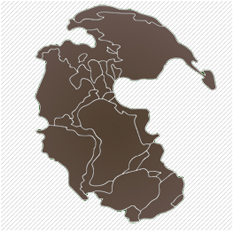 There appears to have been several supercontinents before Pangaea – Rodinia existed over a billion years ago, broke up, and then Pannotia formed about 400 million years later. As Pannotia drifted apart, it formed slightly smaller supercontinents (Laurentia, Baltica, and Gondwana) that eventually slammed together to form Pangaea about 200 million years ago.
The most famous supercontinent had a good run, though — Pangaea didn’t really start to break up until the Early-Middle Jurassic Period (175 million years ago). The scraps of the once proud island of prehistoric civilization eventually settled into the seven continents we know today around 140 million years after that. Many of the tectonic plates are still technically moving (India and Australia are each sliding northeast at a rate of about 3 inches per year) but because humans only live about 80 years, the changes are rather imperceptible/irrelevant to everyone who isn’t a geologist, studying these sorts of things for a living.
Dinosaurs absolutely lived on Pangaea; in fact, scientists were able to confirm the existence of supercontinents in part because paleontologists found dinosaur fossils of similar/identical species of dinosaurs in locations that are now separated by oceans. For example: remains of the Lystrosaurus have been found in South Africa, India, and Australia (and as you may have deduced by now, dinosaurs were not jetsetting around the globe on yachts). The continents did actually start to break apart before dinosaurs went extinct but were still rather close together, which would explain why the extinction was so definitively widespread.
Sadly, humans never experienced an Earth wherein all the landmasses existed as one giant island (the first form of homo sapiens appeared to have evolved around 7 million years ago, eons after the continents settled into their current positions). It would’ve been cool, though; imagine how diverse we would be – it would be like the whole world was as close-knit as Europe; you could fly from Australia to New York City in like six hours and never worry about having a Cast Away sort of event.
Oh, and the superocean that surrounded Pangaea was called Panthalassa. Rolls off the tongue, doesn’t it?